
China launches offshore lab for coastal ecology research
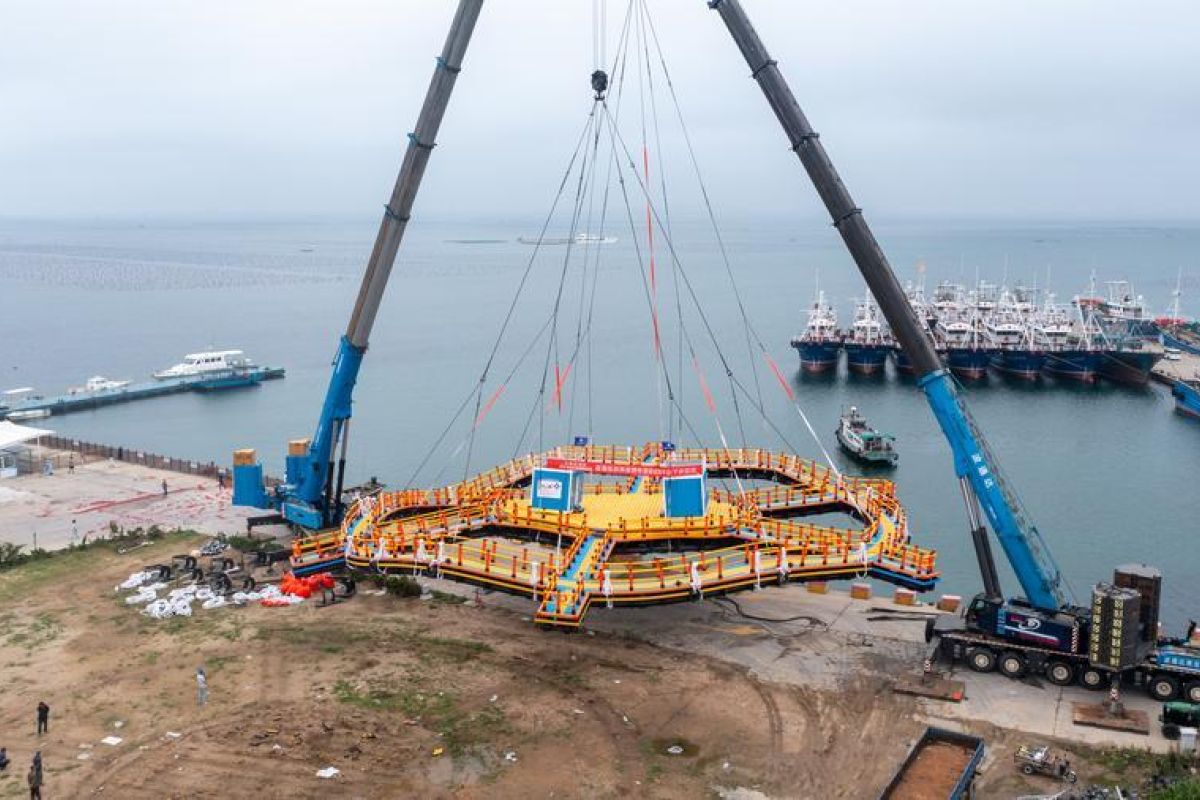
China on Friday (10 July) began operating a large-scale offshore platform for controlled in-situ experiments on coastal ecosystems, marking a new phase in the country’s systematic, intelligent and open coastal ecological research.
Developed by the Institute of Oceanology of the Chinese Academy of Sciences (IOCAS), the facility is located in the Yellow Sea, off Rongcheng in Shandong Province, eastern China. It is China’s largest open-access facility for in-situ experiments in coastal areas, according to IOCAS.
With a total area of 2,000 square metres and an experimental sea zone of 30,000 square metres, the platform is designed to support a wide range of ecological studies under real sea conditions.
“This new platform is essentially a laboratory moved into the sea,” said IOCAS researcher Sun Xiaoxia, who heads the platform’s development team.
Sun explained that in the laboratory, researchers can precisely regulate key factors such as temperature, nutrients and dissolved oxygen under real seawater conditions. The laboratory enables continuous, full-cycle observation and bridges the technical gap between observations in the natural sea and controlled laboratory experiments.
The platform consists of automated monitoring, water regulation, mesocosm ecosystem and logistics support modules. It allows precise single-factor or multi-factor control of temperature, nutrients, dissolved oxygen and other variables, enabling researchers to reproduce scenarios such as marine warming, acidification and eutrophication in a genuine marine environment.
This capability is crucial for understanding how coastal ecosystems respond to gradual climate trends and extreme events, Sun said.
China’s coastal waters, which host a wide range of marine economic activities and ports, are also areas vulnerable to disasters and ecological risks. In particular, these waters face increasing pressure from climate change, land-based runoff and human activity.
“With conventional research vessels, scientists can only collect data at specific times and locations, and land-based laboratory experiments cannot simulate the complex interactions between various species and processes in the real ocean,” Sun explained.
The new laboratory is located in a typical marine aquaculture area in northern China, providing ideal conditions for studying both natural and farmed ecosystems. Researchers can conduct scenario-based experiments on carrying capacity, ecological resilience, marine heatwaves and hypoxia to identify risk thresholds and optimise aquaculture management.
Beyond supporting the aquaculture industry, the facility can also provide technical support for disaster prevention, precision restoration and coastal ecosystem health management, Sun said.
The platform is designed to support open international collaboration and will be accessible to research institutions worldwide, facilitating joint efforts to address urgent marine environmental challenges, she added.