
China Is the 'Thorn in the Flesh' of US Efforts to Subdue Iran
The economic strategy of United States President Donald Trump to pressure Iran faces a major challenge: China. The world’s second-largest economy is the main buyer of Iranian oil and a crucial channel for Tehran’s trade.
US Treasury Secretary Scott Bessent launched what he called ‘Operation Economic Outcast’, threatening sanctions against countries that continue to do business with Iran. However, the effectiveness of that policy depends heavily on whether Washington can limit Iran’s access to the Chinese market.
China has long purchased the bulk of Iran’s oil exports, whose value is estimated at tens of billions of US dollars per year. Beijing has also consistently rejected unilateral US sanctions and asserted its right to maintain trade relations with both Iran and Russia.
Chinese Foreign Ministry spokesman Lin Jian said Beijing would take the necessary steps to protect its interests. He also warned that the policy could increase tensions and risks to the global economy.
‘Economic war and maximum pressure will not help solve this problem,’ he said, as quoted by CNN International on Thursday (27/8/2026).
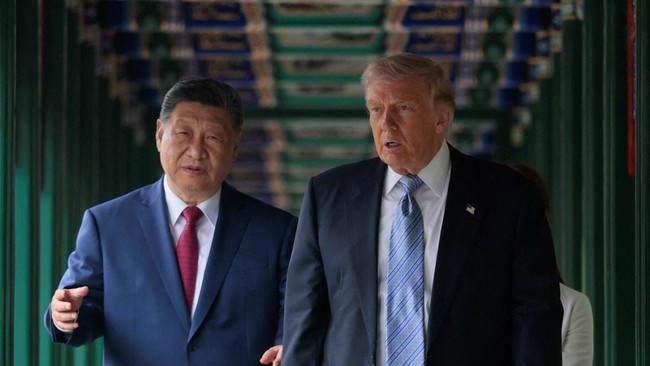
Washington’s pressure comes ahead of Chinese President Xi Jinping’s planned visit to the US next month. That meeting is considered important for maintaining the trade ceasefire between the two countries, so the threat of sanctions against Chinese companies could complicate Washington-Beijing relations.
Zhao Long, an analyst at the Shanghai Institutes for International Studies, believes China’s room to meet US demands is very limited. According to him, China is unlikely to accept a situation in which Washington determines what Chinese companies may legally trade with third countries.
For years, China has used a trade network relatively isolated from the US dollar system to buy Iranian oil. Independent refineries known as ‘teapot refineries’, together with a network of ports, tankers and financial institutions, have allowed that trade to continue despite sanctions pressure.
Nevertheless, the US still has several points of leverage. Max Meizlish of the Foundation for Defense of Democracies said a number of companies involved have direct or indirect links to Chinese state-owned enterprises that are integrated with the US dollar system, so Washington can target subsidiaries to pressure their parent companies.
Bessent previously revealed that Washington had warned two Chinese banks about transactions with Iran. He even stressed that no party is beyond the reach of US sanctions, including Chinese banks and shipping companies.
Even so, Beijing has strong bargaining tools and can retaliate if Washington targets China’s major banks. On the other hand, China is still leaving room to promote peace and stability in the Middle East, including restoring trade routes in the Strait of Hormuz, but insists that such steps do not mean helping Trump’s maximum pressure strategy against Iran.
‘If Washington crosses that threshold, Beijing will almost certainly respond,’ said Sun Chenghao of the Center for International Security and Strategy at Tsinghua University, warning that the Trump-Xi meeting could turn from a stabilisation effort into damage control.
Source: jawawa.id (https://jawawa.id/newsitem/china-is-the-thorn-in-the-flesh-of-us-efforts-to-subdue-iran-1787835104)
Originally published by CNBC Indonesia (https://www.cnbcindonesia.com/news/20260827160522-4-762823/duri-dalam-daging-as-taklukkan-iran-china), translated from Indonesian