
China-Indonesia partnership focuses on smart manufacturing and sustainability
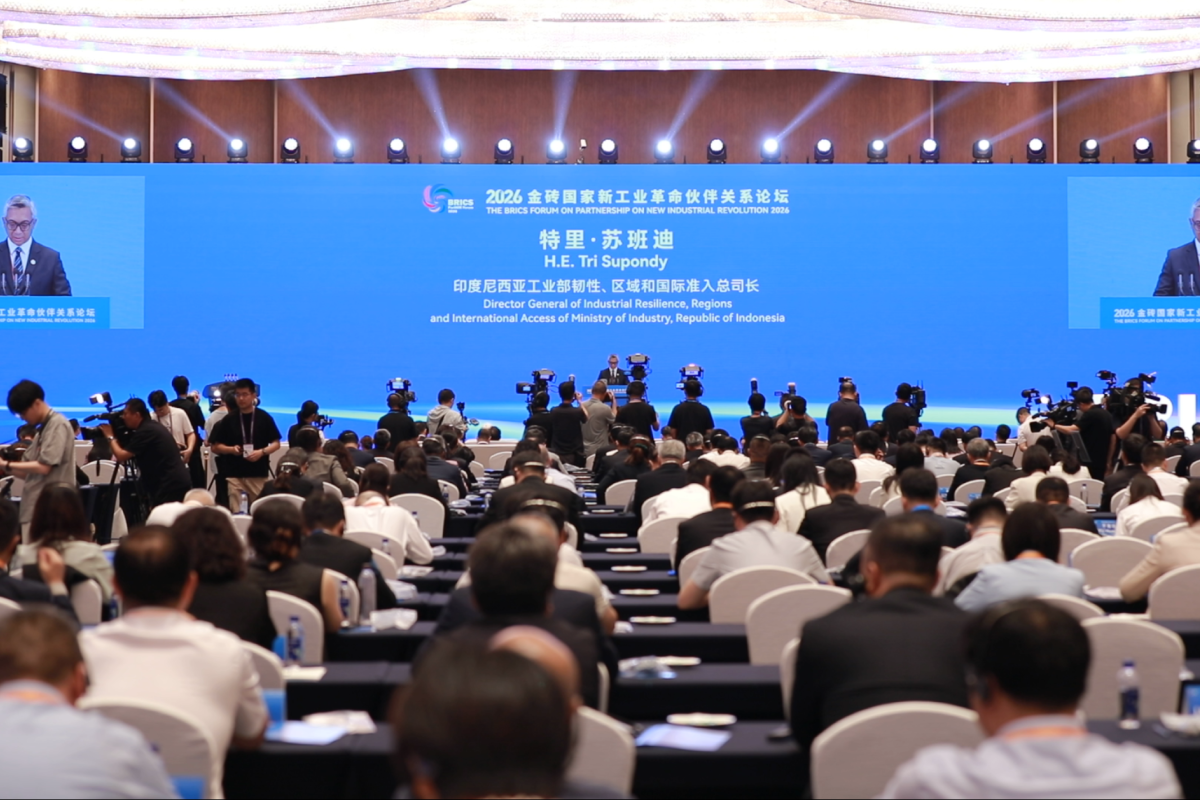
The 2026 BRICS New Industrial Revolution Partnership Forum opened on Wednesday (27 May) in Xiamen, Fujian Province, southeastern China, attended by representatives from government departments, companies, and international organisations across 27 countries. During the forum, China-Indonesia cooperation was further strengthened. Chinese companies are investing in and building factories in Indonesia, while Indonesian firms are bringing projects to China to seek partnership opportunities. The collaboration between the two nations centres on smart manufacturing, green industry, and sustainable development. Indonesia’s Director General of Industrial Resilience, Regionalisation, and International Industrial Access, Tri Supondy, delivered a speech at the forum’s opening ceremony. He stated that rapid technological advancements, including artificial intelligence (AI), industrial internet, robotics, and big data, are reshaping the global manufacturing sector. “For Global South nations, this transformation is urgent. We must enhance human resource development, strengthen international cooperation, and update technology. Indonesia believes no single country can undergo this transformation alone,” he said. He also introduced the national roadmap ‘Making Indonesia 4.0’ and called for enhanced BRICS nations’ collaboration. “We believe that through collaboration in developing smart technologies, setting smart standards, and nurturing top talent, we can build an industrial landscape ready for the future and ensure the new industrial revolution brings inclusive, sustainable, and equitable progress for all nations,” Supondy said. Supondy also shared the latest manufacturing sector data. Indonesia’s manufacturing industry grew by 5.0% in Q1 2026, contributing over 19% to national GDP. Manufacturing exports accounted for more than 80% of total exports between January and February 2026. He added that these achievements underscore the importance of industrial development for Indonesia’s long-term economic transformation. Oki Suryowahono, Head of the Strategic Policy Centre at Indonesia’s Ministry of Communications and Digital (Kemkomdigi), told Xinhua that China’s economy has shown strong performance due to advanced technology adoption. “We hope to collaborate with Chinese manufacturers, especially in technology. We do not want to be mere consumers but also producers,” Suryowahono said. According to CATL project information, the integrated battery project in Indonesia began construction on 30 June 2025 with an investment of nearly $6bn (£4.7bn) and over 2,000 hectares of land, covering the entire battery value chain. Zeng Yuqun, founder, chairman, and CEO of Contemporary Amperex Technology Co., Limited (CATL), used the Indonesian project as an example in his keynote speech to explain how BRICS nations can turn resource advantages into industrial strengths. According to Zeng, CATL, along with Indonesian state-owned mining company ANTAM and Indonesia Battery Corporation (IBC), formed a consortium with a total investment of nearly $6bn (£4.7bn) to build an electric vehicle battery industry chain project encompassing nickel mining and smelting, battery materials, production, and recycling. The project is expected to create over 8,000 direct and 35,000 indirect jobs. The Indonesian government describes it as a flagship collaboration benefiting all parties. He stressed that the new industrial revolution is not merely a simple upgrade of traditional industry but a transformation driven by green and smart technologies. “For BRICS nations, carbon-zero technology is not a burden but a new opportunity to boost future competitiveness,” Zeng said. The first-phase battery plant in Karawang will have an annual production capacity of 6.9 GWh. The project will also establish Indonesia’s first renewable energy circulation system with over 95% metal recycling rate. Once fully operational, it is expected to produce 142,000 tonnes of nickel and 30,000 tonnes of cathode materials annually, while processing around 20,000 tonnes of used batteries. Xiamen-based Fortune Global 500 company Xiangyu Group has long been expanding its operations in Indonesia. The group has built an integrated stainless steel smelting project with an annual capacity of 2.5 million tonnes in Indonesia, combining Chinese technology and market access with Indonesia’s resource advantages. By December 2025, the project has driven over $20.8bn in import and export trade and directly created around 12,000 local jobs, while establishing a mutually beneficial international industrial chain between China and Indonesia. Xiangyu Group is also actively contributing to local communities by installing clean water pipelines in surrounding villages, using iron slag waste to build roads in 10 villages, and running educational programmes such as ‘100 Student Assistance’ and ‘1,000 Talent Development’, thereby fostering people-to-people ties within the BRICS cooperation framework. At the BRICS cross-border innovation accelerator ‘Plug and Play’, Evlin Marcelline, CEO of Indonesian tech firm PT Nusantara Innovation Global, said her project focuses on a management system pi