
China highlights challenges in global climate governance
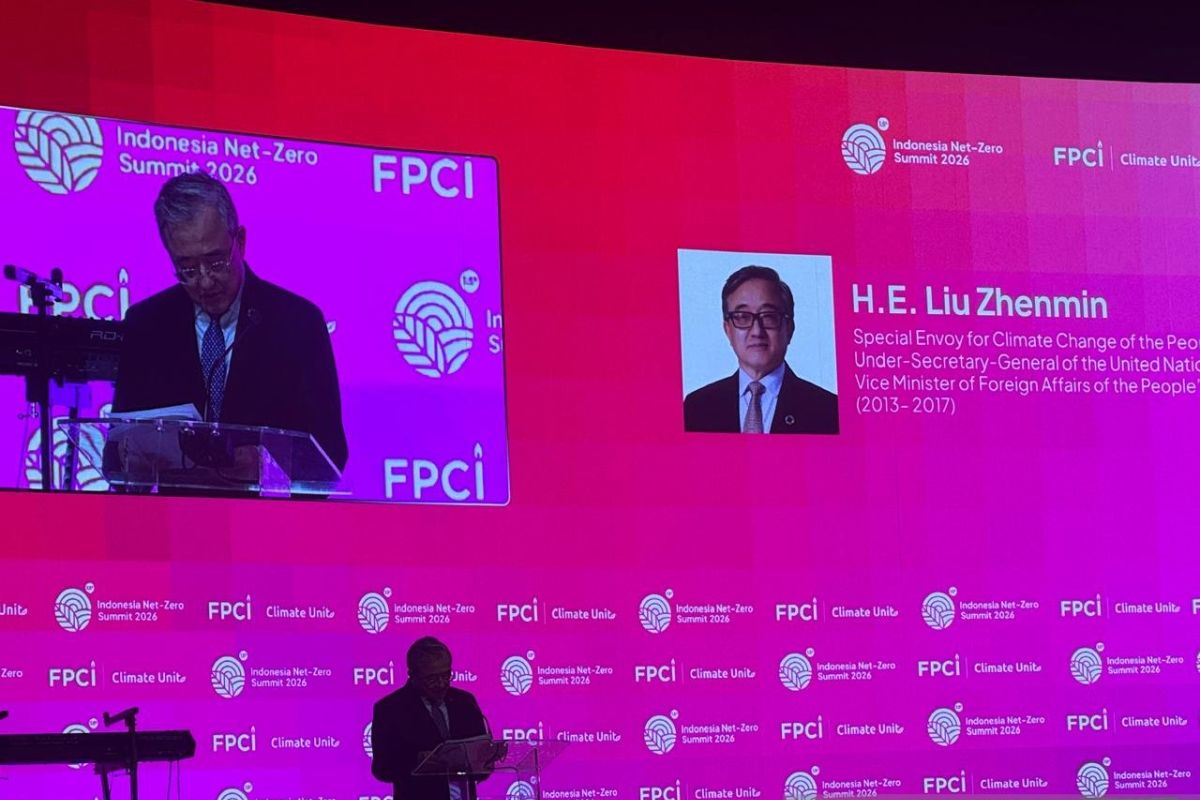
Jakarta (ANTARA) - China’s Special Envoy for Climate Change, Liu Zhenlar, has highlighted three primary challenges facing global climate governance: geopolitical rivalry, a leadership vacuum caused by developed nations withdrawing from multilateral processes, and the double burden faced by developing nations.
“According to estimates by Wood Mackenzie, efforts by some parties to decouple from green energy industry chains could add $6 trillion to the global energy transition cost, thereby increasing overall expenditure by 20 per cent,” Liu stated in Jakarta on Saturday.
He shared these insights during the “How is China Building Its Green Future and Lessons for the World” session at the Indonesia Net Zero Summit (INZS) 2026, organised by the Foreign Policy Community of Indonesia (FPCI) in Jakarta.
He observed that the withdrawal of the United States from the multilateral climate process and the reduction of funding support have slowed coordination between developed nations, hindering the fulfilment of commitments regarding funding, technology, and capacity building for developing countries.
According to Liu, developing nations bear the heaviest impact of climate change while simultaneously having to pursue economic growth and poverty alleviation with limited resources, noting that China and Indonesia face different challenges compared to developed nations.
Nevertheless, Liu expressed optimism regarding the global trend towards carbon neutrality, noting that more than 150 countries remain committed despite the US twice withdrawing from the Paris Agreement, and nearly 150 countries, including Indonesia, have updated their Nationally Determined Contributions (NDCs).
The former Chinese Vice Foreign Minister (2013-2017) also presented four recommendations for the global community to achieve global carbon neutrality. These recommendations include upholding multilateralism and political trust, focusing on practical implementation based on differentiated responsibilities, accelerating technological innovation and green finance, and rejecting unilateralism and trade barriers.
He also urged developed nations to achieve carbon neutrality before 2040 to support global targets, while providing more serious support in terms of funding, technology, and capacity building to developing nations.
One of China’s targets in its 2035 NDC is to increase solar and wind energy capacity to approximately 3.6 billion kilowatts by 2035; currently, almost four out of every ten kilowatt-hours of electricity consumed in China is green electricity.
As of June 2026, China has signed 56 memoranda of understanding and social cooperation agreements on climate change with 43 developing nations and has established green energy project cooperation with over 100 countries and regions.