
China expands hydrogen use through pilot programmes in five city clusters
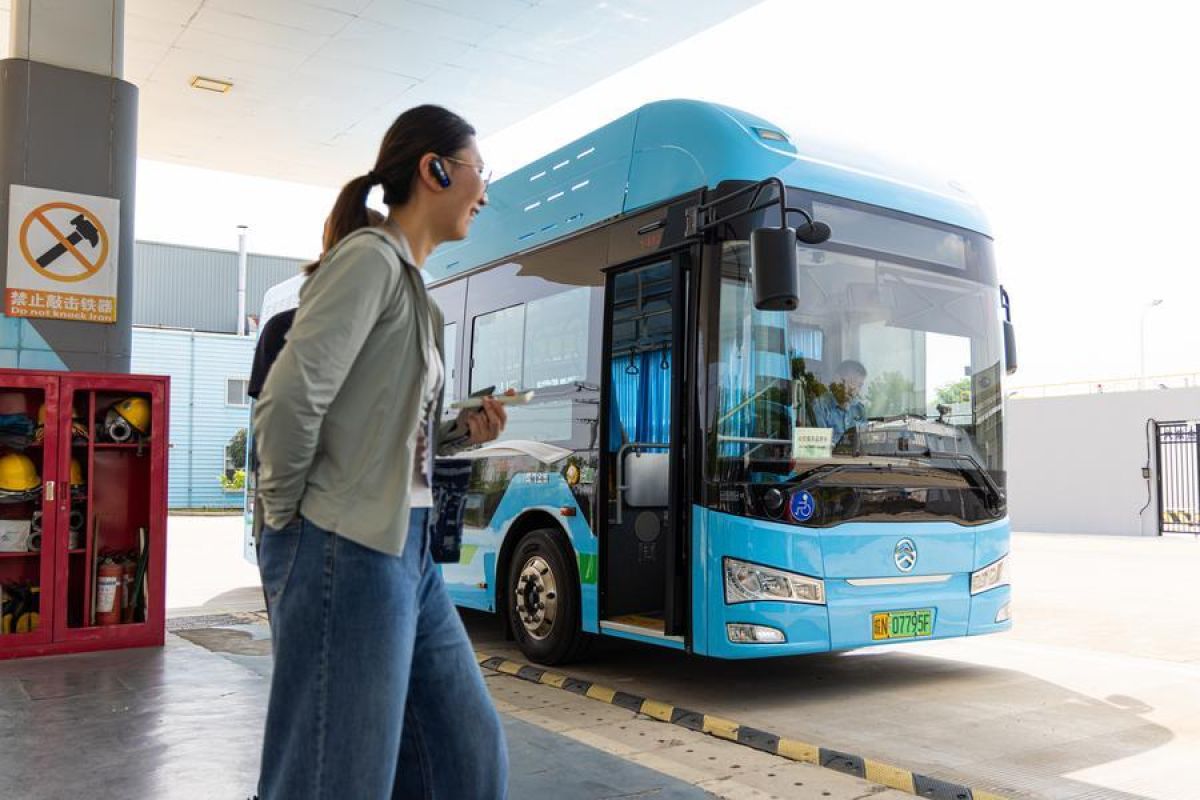
Beijing (ANTARA) – China has approved a four-year pilot programme for the comprehensive deployment of hydrogen energy in five city clusters, according to a government circular released on Friday (16 October).
The programmes will cover the Beijing-Tianjin-Hebei region and the Guangdong-Hong Kong-Macao Greater Bay Area, as well as three inter-regional clusters linking north-eastern China, including eastern Inner Mongolia, with the Yangtze River Delta; Xinjiang with the Chengdu-Chongqing economic circle; and the Yellow River Bend with the Central Plains.
The circular, jointly issued by China’s Ministry of Industry and Information Technology, Ministry of Finance, and National Development and Reform Commission, calls on participating cities to accelerate four priority areas: hydrogen technology and equipment development, industrial hydrogen projects, wider use of fuel-cell vehicles, and the construction of hydrogen refuelling stations.
The cities are also encouraged to strengthen industrial and supply chains, promote the smooth circulation of goods and services within the domestic market, and avoid local protectionism.
The circular also calls for better planning of major projects, stronger safety management, and timely assessments of the pilot programmes’ economic, social and environmental benefits.
The three departments will evaluate the programmes, with the results serving as the basis for allocating incentive funds from the central government.
According to the circular, the funds must be disbursed promptly and used only to support hydrogen energy deployment, help reduce the cost of using hydrogen, and pass those savings on to end users.
The initiative comes as China seeks to expand the use of cleaner energy in industry and transport.
Hydrogen produced using electricity from renewable sources can help reduce carbon emissions, although high costs and challenges in storing and transporting hydrogen remain obstacles to wider deployment.
Official data show that China has become the world’s largest producer and consumer of hydrogen, with output exceeding 39 million tonnes in 2025.
Under a policy issued in March, China aims to have 100,000 fuel-cell vehicles nationwide by 2030. Each city cluster may receive up to 1.6 billion yuan (1 yuan = Rp2,698) in central-government incentive funding over the four-year pilot period.