
China Eases Monetary Policy, Injecting Rp1.474 Trillion into Banks — What’s Behind the Move?
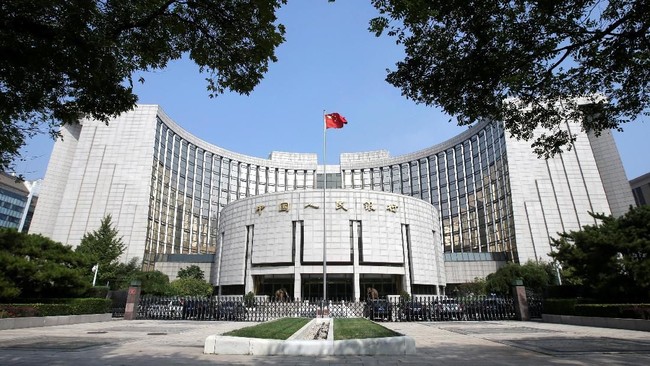
Jakarta, CNBC Indonesia — China’s central bank has begun shifting its main policy rate to the one-day (overnight) tenor and injected 541 billion yuan, or about Rp1.474 trillion, into the banking system. The move is expected to ease funding conditions, reduce borrowing costs and support economic growth amid turbulence in financial markets.
Reuters reported on Monday (2 November 2026) that the People’s Bank of China (PBOC) provided the funds through one-day reverse repurchase agreements (reverse repos) at an interest rate of 1.25%.
“The policy rate has now officially shifted to the one-day (overnight) tenor, with the 1.25% rate confirming the current benchmark for funding costs,” said Ming Ming, chief economist at CITIC Securities.
The change to the operating framework effectively lowers the floor of China’s interest-rate corridor by 15 basis points. Although it is not a conventional rate cut, the move is seen as capable of pushing down bond yields and reducing funding costs for financial institutions.
Marco Sun, head of financial market research at MUFG China, said the initial rate setting of 1.25% signals a monetary policy direction that will bring short-term interest rates lower.
Meanwhile, Zhaopeng Xing, ANZ’s senior China strategist, said the move was equivalent to a 15-basis-point rate cut for financial institutions. In Xing’s view, the policy is like a “red envelope” for the financial sector, potentially lifting net interest margins by about five basis points.
“The aim is to stabilise profitability in the financial sector and strengthen its capacity to absorb risks,” he said. However, he expects the impact on the share market to be limited.
The PBOC’s move comes as credit concerns over state-owned developer Zhuhai Huafa Group have unsettled the bond market, adding to pressure on the government to restore investor confidence.
Separately, several Chinese regulators, including the central bank, are reportedly due to meet financial institutions to discuss measures to support capital markets amid volatility in shares and bonds.
Further easing, however, may not come soon. Citi analysts said the change was a market-based adjustment (mark-to-market), rather than a de facto interest-rate cut. They also do not expect China’s Loan Prime Rate (LPR), its benchmark lending rate, to be lowered in November.
Citi expects a rate cut to be more likely in 2027. Meanwhile, fresh credit concerns involving Zhuhai Huafa have heightened the urgency of resolving local government debt, which could keep liquidity conditions loose for the time being.
The PBOC had previously signalled plans to make the one-day reverse repo rate its main benchmark to improve the transmission of monetary policy and support economic growth.
Source: jawawa.id (https://jawawa.id/newsitem/china-eases-monetary-policy-injecting-rp1-474-trillion-into-banks-whats-behind-the-move-1793605844)
Originally published by CNBC Indonesia (https://www.cnbcindonesia.com/news/20261102131506-4-781527/china-longgarkan-keran-uang-bank-diguyur-rp1474-triliun-ada-apa), translated from Indonesian