
China claims Japan's remarks on defence modernisation are baseless
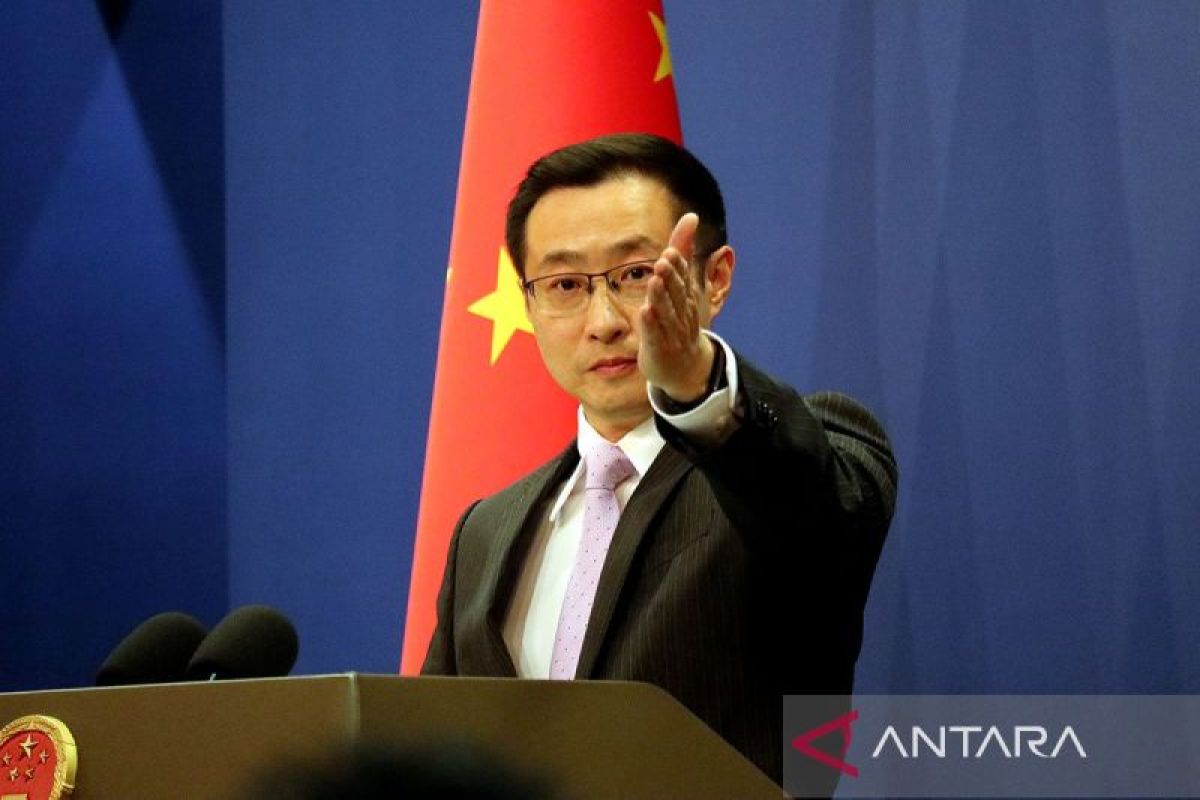
Beijing (ANTARA) - The Chinese government has stated that Japanese Defence Minister Shinjiro Koizumi’s explanations regarding the country’s defence modernisation programme are baseless and unreliable.
“The statement from the Japanese official is entirely without foundation. The statement lacks authority in the face of history, law, facts, and figures,” said Chinese Foreign Ministry Spokesperson Lin Jian during a press conference in Beijing on Monday (1/6).
Lin Jian added that “it is impossible for such statements to help Japan gain the trust of its neighbouring countries in Asia and the international community.”
At the Shangri-La Dialogue security forum in Singapore last week, Japanese Defence Minister Shinjiro Koizumi defended Japan’s defence modernisation programme, which includes plans to revise key national security documents by the end of this year, as well as investments in artificial intelligence, unmanned systems, cyber capabilities, and space technology.
“There is a country that possesses a large number of nuclear weapons and strategic bombers. Japan does not possess such weapons. Yet, Japan is being labelled as a new militarism. Is that not strange?” said Koizumi, seemingly referring to China’s criticism of Japan.
Koizumi also pledged to strengthen his country’s defence capabilities and security cooperation in the Indo-Pacific region, while rejecting China’s criticism that these steps constitute a form of “new militarism.”
Lin Jian noted that Japan’s latest defence budget has exceeded nine trillion yen, the highest for 14 consecutive years since World War II.
“Defence expenditure per capita has reached three times that of China, and total defence spending has surged to two per cent of GDP, with plans to increase further to 3.5 per cent,” Lin Jian stated.
Furthermore, orders for military equipment from the Japanese Ministry of Defence have tripled over the last five years.
“Since the current administration took power, they have accelerated the deployment of medium- and long-range missiles, loosened restrictions on the export of lethal weapons, and pushed for the revision of the Constitution and three security documents,” said Lin $
{Jian}$.
By doing so, Japan is attempting to further violate international and domestic laws and challenge the post-war international order, he said, assessing that Defence Minister Koizumi is deliberately avoiding Japan’s historical crimes and the facts of Japan’s increasing military budget.
“He is even attempting to shift blame and create confusion. Is this a sign of discomfort, or an attempt to hide Japan’s own military expansionist ambitions? In such a state, Japan’s claim that they seek dialogue is merely a performance and shows no sincerity at all,” Lin Jian added.
Japan, according to Lin Jian, has been pursuing re-militarisation at full speed, engaging in more intensive interactions with military organisations from outside the region, expanding the scope of the Japan Self-Defence Forces’ activities, and building a combat-ready operational system.
“Japan describes itself as a ‘peace-loving nation’, but its actions suggest otherwise. The emergence of malicious neo-militarism in Japan threatens regional peace and stability. The international community must remain vigilant and take decisive countermeasures,” Lin Jian stated.
Regarding regional security, at the Shangri-La Dialogue security forum, Defence Minister Koizumi stated that the regional security environment is becoming increasingly challenging amidst economic and military pressures, alongside rising competition in cyber, space, and information sectors.
He also emphasised that Japan’s reputation as a peace-loving nation since the end of World War II would not be tarnished by what he called false accusations.
Koizumi warned again that non-transparent military development and actions without clear objectives would lead to mistrust and miscalculation. He added that Japan would carry out its defence updates with a “high level of transparency.”
At the same time, Koizumi asserted that Tokyo remains committed to dialogue with Beijing, despite the ongoing differences in views between the two neighbouring nations.
Koizumi stated that Japan would take a larger role in defence equipment and technology cooperation following the loosening of weapons export restrictions last April.
“Division weakens deterrence. Unity strengthens deterrence,” said Koizumi.
Relations between Tokyo and Beijing have been tense since 7 November 2025, when Japanese Prime Minister Sanae Takaichi stated that the use of military force by China against Taiwan could “create a situation that threatens the very survival of Japan,” which continues to strain China-Japan relations.
Koizumi expressed his disappointment at not having the opportunity to meet Chinese Defence Minister Dong Jun at the forum.
Minister Dong did not attend the Shangri-La Dialogue for the second consecutive time, while China was represented by Meng Xiangqing, a professor at the National Defence University.
The Chinese delegation also included members of the People’s Liberation Army (PLA) from the National Defence University, the PLA Academy of Military Sciences, and the PLA Navy.
China typically sends high-ranking officials to the event, which has been held since 2007. The Chinese Defence Minister attended meetings in 2011, 2019, 2022, and 2024, while the Shangri-La Dialogue was suspended in 2020 and 2021 due to the COVID-19 pandemic.