
China Begins Unravelling the Secrets of the Universe's 'Ghost Particles'
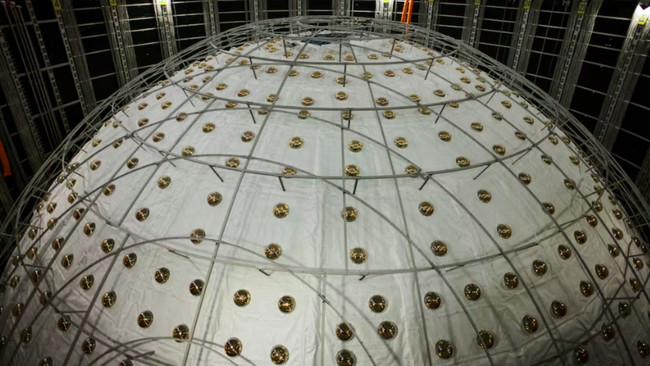
A massive underground detector built in China has just released its first major findings on neutrinos, cosmic particles dubbed ‘ghost particles’ due to their elusive nature and near-zero mass. A report published in the journal Nature states that Chinese researchers have been collecting data since August at the Jiangmen Underground Neutrino Observatory (JUNO), located in Kaiping, Guangdong Province. After two months of observation, the research team revealed the most accurate measurements to date of how neutrinos change between three forms as they travel through space. Neutrinos are particles that emerged from the Big Bang. Trillions of them pass through the human body every second without leaving any trace. Because their mass is almost zero and they barely interact with other matter, capturing and studying these particles poses a major challenge for physicists worldwide. To detect neutrinos, JUNO uses a giant spherical machine placed 700 metres underground to avoid interference from external radiation. Inside, it contains 20 kilotons of light-emitting liquid that captures antineutrinos, the neutrino’s counterpart with similar properties, from two nuclear power plants near the site. When antineutrinos encounter particles within the liquid, the resulting interaction produces a flash of light, which is then recorded by thousands of surrounding sensors. One of the primary goals of this research is to solve the mystery of the mass hierarchy of each neutrino type. Scientists suspect that two of them have similar masses, while the third type is significantly different. However, it remains unknown whether the two types are heavier and one lighter, or vice versa. ‘These initial results do not yet answer that question directly, but they have proven the detector’s capability. Going forward, JUNO will be able to test the subtle differences that separate the neutrino types and their respective masses,’ said Liangjian Wen, a researcher in the JUNO collaboration. Kate Scholberg, a physicist from Duke University who was not involved in the study, assessed the preliminary findings as very promising. ‘These results make me even more eager for the other exciting discoveries to come from this project,’ she said. China’s project is the first neutrino detector to begin operations. Similar facilities are under construction in two other countries: Hyper-Kamiokande in Japan and the Deep Underground Neutrino Experiment in the United States, both set to operate in the near future. The two will conduct observations using different approaches, allowing them to later verify the results obtained by the Chinese research team. This research is an important step in understanding the most abundant yet most elusive particles in the universe, which in turn could help humanity unravel the secrets of how stars, galaxies, and the history of the universe itself were formed.