
China and Indonesia Discuss Technological Approaches to Nature Conservation
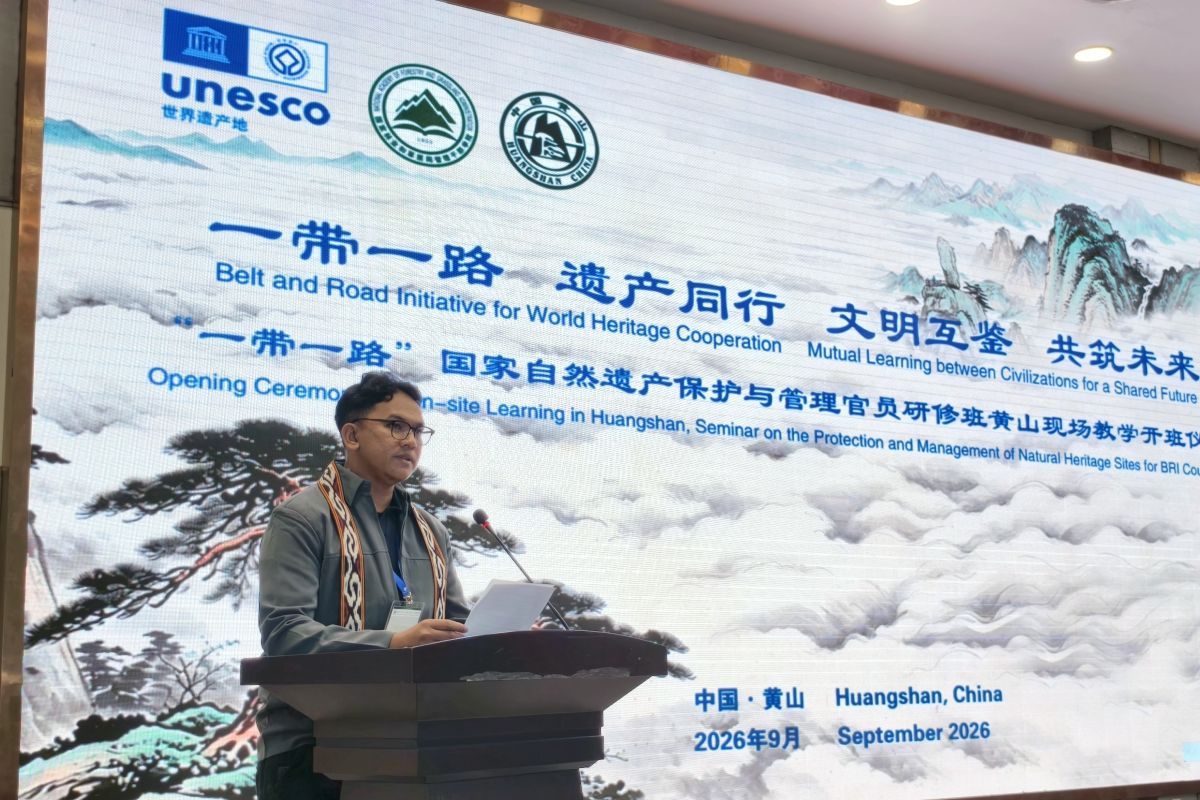
Hefei (ANTARA) - Officials from China and Indonesia are exploring how modern technology can contribute to the conservation and management of natural heritage sites as a training programme for heritage officials from Belt and Road Initiative countries commences in Huangshan, Anhui Province, eastern China.
Organised by the China National Forestry and Grassland Administration and the Huangshan Scenic Area Management Committee, the week-long seminar is themed “Belt and Road Initiative for World Heritage Cooperation, Mutual Learning between Civilisations for a Shared Future.”
Field learning in Huangshan during the Seminar on the Protection and Management of Natural Heritage Sites for Belt and Road Initiative (BRI) countries opened on Tuesday (15/9), bringing together conservation and heritage management officials from 10 countries, including Indonesia, Cambodia, and Jordan, to exchange views on heritage conservation, digital management, and community engagement.
This marks the fourth consecutive year that Huangshan has been selected as the field training location for the programme.
Located in southern Anhui, Huangscale is renowned for its distinctive pine trees, spectacular rock formations, seas of clouds, and hot springs, and is listed as a UNESCO World Natural Heritage site. Huangshan has received the highest ratings in several assessment rounds under the International Union for Conservation of Nature (IUCN) World Heritage Review.
Huangshan has also participated in international cooperation regarding heritage conservation, including initiating the RCEP World Heritage Cooperation Alliance (RCEP-WHCA) and establishing partnerships with heritage sites worldwide.
Indonesian official Muhammad Asad Nuzulul, a technical policy analyst at the Indonesian Ministry of Forestry, stated that the seminar provides an important platform for heritage professionals from various Belt and Road countries to share knowledge and experience.
For the Indonesian participants, China’s approach to balancing heritage conservation with sustainable tourism is a particular focus.
“I am very interested in how Huangshan manages tourism while preserving the natural and cultural values of the site, as well as how they implement long-term planning and risk management,” said Bennasita Dyah Ramya, a policy analyst at the Indonesian Ministry of Tourism.
During the seminar, participants learned how technologies such as artificial intelligence and continuous monitoring are used to observe and analyse heritage sites and identify potential risks. This approach can also be applied to monitor ecological elements, including flora and fauna, as well as factors that may pose risks to heritage sites.
“This is something that truly interests me, as modern technology is becoming a vital factor in heritage management,” she said.
She expressed hope that the exchange would help participants explore innovative solutions, deepen international cooperation, and work together to protect the irreplaceable heritage shared by humanity.
Huangshan was designated as a training base by the China National Forestry and Grassland Administration in 2023. Since then, the area has provided training to nearly 300 heritage conservation officials from Belt and Road countries.
During the week-long programme, participants will visit Huangshan, Hongcun Village—a UNESCO World Heritage site—the Huizhou History Museum, and the Tunxi Ancient Street.
These visits will provide participants with the opportunity to further study China’s approach to the sustainable preservation, maintenance, and utilisation of natural and cultural heritage, according to Xinhua.