
China Allegedly Building World's First Submarine Drone Aircraft Carrier
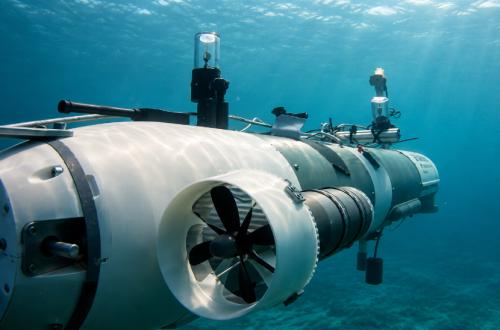
China is allegedly constructing a specialised aircraft carrier designed specifically to operate very large submarine drones. If the satellite imagery analysis emerging this week is confirmed, the vessel currently under construction in Shanghai could become the world’s first mothership specifically designed to carry, launch, recover, and support uncrewed underwater vehicles.
Naval News reported on Tuesday, 15 September 2026, revealing the presence of an unusual vessel being built at the Hudong-Zhonghua shipyard in Shanghai. The maritime defence specialist media outlet stated it had reviewed several satellite images to assess the potential function of the ship.
The ship’s shape and configuration appear different from conventional surface vessels. While it superficially resembles an amphibious landing ship, the structure of its stern suggests a design intended to handle extra-extra large uncrewed underwater vehicles (XXLUUV).
To date, neither the Chinese government nor the People’s Liberation Army Navy (PLAN) has announced the name, classification, or function of the vessel. Therefore, the identification as a submarine drone aircraft carrier remains an open-source analysis based on satellite imagery and visible technical configurations.
Naval News assesses that the most plausible explanation for the ship’s design is its role as a mothership for uncrewed submarines. Its presence could simultaneously mark the latest development in China’s autonomous underwater vehicle programme, which has been relatively secretive in recent years.
The most striking feature is at the stern. The ship possesses a large well-deck, but it is not arranged like the well-decks of amphibious ships typically used for operating landing craft. Beneath this section, there is a large cradle or mount estimated to be capable of being lowered directly into the water. Naval News identified 12 vertical jack-up arms believed to function in raising and lowering this mount.
This mechanism would allow extra-extra large underwater vehicles to be placed on the cradle before being slowly lowered into the sea. Conversely, vehicles can be pulled back onto the mount after completing their missions. In front of the well-deck, there is a large internal hangar. Based on the dimensions of this space and the size of previously observed Chinese XXLUUVs, Naval News estimates the ship could carry approximately four extra-extra large underwater vehicles, or more if carrying smaller drones.
Defence Security Asia reported on Wednesday, 16 September 2026, estimating that the mysterious ship is approximately 205 metres long and 27 metres wide. However, these dimensions are derived from open-source analysis and have not been officially confirmed by Beijing.
From Testing to Operations
The emergence of a specialised support ship is significant because China has previously been known to be testing at least two uncrewed underwater vehicles with sizes comparable to submarines. These two vehicles are estimated to be approximately 3able 35 metres and 45 metres in length and have been seen undergoing testing around Hainan.
Naval News previously reported that two uncrewed submarines larger than 40 metres were undergoing testing in the South China Sea. These vehicles were stationed in the area around Hainan and utilised specialised infrastructure during the testing process.
During the development stage, such systems can be launched from coastal facilities or floating docks. While this method is sufficient for testing, it limits flexibility if the vehicles must eventually operate thousands of kilometres from a base.
The presence of a mothership could change this situation. A mobile aircraft carrier would allow XXLUUVs to be transported closer to operational areas before being released to carry out missions independently. The ship could also provide maintenance, system inspections, technical support, and potentially energy replenishment or mission payload preparation. Consequently, underwater vehicles would not always need to return to facilities located on the Chinese coast.
Military Watch Magazine also suggests that the emergence of a specialised support ship could indicate that China’s XXLUUV programme is moving beyond the experimental testing phase towards the formation of a more combat-ready system. However, the actual operational status remains unknown.
If this function is confirmed, the ship could perform two tasks simultaneously. First, it would act as a mobile tender to transport and maintain uncrewed underwater vehicles. Second, the ship could serve as a launch and recovery platform. This latter function would allow XXLUUVs to begin missions far from the Chinese coast, reducing the need for vehicles to travel long distances before reaching patrol areas.
The size of China’s underwater drones is also noteworthy, as they far exceed most UUVs currently known to the public. However, comparisons with United States systems must be made with caution. Boeing has noted that the US Navy’s Orca XLUUV has a base length of approximately 15.5 metres, plus a payload module of 10.4 metres. The Orca has a range of up to about 6,500 nautical miles and is designed to undertake missions lasting months with a high level of autonomy.
Therefore, the claim that China’s XXLUUV is six to eight times larger than the Orca refers to estimates of volume or mass, rather than solely the length of the vehicle. In terms of length, the Chinese vehicles, estimated to be between 35 and 45 metres, are approximately 1.3 to 1.7 times the full length of the Orca configuration.
Source: jawawa.id (https://jawawa.id/newsitem/china-allegedly-building-worlds-first-submarine-drone-aircraft-carrier-1789520117)
Originally published by Republika (https://news.republika.co.id/berita/tlfj57451/china-diduga-bangun-kapal-induk-drone-kapal-selam-pertama-di-dunia), translated from Indonesian