
China Accelerates Bamboo Industry Expansion for Sustainable Development
In the midst of efforts to promote sustainable development and expand the use of environmentally friendly materials, a batch of neatly packaged bamboo chairs has just passed customs inspection at the China-Vietnam border and is ready to be shipped to customers in Hanoi.
Since the first order in February this year, bamboo products from the Daguan region in Yunnan, including chairs and walking sticks, have been highly sought after in Vietnam, with orders continuing to pour in.
“We believe that high-quality bamboo products can cross national borders and allow friends abroad to experience the charm of Chinese bamboo culture,” said Ou Xianqin, chairman of a local bamboo cultural technology company.
He added that their bamboo products are exported to Australia, Japan, the United States (US), Singapore, and other countries, with export values reaching approximately 2 million yuan (1 yuan = Rp2,542) or about 275,000 US dollars (1 US dollar = Rp17,378) over the past three years.
The Daguan region, with its supportive climate and geographical conditions, is a major bamboo production area. By 2025, the bamboo planting area in the region will reach 68,000 hectares, with total bamboo industry output exceeding 3.1 billion yuan.
China has the world’s richest bamboo resources and is the most advanced in their utilisation, earning it the nickname “Bamboo Kingdom”.
Data from the National Forestry and Grassland Administration shows that the country has nearly 8 million hectares of bamboo forests, with an annual production of 150 million tons of bamboo. The bamboo industry generates more than 520 billion yuan annually, with over 15,000 types of bamboo products available.
As China seeks to replace wood and plastic products with bamboo alternatives to reduce pollution and carbon emissions, Chinese bamboo companies are accelerating global expansion, exploring both domestic and international markets, and contributing to sustainable development worldwide.
Known as the “hometown of bamboo”, the Anji region in east China’s Zhejiang Province has around 66,700 hectares of bamboo forests and nearly 1,000 bamboo companies. By 2025, the region’s bamboo industry output will exceed 20 billion yuan.
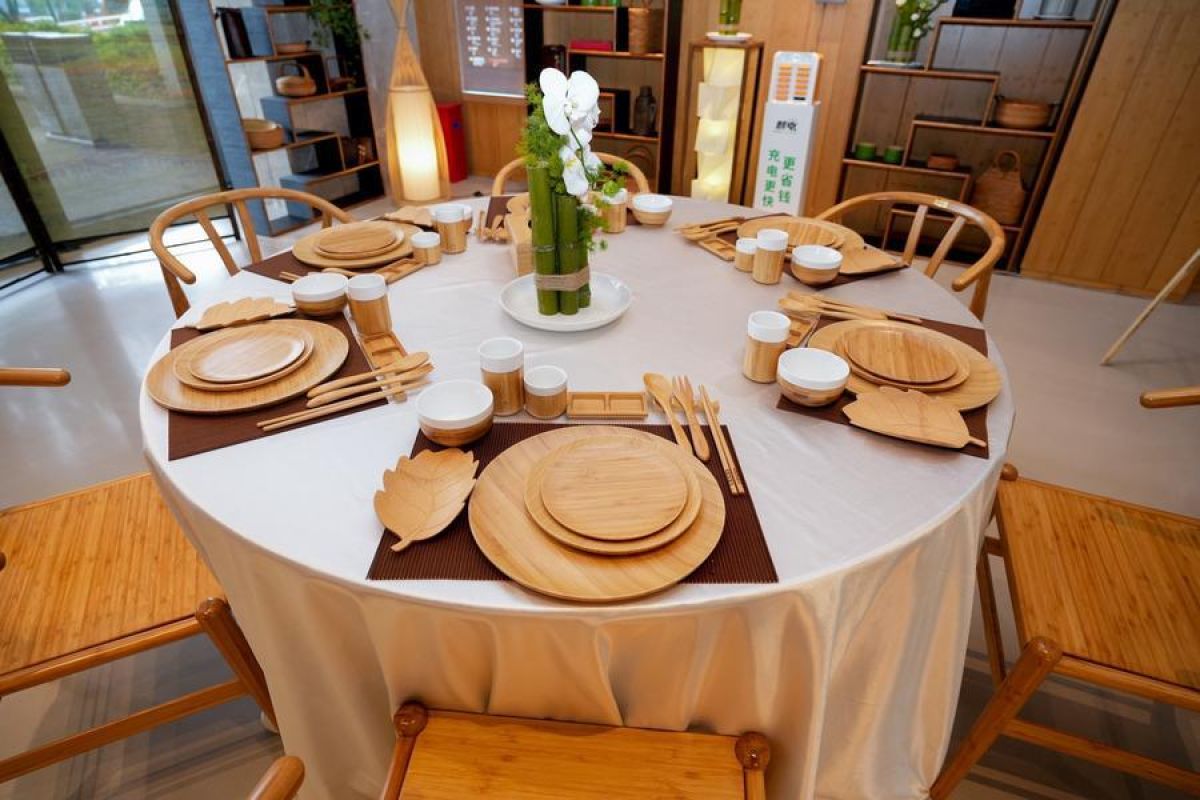
At Zhejiang Fenghui Bamboo and Wood Co., Ltd. in the region, a variety of bamboo tableware, packaging, and lighting fixtures are on display.
General Manager Liang Fenghui, who took over the business from his father, said the company processes stems, branches, skins, and even bamboo residues into everyday plastic alternatives, offering more than 3,000 related products.
A few years ago, Liang’s company developed a series of tableware from unused bamboo shoot skins.
The product then became popular online, with bamboo shoot skin lunch boxes alone generating more than 500,000 US dollars in overseas sales last year.
The company exports 70 percent of its products to markets such as the US, Japan, and European countries, with sales revenue reaching 185 million yuan in 2025.
“Don’t underestimate these plastic-replacing everyday items; they represent a huge market,” said Liang.
According to China Green Times, an industry forestry newspaper, bamboo straws alone have an annual production capacity of more than 1.2 billion units in the country.
Bamboo tableware and lunch boxes are exported to nearly 110 countries and regions, including Japan, South Korea, and the US.
“When I took over from my father, we mostly waited for orders and were satisfied with 10 percent annual growth,” Liang said.
“But now, it’s time to expand outward,” he added.