
Chilli Prices Surge, BPS Warns of Potential Inflationary Impact on Indonesian Citizens
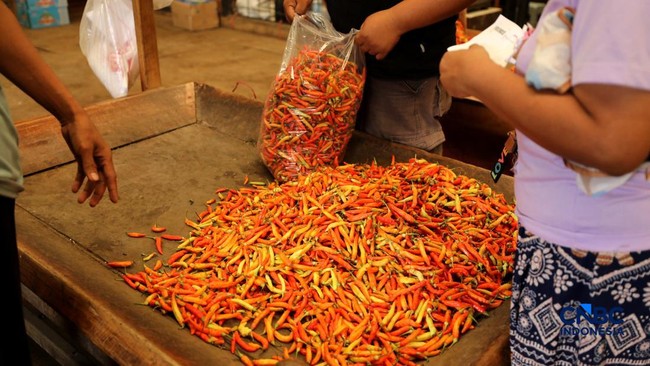
The prices of red chillies and bird’s eye chillies continued to rise in early October 2026. This situation has prompted the Indonesian Central Statistics Agency (BPS) to remain vigilant regarding its impact on inflation towards the end of the year.
According to BPS monitoring, the average price of red chilli in the first week of October 2026 reached Rp63,913 per kg. This figure represents an 11.38% increase compared to September and has already surpassed the upper limit of the Maximum Retail Price (HAP) of Rp55,000 per kg.
Ateng Hartono, Deputy for Distribution and Services Statistics at BPS, stated that the price hike for red chillies is occurring in many regions. It was recorded that 292 regencies/cities, or 81.11%, experienced an increase in the Price Development Index (IPH) for red chillies.
“The current average price is Rp63,913, whereas the upper limit of the HAP is Rp55,000 per kg,” said Ateng during the Regional Inflation Control Coordination Meeting of the Ministry of Home Affairs on Monday (5/10/2026).
Meanwhile, bird’s eye chilli prices also experienced a significant increase. In the first week of October, the average price of bird’s eye chilli reached Rp86,846 per kg, a 10.21% increase from September’s price of Rp78,802 per kg. This price is also far above the upper HAP limit of Rp57,000 per kg.
“Bird’s eye chilli prices rose quite substantially in the first week of October, with an increase of up to 10.21%. In fact, when compared to the upper HAP limit, the gap is widening,” he noted.
BPS recorded that 259 regencies/cities, or 7lar7.94%, experienced an increase in the IPH for bird’s eye chillies during this period.
Ateng stated that chilli price developments require close attention, especially heading into the end of the year. If the upward trend persists, prices in December 2026 could potentially be higher than the same period in the previous year.
“This is a significant note; if bird’s eye chilli prices continue to rise, the year-on-year condition in December could be much worse than December 2025, which would lead to annual and year-on-year inflation in December,” he explained.
A similar situation applies to red chillies. According to Ateng, the current price position of red chillies is much further from the HAP than it was towards the end of last year.
“Looking at the December condition, red chillies were only slightly above the HAP, but now they are quite far off. If not monitored, the December 2026 situation will be much higher compared to December 2025, meaning annual inflation could be pushed up by red and bird’s eye chillies,” said Ateng.
Ministry of Agriculture Reveals Chilli Stocks
On the other hand, the Ministry of Agriculture (Kementan) stated that the national availability of chillies is actually quite sufficient. The Director of Vegetables and Medicinal Plants at Kementan, Sudi Mardianto, said that the national availability of bird’s eye chillies is approximately 130,000 tonnes, while large chillies are around 115,000 tonnes.
“The aggregate national availability of various bird’s eye chillies is about 132,000 tonnes, while for large chillies, it is around 115,000 tonnes,” Sudi said during the same session.
He also mentioned that the chilli harvest area in October reached approximately 11,917 hectares. According to him, this figure is sufficient to help control price dynamics.
However, inter-regional distribution remains a challenge. Sudi noted that cooperation between regions in distributing chillies has not yet functioned optimally.
“In practice, this inter-regional cooperation has perhaps not been implemented optimally,” said Sudi.
Sudi cited the shipment of chillies from Kediri to the Kalimantan region as a significant example. This condition is believed to affect price movements in production centres.
“We have received information, for example, in the Kediri area, there is quite a large trade of chilli shipments to Kalimantan. This may be one of the triggers for price movements in production centres,” he explained.
For curly red chillies, Sudi stated that prices generally remain in the range of Rp40,000-Rp50,000 per kg. However, there are production centres where prices have reached Rp90,000 per kg.
“But for curly red chillies, generally, it is still in the range of Rp40,000-Rp50,000 per kg; only some areas, such as Batu Bara Regency, have seen prices reach Rp90,000 per kg in production centres,” said Sudi.
The Ministry of Agriculture is also continuing to increase the chilli planting area. In the last two months, there has been an additional planting area of about 1,023 hectares for bird’s eye chillies. For large chillies, the additional planting area reached nearly 1,070 hectares.
“This means that over the last two months, there has been an additional new planting area of about 1,023 hectares for bird’s eye chillies. As for large chillies, there was about 380 hectares in September and 690 hectares in October. So, there is an additional planting area of almost 1,070 hectares for large chillies,” he explained.
This increase in planting area is expected to help control the rise in chilli prices, particularly ahead of the Christmas and New Year (Nataru) period.
“This increase in planting area is expected to serve as a means to control the price increases of bird’s eye and large chillies, especially leading up to Nataru,” he concluded.
Source: jawawa.id (https://jawawa.id/newsitem/chilli-prices-surge-bps-warns-of-potential-inflationary-impact-on-indonesian-citizens-1791190453)
Originally published by CNBC Indonesia (https://www.cnbcindonesia.com/news/20261005133211-4-773374/harga-cabai-makin-mahal-bps-ungkap-efek-horornya-ke-warga-ri-ini), translated from Indonesian