
Chilli Prices Remain High, Batam Residents Reduce Purchases
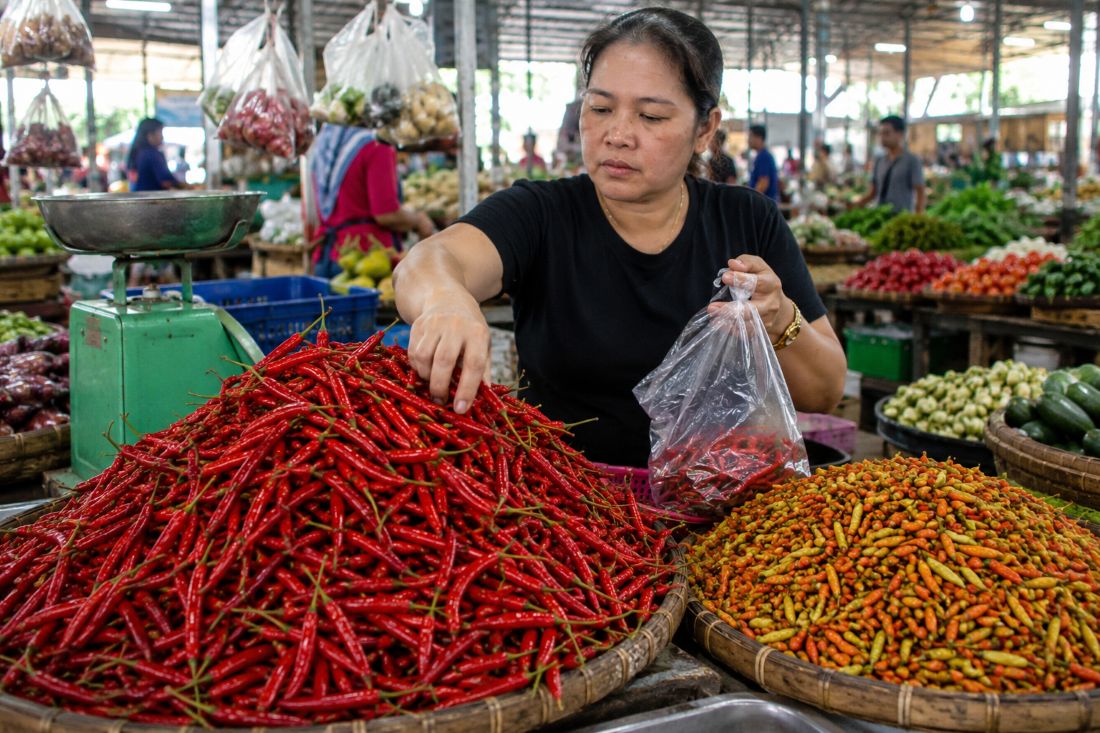
The price of chillies in several traditional markets in Batam City remains at a high level. This situation is forcing residents to adjust household spending by reducing the quantity they purchase, while traders hope that supply from production centres will soon increase so that prices can return to normal. Based on monitoring by Media Indonesia of food prices in Batam on Thursday (6/8), the price of red chillies was in the range of Rp68,000 to Rp69,000 per kilogram, while bird’s eye chillies were sold for around Rp60,000 to Rp61,000 per kilogram. These prices are still higher than the normal price, which generally ranges from Rp40,000 to Rp50,000 per kilogram, depending on the type of chilli. At Mitra Raya Market, buying and selling activities continue as usual. However, traders admit that residents’ shopping patterns have begun to change since chilli prices have remained high in recent weeks. Whereas previously buyers did not hesitate to purchase one kilogram, now most only buy half a kilogram, or even a quarter of a kilogram. One trader, Rina, 32, said that chilli prices have not seen a significant decrease because the supply entering Batam is still limited. Most of the chillies sold come from West Sumatra, North Sumatra, and Java. ‘Supply continues to arrive, but the quantity is not yet large. As a result, prices remain high. There are still buyers, it is just that now more are buying in small amounts,’ she said on Thursday (6/8). According to her, the high prices mean traders’ turnover does not automatically increase. Although the selling price has risen, sales volume has actually declined because people are more careful with their spending. ‘Previously, one person could buy one kilogram, now on average they only buy half a kilogram. Some even buy just a quarter of a kilogram for one or two days’ needs,’ she said. She hopes that the distribution of chillies from producing regions will become smoother so that supply in Batam increases and prices gradually fall. ‘If supply is plentiful, prices usually come down. We as traders also find it easier to sell because buyers do not hesitate to buy in large quantities,’ she added. Similar conditions are felt by buyers. Batam resident Siti Rahma, 22, admitted she has to rearrange her household shopping budget so that kitchen needs are still met even though the prices of several food items, including chillies, remain high. ‘The price of chillies is quite expensive now. Usually I buy one kilogram for a week’s stock, now I only buy half a kilogram. Spending must be managed so I can still buy other necessities,’ she said. Another buyer, Andi, said that chilli is an ingredient used in almost every family meal. Therefore, despite the high price, he still buys it but in adjusted quantities. ‘Like it or not, we still have to buy it because it is used almost every day. Now we just reduce the amount, or choose a type of chilli that is slightly cheaper,’ he said. An economist from the University of Maritim Raja Ali Haji (UMRAH), Endri Sanopaka, assessed that the high price of chillies in Batam is inseparable from the region’s dependence on supply from outside the Riau Islands. Weather disruptions in production centres or distribution issues can directly affect prices at the consumer level. ‘Batam still depends on supply from outside the region. When production decreases or distribution is disrupted due to weather or increased logistics costs, the impact is immediately felt in the market,’ he said. He noted that the local government needs to strengthen coordination with distributors and maintain smooth distribution so that supply remains available. In addition, developing chilli cultivation in the Riau Islands region could also be a long-term solution to reduce dependence on supply from outside the region. Meanwhile, traders hope that chilli prices will gradually decline in the coming weeks as supply from producing regions increases. They are optimistic that the price drop will boost people’s purchasing power and increase transaction volumes in traditional markets.