
Chilli Consumption Drops by Tens of Thousands of Tonnes: Are Indonesian Taste Buds Changing?
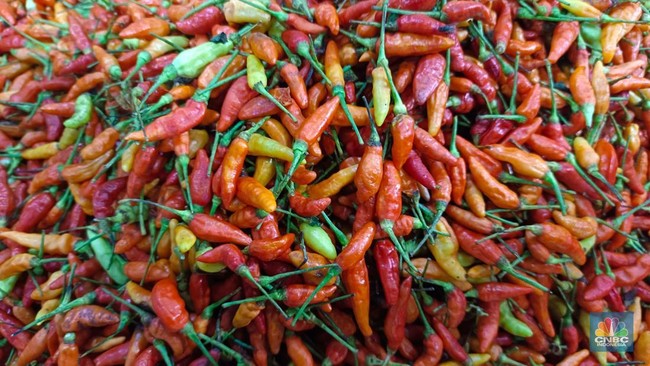
Indonesia’s cayenne pepper production continued to grow in 2025, even as household consumption moved in the opposite direction. Data from the Central Statistics Agency (BPS) shows that production throughout 2025 reached 1.74 million tonnes, an increase of 11.12% or approximately 174,360 tonnes compared to the previous year. Conversely, household consumption fell to 556,620 tonnes, a decrease of 5.32% or 31,850 tonnes from 2024. Production of cayenne pepper has generally trended upwards over the past five years. After a dip in 2023, output recovered in 2024 and hit 1.74 million tonnes in 2025, the highest level in the 2021-2025 period. Household consumption, however, has not returned to its peak. After reaching 610,850 tonnes in 2023, consumption declined to 598,470 tonnes in 2024 and weakened further to 556,620 tonnes in 2025. Despite this, cayenne pepper remains a commodity consumed by the majority of Indonesian households, with a household consumption participation rate of 78.11% recorded in 2025. National cayenne pepper production is still concentrated on the island of Java. The three provinces with the largest production in 2025 were East Java, Central Java, and West Java, together accounting for more than 61% of national output. East Java was the largest producer with a 34.61% contribution, or around 604,000 tonnes. Central Java followed with a 15.26% share, or 266,000 tonnes, and West Java contributed 11.40%, or 199,000 tonnes. This dominance indicates that the national supply of cayenne pepper remains heavily dependent on production centres in Java. The production pattern throughout 2025 showed a fairly seasonal movement. The highest output occurred in April, reaching 178,100 tonnes. After that, volume tended to decline, hitting its lowest point in August at 118,970 tonnes, before rising again towards the end of the year. A similar pattern was observed in the harvested area. The harvest area peaked in April at 58,680 hectares, coinciding with the year’s highest production. Entering the second half of the year, the harvested area shrank before stabilising relatively through to December.