
Chilli and Shallot Prices Climb at Kramat Jati Central Market
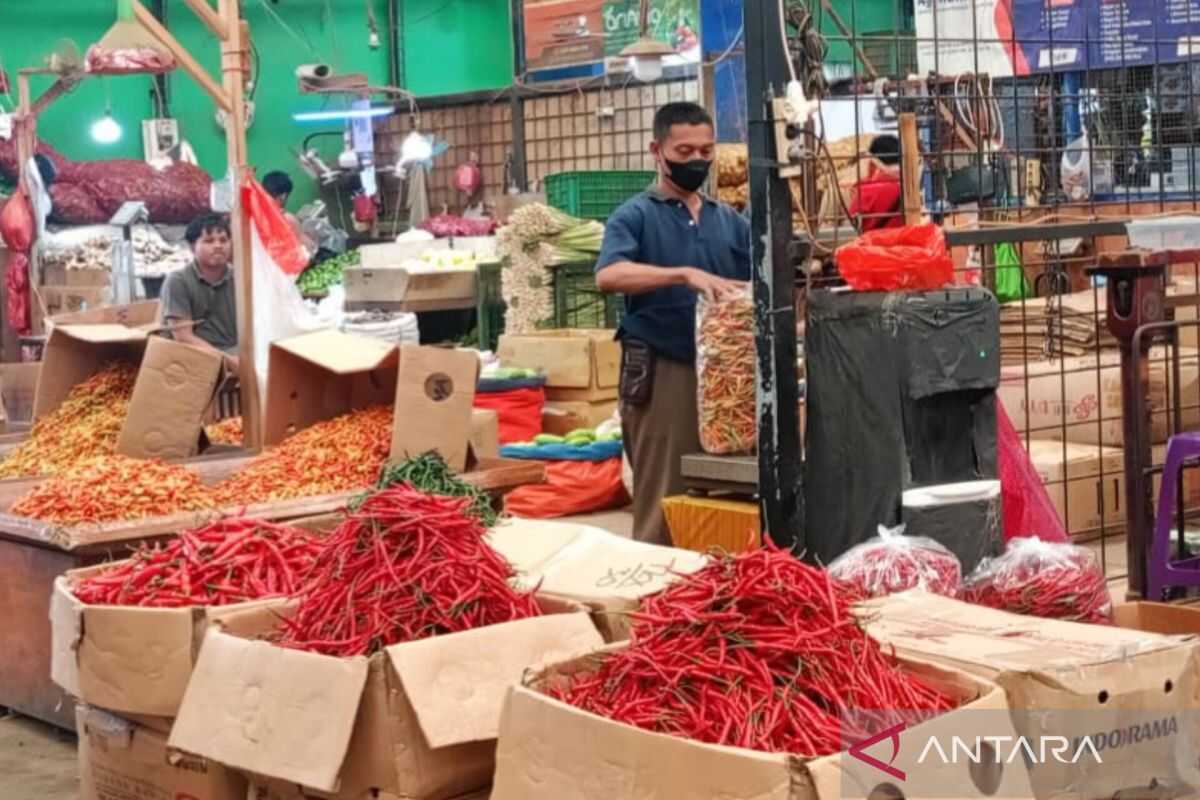
Jakarta (ANTARA) - Two food commodities at Kramat Jati Central Market in East Jakarta — large red chillies and shallots — have risen significantly in price at the start of Ramadan 1447 Hijriah.
A chilli trader, Andi (35), said the price of large red chillies has now reached Rp40,000 per kilogram. The increase has occurred gradually over the past week.
“The price of large red chillies today is Rp40,000 per kilogram. It’s been going up quite a bit — it’s getting expensive. It’s been rising for about a week now, climbing step by step,” Andi said at Kramat Jati Central Market in East Jakarta on Thursday.
Andi explained that previously, large red chillies were still priced in the range of Rp25,000 to Rp30,000 per kilogram. However, as supply has diminished, prices have continued to creep upward.
“Initially it was around Rp25,000 to Rp30,000 per kilogram, and it just kept going up. When prices rise, it means stock is running thin. When it’s expensive, it’s usually because there isn’t much product available,” Andi said.
According to Andi, chilli price fluctuations are highly dependent on stock availability at distribution centres. If supply returns to abundance, prices could potentially fall. Conversely, if stock remains limited, prices could continue rising throughout Ramadan.
“Whether prices go up or down during Ramadan depends on stock at the main supply points. If there’s plenty of stock, prices will come back down. If stock is low, they could rise again,” he said.
It is not only chillies that have seen price increases — shallot prices have also climbed in recent days.
Shallot trader Aril (44) said peeled shallots are currently selling at Rp42,000 per kilogram, whilst unpeeled shallots, particularly the larger variety, have reached Rp50,000 per kilogram.
“Peeled shallots are Rp42,000 per kilogram. The unpeeled ones, the big ones, are around Rp50,000,” he said.
According to Aril, the price increase began around 15-16 February 2026. Previously, shallots were still in the range of Rp35,000 per kilogram. However, over the past three days, prices have surged to between Rp40,000 and Rp50,000 per kilogram.
“Prices have been going up, starting from about three days ago around 15-16 February. Initially it was about Rp35,000 per kilogram, now it’s already Rp40,000 to Rp50,000,” he said.
Aril suspects the price increase is due to reduced supply from key production areas, particularly Brebes in Central Java. According to him, disrupted distribution has caused stock at the central market to thin out.
“In my view, this increase is because stock from Brebes is becoming scarce — it’s getting difficult,” he said.
Aril even estimates that shallot prices could continue to rise during Ramadan, potentially breaking through the Rp60,000 per kilogram mark if supply does not return to normal.
“It looks like during Ramadan, prices are expected to keep rising up to Rp60,000 per kilogram,” Aril said, adding that a number of inspections have been carried out to ensure there is no hoarding.
The rising prices of chillies and shallots have drawn the attention of both traders and buyers, given that both commodities are staple ingredients in high demand, particularly during Ramadan.
Previously, Kramat Jati Central Market Manager Agus Lamun stated that to prevent unreasonable price spikes, market management together with relevant agencies are continuing surveillance efforts.
He said inspections have already been conducted by the National Food Agency and the Criminal Investigation Division of the National Police. “They are ensuring that these price increases are due to supply factors, not manipulation,” Agus said at Kramat Jati Central Market in East Jakarta on Wednesday (18 February).
According to him, this oversight is essential to maintaining price stability and protecting the public from speculative practices.
With supply beginning to improve, market management hopes that chilli prices can continue to decline and stabilise throughout Ramadan and into Eid.
“We hope the weather improves and farmers can harvest normally. If supply flows smoothly, prices will also be more controlled,” he said.
Agus also urged the public to shop according to their needs and to avoid excessive purchasing.