
Child Protection Becomes Shared Agenda, Nusantara Pesantren Leaders Formulate Strategic Steps
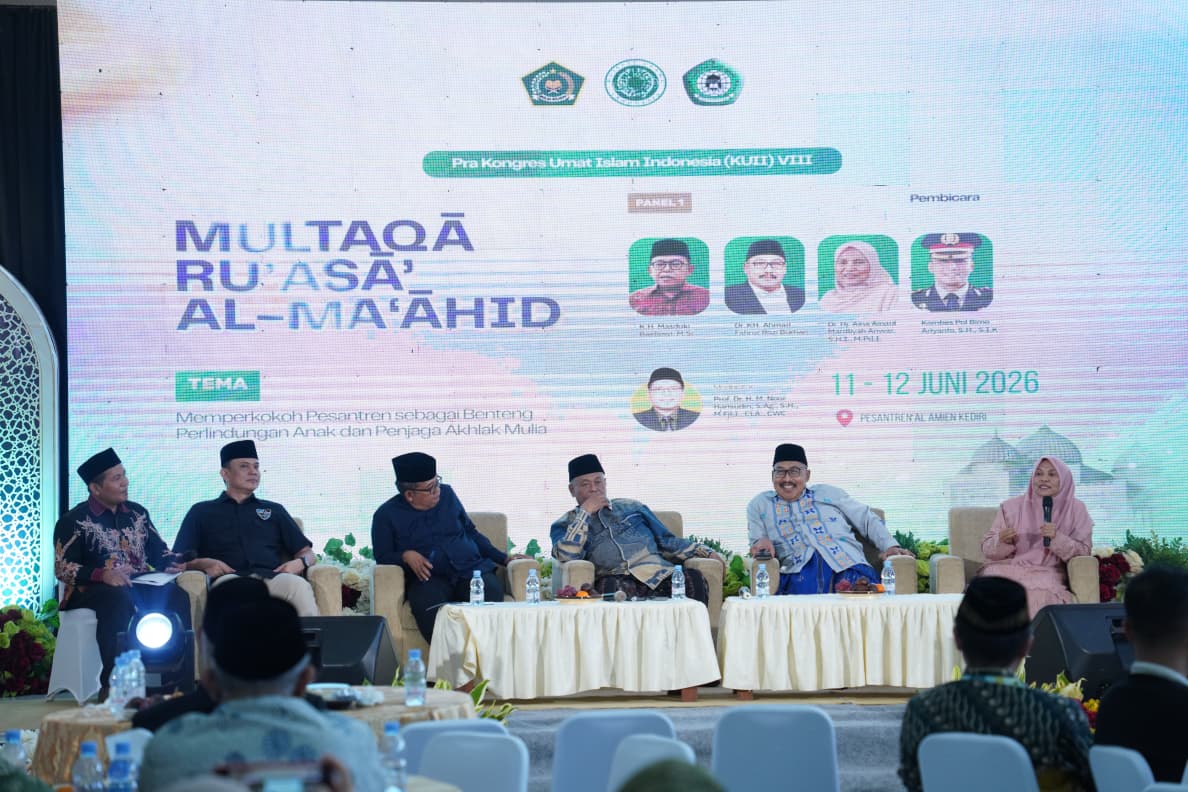
A gathering of kiai, ulama, and pesantren leaders from across Indonesia has called for more tangible state support for Islamic boarding schools. The call was made during the Multaqa Ru’asa’ al-Ma’ahid forum held at Pondok Pesantren Al-Amien, Kediri, East Java, on 11–12 June 2026. The forum not only discussed strengthening child protection and pesantren governance but also highlighted the implementation of state policies following the enactment of Law Number 18 of 2019 on Pesantren. Chairman of the Indonesian Ulema Council (MUI), Kyai Anwar Iskandar, stressed that pesantren are an integral part of the national education system that have contributed to the intellectual life of the nation long before Indonesia’s independence. “Pesantren have existed for hundreds of years before this country was established. The kiai and santri fought to defend this nation,” he asserted. Director of Pesantren at the Ministry of Religious Affairs, Basnang Said, stated that issues within pesantren should not be viewed partially. He noted that while pesantren must continuously evaluate and improve, the state also needs to be more present to help overcome challenges such as limited facilities, student healthcare, and the welfare of dormitory supervisors. “Pesantren have carried out the constitutional mandate to educate the nation. Therefore, strengthening pesantren cannot be solely the responsibility of the pesantren themselves,” Basnang said. He explained that the Pesantren Law marked a milestone in state recognition of the three main functions of pesantren: education, propagation, and community empowerment. However, the implementation of its derivative regulations still requires reinforcement. Basnang also reminded that pesantren are not asking for charity. “As KH Ma’ruf Amin once said, when pesantren submit proposals to the government, do not view them as beggars. In truth, they are claiming rights guaranteed by the state,” he stated. Forum participants also highlighted the need to strengthen national data collection on santri. Many educational units integrated with pesantren are not yet recorded in the national pesantren data system, leading to inaccurate perceptions of the number of santri in Indonesia. Beyond policy issues, the forum discussed strengthening child protection within pesantren. Committee chairman Gus Faried noted that pesantren face a significant challenge from negative stigma in the public sphere. He said that a few cases in a small number of pesantren often overshadow the contributions of thousands of others that educate millions of santri and produce numerous achievements daily. “Pesantren must continue to strengthen governance and child protection. At the same time, the public needs to see the enormous contributions of pesantren in a more complete and balanced way,” he said. Deputy Mayor of Kediri, Kyai Marsudi Syuhud, stressed that child protection must be a shared commitment of all education stakeholders, including pesantren. He expressed hope that the forum would produce concrete recommendations to strengthen the quality of santri care and enhance synergy between pesantren and the government in building a generation of Indonesians who are moral, resilient, and competitive. Through the Multaqa Ru’asa’ al-Ma’ahid, pesantren leaders agreed that the future of pesantren requires two parallel efforts: improving pesantren governance and ensuring a more tangible state presence to support the sustainability and development of pesantren as a pillar of national education.