
Child-Friendly Toddler Scales Introduced with Simple IoT Technology
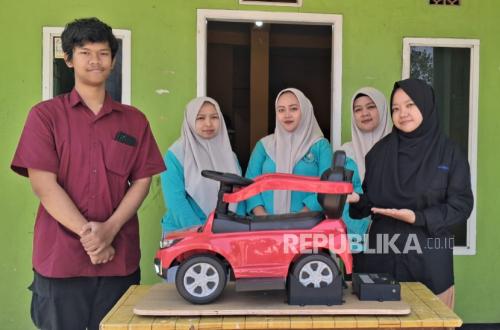
Technology does not have to be complex to benefit society. At the Mayasari 3 Posyandu (Integrated Healthcare Centre) in Bandung Regency, West Java, a team of lecturers from Muhammadiyah University (UM) Bandung is attempting to translate technology into a simple solution to help community health workers and parents monitor toddler growth.
Through a Community Service (PKM) programme, the team has introduced a child-friendly toddler scale innovation based on the Internet of Things (IoT). This scale is connected to a digital dashboard.
The innovation is paired with ‘prophetic parenting’ education, ensuring that child growth monitoring does not rely solely on data but is also reinforced by parenting patterns within the family environment.
The programme, titled “Empowering Posyandum through Innovation of Child-Friendly Toddler Scales Based on IoT and Prophetic Parenting Counselling at Posyandu Mayasari 3,” is led by Dianti Eka Aprilia, a lecturer from the Informatics Engineering Department at UM Bandung. The programme is part of the Beginner Community Service Scheme, funded by Kemdiktisaintek.
On Tuesday (15/09/2026), during the testing of the IoT scales and training for health workers, Dianti stated that the developed innovation stemmed from the real needs of the partners. Before determining a solution, the team conducted focus group discussions, service flow observations, and needs analyses alongside the Mayasari 3 Posyandu workers and village midwives on 20 July 2026.
“The main focus of this activity is to help realise Posyandu services that are more efficient, child-friendly, and technology-based, while simultaneously encouraging parental involvement in monitoring child development,” Dianti said in a statement on Wednesday (16/09/2026).
The PKM team consists of Dianti Eka Aprilia from the Informatics Engineering Department as chair, alongside Mulki Rezka Budi Pratama from the Electrical Engineering Department and Dian Kusumawati from the Early Childhood Education Department. The team also involves students Sultan Fadhilah Hilmiqashmal and Zahra Hariah Attin from Informatics Engineering, and Ridwan Romadlon from Electrical Engineering.
One of the key innovations in the programme is the IoT-based toddler scale featuring a toy car design. This concept is not merely to make the tool look attractive, but is designed so that the weighing process feels more comfortable and enjoyable for the child.
What sets it apart is that the weighing results can be sent digitally to the Posyandu dashboard. Consequently, health workers do not need to rely entirely on manual recording, making the service process more practical and ensuring child growth data is documented more systematically.
The scale will eventually be integrated with ‘Rasi Balita’, a web-based Posyandu dashboard used to record, store, and monitor toddler growth data digitally.
According to Dianti, the integration of this technology is expected to help health workers operate more efficiently while making it easier for parents to obtain information regarding their child’s development.
“The technology we have introduced is expected not just to be a tool, but to truly assist health workers in providing services and help parents in monitoring child growth,” she said.