
Chief Justice: Short-Term Prison Sentences Should Be Avoided Whenever Possible
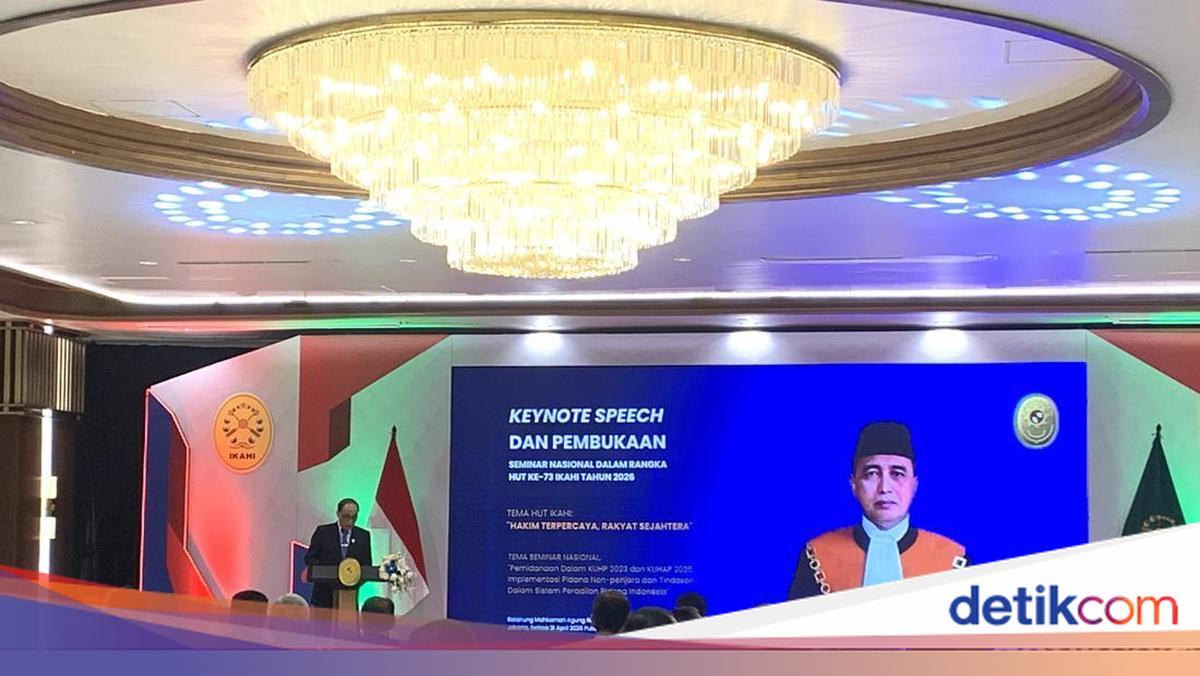
Chief Justice of the Supreme Court (MA) Sunarto stated that strengthening non-custodial penalties and various forms of actions are gaining relevance as more proportional, adaptive alternatives to sentencing that align with modern penal goals. Sunarto said the MA has issued a circular letter (SE) regarding the implementation of these non-custodial penalties.
“As a response to the complexity of implementation challenges, the Supreme Court has issued Supreme Court Circular Letter No. 1 of 2026, as an initial guideline for judges in implementing non-custodial penalties and various forms of actions,” Sunarto said at the 73rd anniversary commemoration of the Indonesian Judges Association (IKAHI) at the Supreme Court building in Central Jakarta on Tuesday (21/4/2026).
Sunarto stated that this MA SE emphasises that sentencing is no longer merely about retribution, but rather an effort to rehabilitate the offender and restore the victim. He said short-term prison sentences should be avoided whenever possible if alternative methods exist.
“Short-term prison sentences should be avoided as much as possible if there are more effective alternatives for reintegrating the offender into society. In this Supreme Court Circular Letter, judges are encouraged to optimise types of penalties that do not deprive physical freedom, including fines, supervision penalties, and community service penalties,” he said.
Sunarto added that the MA SE also expands the application of educational or therapeutic ‘actions’, particularly for vulnerable groups or specific cases. These include medical and social rehabilitation, obligations to attend vocational training, institutional care, and victim rights restoration.
“This is important considering that changes in the penal paradigm not only require a normative basis but also applicative guidelines that can minimise disparities in decisions and avoid legal uncertainty in the implementation stage,” he said.
He hopes this MA SE can serve as a framework for guiding the application of non-custodial penalties and actions. He stated that the SE is a strategic step in addressing prison overcrowding issues while ensuring that criminal justice administration provides tangible benefits to society.
“The Supreme Court Circular Letter is expected to function as a guiding framework that provides direction for interpretation and application by judges, thereby creating consistency in judicial practice, particularly in determining the suitability and proportionality of using non-custodial penalties,” he said.
Sunarto said the national seminar in commemoration of the 73rd anniversary of IKAHI can produce formulations of thought that go beyond the conceptual level and have operational and applicative power in the context of criminal law renewal dynamics. He said the seminar serves as a catalyst in formulating more measured policy and practice recommendations to support the effectiveness of implementing non-custodial penalties and actions in Indonesia’s criminal justice system.
“Given that the implementation of non-custodial penalties and actions is not only a normative issue but also concerns institutional aspects, legal culture, and law enforcement practices, a collaborative approach is needed to bridge potential inconsistencies between subsystems in the criminal justice system,” he said.
Sunarto invited all IKAHI members to commemorate the 73rd anniversary not just as a ceremonial event, but as a space for collective reflection to strengthen commitment to a more adaptive, humane criminal justice reform oriented towards substantive justice. He said the success of implementing the new sentencing paradigm is highly determined by the integrity of all elements in the criminal justice system.
“The success of implementing the new sentencing paradigm, including strengthening non-custodial penalties and actions, is highly determined by the integrity, consistency, and synergy of all elements in the criminal justice system,” said Sunarto.
“Therefore, sustained commitment is needed that is not only normative but also internalised in the practices and legal culture of law enforcers,” he added.
Sunarto then officially opened the national seminar commemorating the 73rd Birthday of the Indonesian Judges Association (IKAHI) in 2026. The seminar’s theme is ‘Sentencing in the 2023 Criminal Code and the 2025 Criminal Procedure Code: Implementation of Non-Custodial Penalties and Actions in Indonesia’s Criminal Justice System’.