
Chicken Meat Prices Surge the Most This Year, Outpacing Chillies and Rice
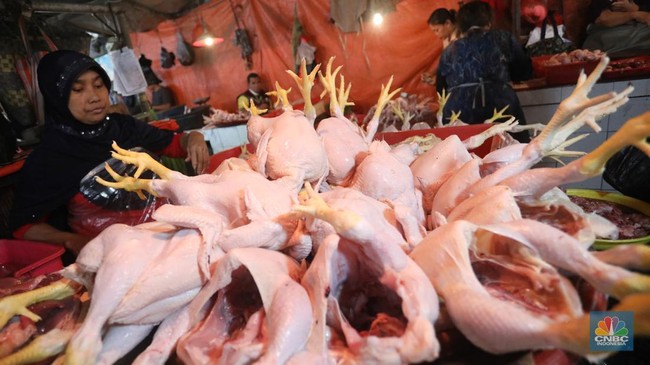
Jakarta, CNBC Indonesia - Chicken meat has become the food commodity with the highest price increase this year, with prices continuing to climb in July.
Data from the National Strategic Food Price Information Centre (PIHPS) shows the average price of broiler chicken meat throughout July reached Rp37,469 per kilogram, up 0.87% compared to the June average of Rp37,445 per kilogram. In the last three days, the price has even held steady in the range of Rp39,000-Rp39,100 per kilogram. Conversely, the average price of chicken eggs fell to Rp29,228 per kilogram from Rp30,030 per kilogram in June, a monthly decline of approximately 2.67%.
When calculated for the full year (January-July 2026) compared to the same period last year, chicken meat is the food commodity with the highest increase. The PIHPS data shows the average price of chicken meat from January to July 2026 was Rp39,925.17 per kg, while in January-July 2025 it was Rp36,453.94 per kg. In July 2025, the price of chicken meat was only Rp35,250 per kg. Following chicken meat, eggs and cooking oil recorded the highest price increases.
The price improvement comes amid rising demand from the Free Nutritious Meal (MBG) programme. Sugeng Wahyudi, Secretary General of the National Chicken Farmers Organisation (GOPAN), said the programme’s absorption of chicken has begun to reduce the supply surplus that had been burdening the market over the past two months.
‘Prices have started to move up. Since Monday, 13 July 2026, farmers’ losses have at least been reduced. Currently, the live chicken price at the farm level is around Rp20,000 per kg, compared to Rp13,000 per kg in June. That means there has been an increase. The farmers’ production cost is currently Rp20,000-Rp22,000 per kg,’ Sugeng told CNBC Indonesia on Friday (17/7/2026).
Despite the price recovery, market equilibrium has not been fully achieved. According to Sugeng, national chicken production still exceeds demand, so the additional demand from MBG has only absorbed part of the existing surplus.
On the other hand, production costs continue to rise. The price of day-old chicks (DOC) has increased from around Rp4,000 to Rp6,500 per bird, while feed prices have risen by approximately Rp1,000 per kilogram since early May. Feed accounts for about 70% of the basic production cost, so any increase in raw material prices directly raises the burden on farmers.
The increased demand from MBG does open up opportunities for the poultry industry. The programme, which is targeted to reach around 82.9 million beneficiaries, requires a large and continuous supply of animal protein.
However, the demand pattern from the government programme differs from household consumption. Absorption is highly dependent on programme implementation, including school activities. When schools are on holiday or food distribution is temporarily reduced, the need for chicken from MBG may also decline. If production remains high during the same period, supply pressure could re-emerge.
At the same time, the government has opened imports of 580,000 grand parent stock (GPS) chickens from the United States under the Agreement on Reciprocal Trade (ART) scheme. The import value is estimated to reach US$17-20 million. The government has also opened imports of mechanically deboned meat (MDM) of around 120,000-150,000 tonnes per year to meet the needs of the processed food industry, such as sausages, nuggets, and meatballs.
GPS is the top link in the commercial chicken breeding system. These breeding stocks produce parent stock, which in turn produce final stock as the source of day-old chicks (DOC) for farmers. The addition of GPS will increase national breeding capacity in the following production cycles.
The National Research and Innovation Agency (BRIN) assesses that Indonesia still depends on GPS imports. Yudhistira Nugraha, Head of the Food Crops Research Centre at BRIN’s Agricultural and Food Research Organisation, said global GPS production is still dominated by countries that have built breeding research for decades, even hundreds of years. This situation has prompted BRIN to develop local GPS based on Indonesia’s genetic resources. According to BRIN, developing local GPS is necessary to strengthen the foundation of the national poultry industry while supporting the increased need for animal protein, including from the MBG programme.
The import agenda coincides with the government’s efforts to build an integrated chicken industry through a Danantara investment worth Rp20 trillion. This programme is designed to strengthen the poultry supply chain from upstream to downstream so that national protein needs can be met from domestic production.
Senior economist at Indef, Tauhid Ahmad, assessed that the opening of chicken imports needs to be carefully calculated so as not to reduce the competitiveness of the industry the government is building. According to him, the chicken downstreaming project through Danantara has already started in several regions as pilot projects.
‘The government has a chicken downstreaming project (Danantara), pilot projects have already been carried out in several locations,’ Tauhid said when met in Jakarta on Thursday (5/3/2026).
According to Tauhid, competition will be largely determined by production cost efficiency. Imported products have the opportunity to enter the market more quickly, while the downstreaming project still needs time to increase its production capacity.
‘In my opinion, it is not threatened with failure, but the market will choose whichever is cheaper. We don’t yet know what price Danantara will produce and how much, but if imports can be much cheaper, consumers will definitely choose the cheaper price,’ Tauhid said.
This situation makes the balance between production growth and demand a major challenge for the poultry industry. MBG provides additional space for the market to absorb national chicken production.
Source: jawawa.id (https://jawawa.id/newsitem/chicken-meat-prices-surge-the-most-this-year-outpacing-chillies-and-rice-1785318832)
Originally published by CNBC Indonesia (https://www.cnbcindonesia.com/research/20260729121116-128-754705/kalahkan-cabai-beras-harga-daging-ayam-paling-melonjak-tahun-ini), translated from Indonesian