
Chicken Meat Prices Remain Uncontrolled, Reaching Rp100,000; BPS and KSP Issue Warning
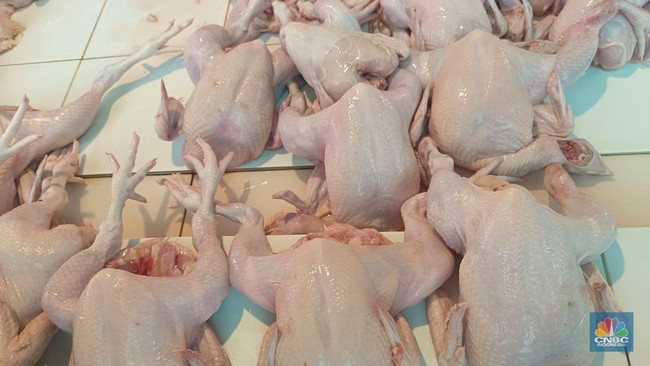
Jakarta, CNBC Indonesia - The price of broiler chicken meat is beginning to show pressure in several regions. The Central Statistics Agency (BPS) recorded that 188 regencies/cities, or around 52.22% of monitored areas, experienced an increase in the Price Development Index (IPH) for broiler chicken meat up to the first week of August 2026.
Head of BPS Amalia Adininggar Widyasanti said that nationally, the price of broiler chicken meat is still slightly below the government’s Sales Reference Price (HAP) of Rp40,000 per kilogram (kg), namely Rp39,712 per kg on a national average.
However, the price has risen by 4.06% compared to July 2026. In addition, Amalia assessed that the increase also needs attention, because chicken meat prices in several regions have already moved quite high.
“This may need attention, because if this price increase is allowed to continue, at some point it will be above the HAP. And if we look at the number of regencies/cities experiencing an increase in the IPH for broiler chicken meat, there are already 188 regencies/cities experiencing an increase in the IPH for broiler chicken meat,” said Amalia in the Regional Inflation Control Coordination Meeting of the Ministry of Home Affairs (Kemendagri), Monday (10/8/2026).
Price pressure is even much higher in several regions. BPS recorded the highest broiler chicken meat price at Rp100,000 per kg in Intan Jaya Regency. Furthermore, prices were also recorded at around Rp85,000 per kg in Yahukimo Regency, and Rp80,000 per kg each in Pegunungan Arfak Regency and Pegunungan Bintang Regency.
Chicken Prices Rise by More than 30%
BPS also mapped the areas with the highest increase in the IPH for broiler chicken meat. South Bangka Regency became the area with the highest increase, reaching 34.58%.
Although the increase was very high, chicken prices in South Bangka were still around 3% below the HAP, namely Rp38,800 per kg.
Furthermore, Binjai City recorded an IPH increase of 29.78%, with broiler chicken meat prices reaching Rp42,000 per kg or around 5% above the HAP. South Labuhanbatu Regency experienced an IPH increase of 25.75%, with prices around Rp40,000 per kg or still in line with the HAP. Meanwhile, Central Bengkulu Regency recorded an increase of 25.41% with prices at Rp39,600 per kg.
In Central Bangka Regency, the chicken IPH rose by 24.70%, while prices reached Rp42,000 per kg or around 5% above the HAP. Seluma Regency also experienced an increase of 23.97%, with prices at Rp45,000 per kg or 12.5% above the HAP.
Meanwhile, Kepahiang Regency recorded an IPH increase of 21.34%, but became one of the areas that needs special attention because broiler chicken meat prices have already reached Rp48,000 per kg or 20% above the HAP.
“This means, ladies and gentlemen, there are regencies/cities that we have marked in red that need special attention, because they are already above the HAP and the rate of increase in their IPH is already above 15% or so,” he said.
In addition to these areas, BPS recorded IPH increases of more than 20% also occurred in Bangka Regency at 20.92% and Simalungun Regency at 20.55%.
BPS Reveals Causes of Chicken Meat Price Increases
BPS also revealed a number of causes for the increase in broiler chicken meat prices in the regions. One of them occurred in South Bangka Regency.
In that area, demand for chicken increased because people switched from fish to chicken. This condition occurred after strong winds and high waves hampered fishing activities, reducing fish supply.
“For example, in South Bangka Regency, the increase in broiler chicken meat prices was influenced by increased demand as an alternative substitute for fish, because strong winds and high waves limited fishing activities so that fish stocks decreased and people then switched to buying chicken,” explained Amalia.
Meanwhile in Binjai City, the increase in broiler chicken meat prices was influenced by the resumption of activities to fulfil the Free Nutritious Meals (MBG) programme after the school holidays ended.
“Then in Binjai City, the increase in chicken meat prices was also triggered by increased market demand as SPPG resumed operations because the school holidays were over,” she said.
As for South Labuhanbatu Regency, the problem stems from a combination of supply and demand.
“Then for South Labuhanbatu Regency, the price increase occurred because chicken stocks in the market were limited while demand increased,” she revealed.
According to Amalia, this condition shows that the increase in broiler chicken meat prices in the regions does not have a single common cause. Some areas face supply constraints, while others experience a surge in demand.
Palace Reminds That Chicken Meat Is in the Alert Zone
The pressure on chicken prices has also attracted the attention of the palace. Acting Deputy II of the Presidential Staff Office (KSP) for Economic and Food Affairs, Popy Rufaidah, said broiler chicken meat is on the list of commodities in the alert zone.
Overall, the government is highlighting 12 commodities in the alert zone, including broiler chicken meat, broiler chicken eggs, live broiler chickens or live birds, Minyakita, bulk granulated sugar, beef, garlic, and shallots.
Popy said that food price conditions in general are still relatively stable compared to the previous week. However, the government still needs to monitor the dynamics of each commodity and region so that price pressure does not spread further.
According to her, food price control also cannot only look at the national average price. The government needs to look at pressure points in the regions, including when prices are too high for consumers and when prices are too low for producers.
“This shows that food stabilisation should not only be seen from the affordability of prices for consumers, but also from the sustainability of businesses and production incentives for farmers and breeders,” said Popy on the same occasion.
Therefore, the government is encouraging inflation control to be more based on the conditions of each region.
“The approach to inflation control can perhaps be increasingly directed from merely reading the national average towards identifying pressure points in the regions,” she said.
She assessed that regions experiencing a supply surplus need to be connected with regions experiencing a deficit. In this way, supply interventions can be carried out more quickly and precisely.
“Meanwhile, surplus regions can be increasingly connected with deficit regions, while supply interventions and absorption facilitation can be adjusted to the characteristics of each region’s problems,” she said.
Thus, although chicken prices nationally are still slightly below the HAP, the increase in 188 regencies/cities and prices that are already far above the reference price in several regions are signals that the government needs to anticipate so that price pressure does not spread further.