
Chery Tiggo 7 HEV Spied Testing, Set for Global Markets
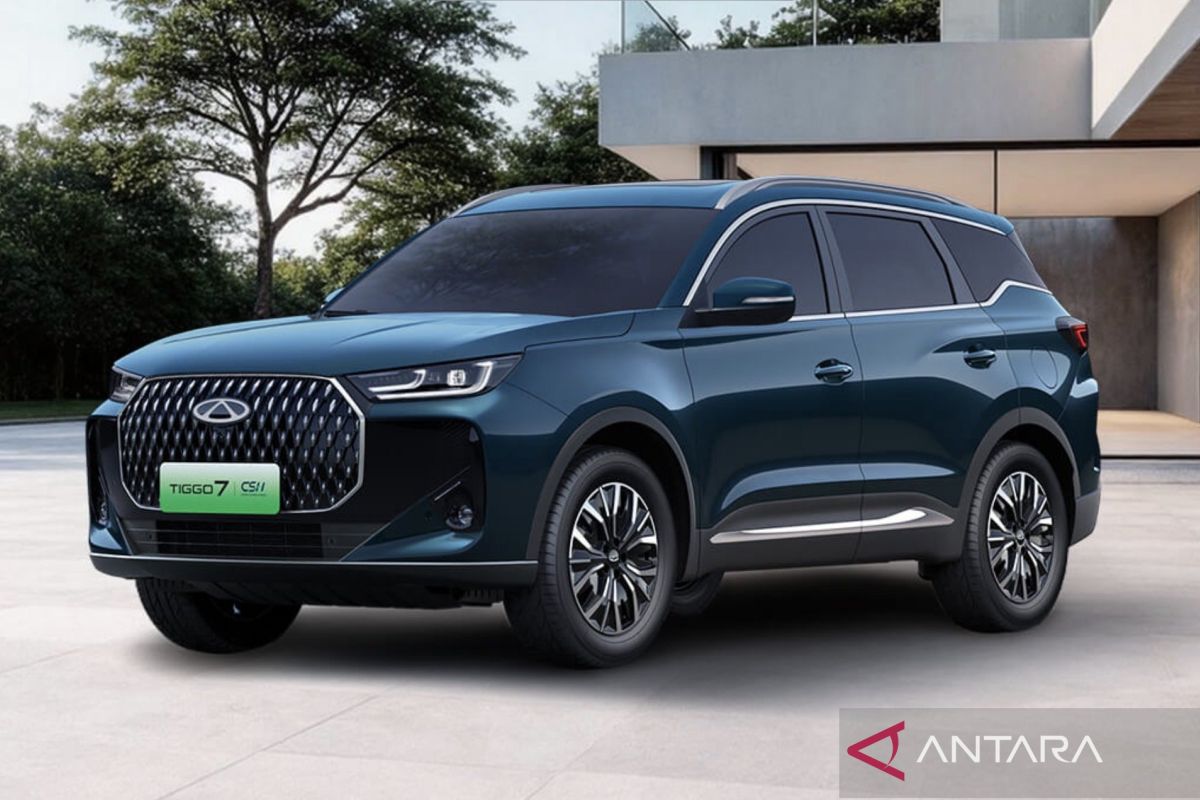
Jakarta (ANTARA) - Spy photographs showing the Chery Tiggo 7 Hybrid Electric Vehicle (HEV) variant, which is capable of self-charging, undergoing road tests in China indicate that the compact SUV will be sold in global markets.
CarNewsChina reported on Sunday that the new model, bearing the development name ‘T1E HEV’ on the bonnet, features Chery emblems in English and an interior design specifically tailored for export markets.
The Tiggo 7 is currently available in a 48-volt Mild Hybrid Electric Vehicle (MHEV) variant, a Plug-in Hybrid Electric Vehicle (PHEV), and an Internal Combustion Engine (ICE) version. Unlike the PHEV, which Chery Australia claims can travel up to 90 km in electric mode, the MHEV model cannot run solely on electric power.
The HEV variant can operate in electric mode for short periods but cannot be charged from an external source. It derives its energy from the engine or through energy recovery during braking. This system offers maximum efficiency in urban driving with stop-and-go traffic conditions. The new Tiggo 7 HEV is expected to fill the gap between the MHEV and PHEV variants.
The model is anticipated to use Chery’s ‘Kun Peng 2.0’ hybrid system, which employs a 5.1 kWh battery and supports an electric motor delivering up to 150 kW (201 hp). Combined with a 1.5-litre turbocharged engine, the total system output is estimated to reach 260 kW (349 hp).
Chery claims the HEV system allows users to drive in EV mode for longer periods. The system is also claimed to provide a high-power Vehicle-to-Load (V2L) AC charging function, enabling users to operate household appliances using power from the hybrid battery, a feature typically reserved for pure electric vehicles and PHEVs.
Images of the vehicle’s underbody show the Tiggo 7 HEV’s battery pack positioned between the two axles beneath the centre floor. The 5.1 kWh battery pack is expected to use an air-cooling system. The battery layout is identical to that of the Tiggo 4 HEV, which uses Chery’s first-generation HEV system.
The headlight and bumper designs are the same as those on the MHEV, PHEV, and ICE variants. The cabin design is also identical. As a self-charging hybrid vehicle, the Tiggo 7 HEV does not feature a dedicated charging port.
The price of the HEV model is expected to be positioned between the petrol-powered Tiggo 7 and the Tiggo 7 PHEV variant. For reference, the petrol-powered Tiggo 7 is sold in Australia starting from 29,990 Australian dollars (approximately Rp373 million), while the PHEV ‘Super Hybrid’ variant is marketed from 34,990 Australian dollars (approximately Rp435 million).
The vehicle’s kerb weight ranges from 1,489 kg to 1,788 kg depending on the drivetrain system. It uses MacPherson strut front suspension and a multi-link rear suspension.
The Chery Tiggo 7 is marketed as the Tiggo 7 Plus in China and is currently available in ICE and PHEV variants. The PHEV variant is aggressively marketed in the domestic market with prices ranging from 129,900 yuan to 149,900 yuan, or approximately Rp341 million to Rp393 million.