
Cheerful Faces Among Corn Farmers as Prabowo's Policies Bear Fruit
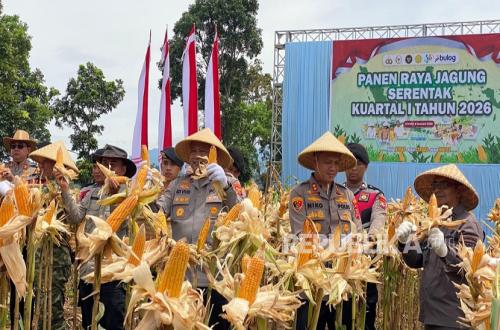
Tasmuri, a corn farmer in Tuban, East Java, is delighted this year. The head of the Ngudi Makmur Farmers’ Group has noticed many differences. The 631.7 hectares of land managed by the group, involving around 750 sharecroppers, successfully underwent a major harvest last May.
President Prabowo Subianto attended the simultaneous first-quarter corn harvest event. He was welcomed enthusiastically by local farmers and farmers’ groups.
“When President Prabowo came here, I was very, very happy. Because our region has never been visited by a President before, this is the first time, I am very excited and happy,” Tasmuri said on the sidelines of the event on 16 May.
Tasmuri believes that current government policies are now being felt by farmers, especially regarding easier access to more affordable fertiliser. “Now there are many changes. In the past, the problem was fertiliser, which farmers always rely on. It used to be very difficult, with long queues. There have been changes, President Prabowo lowered the price. What used to be more expensive has now dropped, and the service is very simple and easy to find,” he said.
Although the fertiliser situation is considered to be improving, Tasmuri hopes the government can assist with drilling wells for irrigation, as their farming area still relies heavily on rainfall. “Because here, in my area, if there is no rain, the second harvest fails. Farmers suffer huge losses because the corn cannot mature,” he explained.
In addition to irrigation issues, Tasmuri also appreciated the improvement in corn selling prices, which now reach more than Rp6,000 per kilogramme, helping farmers cover production costs. “As for selling our produce, thank God it is good now. Previously, the price of corn was only Rp3,800 to Rp4,000. But now it is more than Rp6,000, Rp6,200 per kilo. This means farmers are very happy, because the costs are high,” he said.
Meanwhile, the head of the Wono Lestari Forest Farmers’ Group, Sudarlim, hopes the President’s presence will bring more attention to forest farmers. “We forest farmers, 90 per cent of us in Tuban plant corn. Our hope going forward is to receive more attention, or at least the same as farmers outside forest areas,” Sudarlim said.
He hopes the government will provide post-harvest facility support, such as dryers, so farmers can meet Bulog standards and obtain maximum selling prices. “What we hope for are facilities for post-harvest processing, so we can access Bulog and get the maximum price,” he said.
Sudarlim is also optimistic that the food self-sufficiency programme launched by President Prabowo can run successfully and have a real impact on farmers’ welfare. “With the President’s presence, I am optimistic about farmers’ welfare, not just forest farmers, but that the food self-sufficiency programme he launched will succeed,” he said.
In addition to post-harvest facilities, Sudarlim hopes the government can help build irrigation or deep wells so farmers can increase planting frequency and reduce the risk of harvest failure.
Agriculture Minister Andi Amran Sulaiman stated that Indonesia has achieved self-sufficiency in eight strategic food commodities. Corn is one of them. Besides corn and rice, other commodities that have achieved self-sufficiency include large chillies, bird’s eye chillies, consumption sugar, chicken meat, chicken eggs, and shallots. According to him, this achievement means Indonesia no longer depends on imports for these commodities, and some have even entered the export market.
Amran confirmed that the Government Rice Reserve stock has now exceeded 5 million tonnes. This figure is claimed to be the highest in Indonesian history. In addition to self-sufficiency, the Minister also highlighted other performance indicators. The Farmer Exchange Rate was recorded at 127.73 in May 2026, while the Gross Domestic Product of the agricultural sector grew by 5.74 per cent.
These achievements are considered inseparable from government policy support. These include an increase in the government purchase price for unhusked rice, improvements in fertiliser distribution governance, and a reduction in subsidised fertiliser prices. Amran affirmed that the government will continue to strive to increase food production, maintain price stability, and improve farmers’ welfare.
Previously, President Prabowo Subianto emphasised that the agricultural sector is the main foundation of national development. During a Full Cabinet Meeting at the Presidential Palace in Jakarta, the President stated that amidst global turmoil, Indonesia has managed to record various strategic achievements. “Every country, every economy, is certainly measured. We ask, can that nation provide food, feed its people? That is the most fundamental thing. What is the point of independence if we cannot provide the most basic element of a civilisation, which is food,” the President said.
The President stressed that no civilisation can survive without food security. Therefore, the government has made agricultural development a top priority through the provision of productive land, water management, pro-farmer policies, and the availability of affordable fertiliser. The President also stated that the various policies implemented by the Red and White Cabinet have yielded tangible results. “We are already self-sufficient in eight food commodities. Our rice reserves are the highest in the history of the Republic of Indonesia. Our Farmer Exchange Rate is the highest in the history of the Republic of Indonesia,” he asserted. This achievement is proof of Indonesia’s ability to strengthen food security amidst the threat of a global food crisis due to conflict and climate change.