
Cheap to burn, costly to bear: What fuels Indonesia’s persistent cycle of fires and haze?
Cheap to burn, costly to bear: What fuels Indonesia’s persistent cycle of fires and haze?
Wildfires in Indonesia have caused transboundary haze and disrupted livelihoods in Sumatra. In the last of a three-part series, CNA looks at why the fires persist despite bans and crackdowns - and what it will take to stamp them out for good.
OGAN ILIR, South Sumatra: Salahuddin had been keeping watch on a nearby wildfire through the night when the flames crept dangerously close to a gas pipeline.
That was when the 60-year-old panicked. He woke his wife with one clear instruction: “Evacuate.”
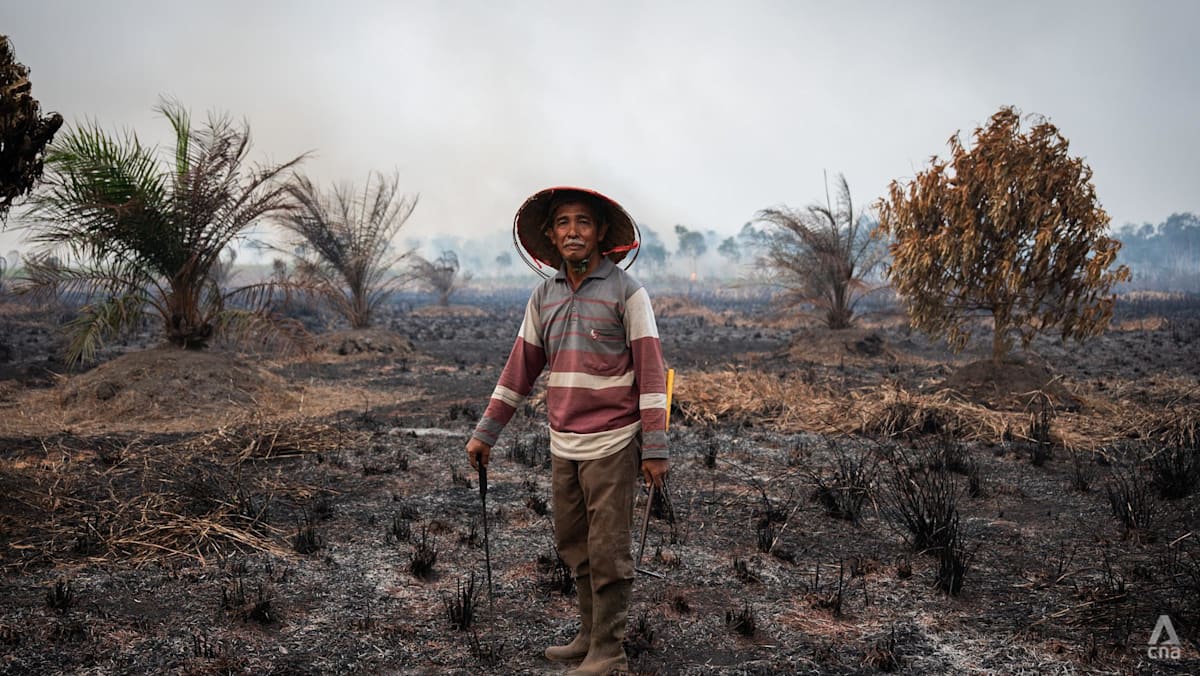
The fire would ultimately consume much of his 4ha farm plot in Ogan Ilir, South Sumatra, reducing oil palm and mango trees to ashes and coming within a few hundred metres of his home.
“The bushes were fine when we were ready to hit the bed,” he told CNA on Sep 12, the morning after the blaze was extinguished by firefighters.
That left Salahuddin, who like many Indonesians goes by one name, wondering what could have started the blaze.
Had someone discarded a still-lit cigarette? Burned rubbish? Or deliberately set vegetation alight to clear land for a plantation?
“How else could the bushes catch fire so suddenly, in the middle of a cold night?” he said.
THE HUMAN SPARK
What sparked the fire on Salahuddin’s land remains unclear. But across Indonesia, authorities say there is little mystery about what is driving the thousands of blazes that have erupted this year: human activity.
“The main cause is human factors, whether deliberate or accidental,” Indonesia’s disaster mitigation agency chief Suharyanto told Reuters on Sep 8.
One common cause is the use of fire to clear land. While largely banned in Indonesia, it has long been seen as a cheap and quick way to prepare the ground for agriculture and plantations.
Open burning is also often used to dispose of household waste, particularly in areas where rubbish collection is poor or non-existent.
Such fires can spread to surrounding vegetation and grow out of control, particularly during prolonged dry spells. This year, an exceptionally powerful El Nino, dubbed “Godzilla”, has brought extreme heat and prolonged drought, leaving vast areas of vegetation tinder-dry.
Between January and July, more than 200,000ha of land burned across Indonesia, according to the Ministry of Forestry. That was 69 per cent more than during the same period last year and 47 per cent more than in the first seven months of 2019, another El Nino year.
The blazes have sent hazardous smoke thousands of kilometres across the region, affecting neighbouring countries including Singapore, Malaysia and the Philippines.
Indonesian President Prabowo Subianto has called for tougher action against those responsible.
“We may ask parliament to amend the laws so that (arson and rubbish burning) can be classified as ecological terrorism. This is very serious,” he said on Sep 16 during a Cabinet meeting.
But Indonesia has grappled with forest and land fires for years, with outbreaks repeatedly returning during dry seasons.
Experts and environmental activists said breaking that cycle will require tackling the problem at its roots - from why people continue to use fire in the first place to whether enforcement goes far enough in holding those responsible to account.
CHEAP TO BURN, COSTLY TO BEAR
The Forestry Ministry said it has taken a range of measures, including public education campaigns, regular patrols and working with volunteers and local communities who can act as the authorities’ eyes and ears on the ground.
In fire-prone areas, billboards warn residents of the penalties they could face for starting fires.
Under Indonesian law, those convicted of deliberately starting a fire can face up to 15 years in prison and a fine of up to 10 billion rupiah (US$558,800), according to the ministry.
Those found responsible for fires caused by negligence can face up to five years in prison and/or a fine of up to 500 million rupiah.
But preventing fires remains a formidable challenge.
“The main issue is not simply how tough the regulations are, but how consistently they are enforced and whether viable alternatives are available to communities,” Mahawan Karuniasa, an environmental science expert from the University of Indonesia in Jakarta, told CNA.
The costs can fall on those trying to protect their land.
Sungkono, 30, whose family owns a 6ha oil palm plantation in Ogan Ilir, said there has been “fire after fire” around his area this year.
Some blazes have come close enough to threaten his farmland and home.
Sungkono said he spends millions of rupiah every year cutting back vegetation and digging canals to create barriers against approaching flames.
“But even then, we have to deal with the suffocating smoke and the fires have at times cut off access to and from my plantation,” he said.
Avoiding fire, however, can itself be costly for small-scale farmers looking to clear their land.
Ashadi Hendra, 42, a farmer in Musi Banyuasin, another part of South Sumatra, said clearing land mechanically can require half a dozen workers wielding chainsaws, an excavator to remove tree stumps and roots and trucks to haul away the debris.
Depending on the terrain, location and vegetation, clearing a hectare of land this way can cost between 10 million and 20 million rupiah, he said. For comparison, South Sumatra’s minimum monthly wage is 3.9 million rupiah.
“That is a lot of money for (small-scale) farmers,” he told CNA.
Ashadi is among the more fortunate ones. He belongs to a farmers’ collective that owns a mini excavator, tractor and wood chipper, allowing members to share equipment and reduce the cost of clearing land without burning.
Another challenge facing authorities is a long-held belief among some traditional farmers that burning vegetation can make the land more fertile.
“The resulting ash can raise soil pH and add some nutrients in the short term, but these benefits are temporary,” Mahawan said.
“Over the longer term, burning c
Source: jawawa.id (https://jawawa.id/newsitem/cheap-to-burn-costly-to-bear-what-fuels-indonesias-persistent-cycle-of-fires-and-haze-1790203825)
Originally published by CNA (https://www.channelnewsasia.com/asia/indonesia-haze-wildfires-sumatra-human-activity-crackdown-6403751)