
Cheap! Ride Multiple Public Transport Modes for 3 Hours for Only Rp10,000
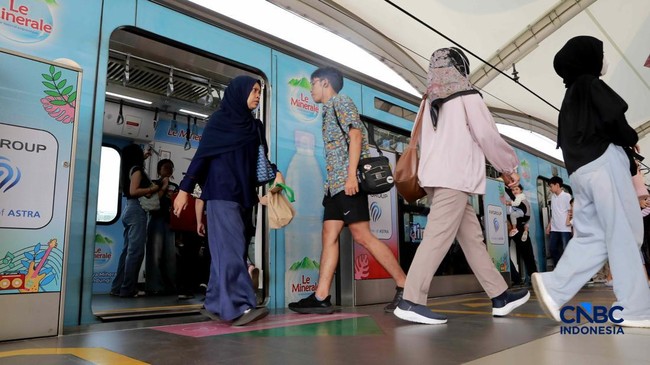
The government is currently preparing to expand the integrated fare scheme for public transport in Jabodetabek. Under this new scheme, the public will only need to pay a single fare to transfer between different modes of transport within a three-hour period, applicable during both peak and off-peak hours.
Currently, a maximum integrated fare of Rp10,000 is already in effect for transport modes managed by the Jakarta Provincial Government. Moving forward, this scheme is planned to be expanded by integrating KRL Commuter Line services to broaden its coverage.
The Secretary of the Directorate General of Transport and Multimodal Integration (Ditjen Intram) of the Ministry of Transportation, Dedy Cahyadi, explained that the Rp10,000 integrated fare is a policy of the Jakarta Provincial Government that applies to various transport modes under Jakarta’s Regional Government-Owned Enterprises (BUMD).
“The Rp10,000 integrated fare is indeed a policy from the Jakarta Provincial Government, where all operator services under Jakarta’s BUMD are integrated at a rate of Rp10,000, covering available modes. This includes Metrotrans, Transjakarta, LRT Jakarta, and MRT Jakarta, and it is valid for 3 hours,” Dedy stated during a media briefing in Jakarta on Friday.
With this scheme, commuters can change transport modes multiple times within a three-hour period without being charged separate fares, making travel costs more affordable.
“If someone wants to commute to work within the Jakarta area within a 3-hour period, they can use various modes, such as MRT Jakarta, LRT Jakarta, Transjakarta, or feeders, including Mikrotrans. The total cost is calculated at only Rp10,000, which is cheaper and more efficient than using individual modes separately,” he explained.
According to Dedy, this policy has been in place since 2022 and applies on weekdays, from Monday to Friday.
“Consider travelling from Bogor or Bekasi to Jakarta, which already costs around Rp20,000. However, with the integrated mode within a specific period, it is certainly cheaper. The hope is that the public can use public transport from their residential areas to their workplaces in Jakarta. This scheme has been operational since 2022,” he added.
Dedy explained that the payment system will continue to use electronic money cards as usual. The JakLingko system will track passenger transfers so that the integrated fare can be applied automatically.
“So, if you want to experience this now, you can use any electronic card, such as e-money, BNI Tapcash, or BRI. For example, if you depart at 6:00 AM and transfer modes—say, from Bekasi via LRT, then disembark at Dukuh Atas to head to Kota, you simply tap into Transjakarta at the station. As long as it is within 3 hours, the maximum is Rp10,000. This is already in effect,” he explained.
He added that the government is also discussing fare integration with the Jabodetabek KRL. Currently, implementation requires an agreement between the central government and the Jakarta Provincial Government, as KRL subsidies are sourced from the State Budget (APBN).
“The plan is that since the current subsidy is provided by the Jakarta Provincial Government, it only applies to modes managed by the Jakarta Regional Government. We plan to integrate this with KCI, specifically the KRL serving the Jabodetabek area,” said Dedy.
“God willing, once an agreement is reached—as this requires mutual consensus—we can integrate the KRL with the existing transport modes in the Jakarta area,” he continued.
Regarding the payment mechanism, Dedy ensured that the public would not need to change their habits when using public transport. Passengers will still tap in and tap out at every mode, while the JakLingko system will automatically calculate the journey transfers.