
Chaos! Spanish Border Overrun by Moroccan Migrants, Military Deployed Amid Casualties
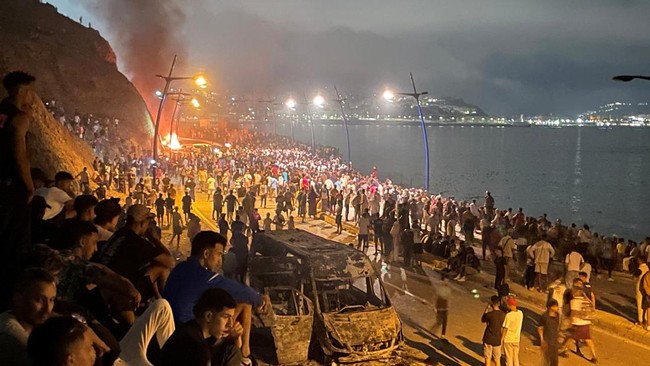
Thousands of migrants have crowded the Moroccan city of Fnideq, which borders the Spanish enclave of Ceuta, in a massive migration wave that has once again shaken one of the most sensitive borders between Africa and Europe. Despite a massive reinforcement of security forces, thousands of people continue to attempt to enter European Union territory via both land and sea.
According to Reuters, the flow of migrants moved towards Ceuta on Thursday after gathering since the previous night around the northern Moroccan city of Fnideq. Spanish state television, TVE, reported that between 2,000 and 3,000 migrants successfully entered Ceuta on Thursday, with most managing to cross before midday.
Ceuta, along with Melilla, comprises the two Spanish autonomous cities located in North Africa and serves as the only EU land border with the African continent. For years, these territories have been primary focal points for migrants seeking to reach Europe. The surge in migration has prompted the Spanish government to dispatch additional military and police personnel to Ceuta. Simultaneously, local authorities confirmed that nine bodies have been discovered in the area.
Although border gates appear tightly closed, groups of migrants continue to move along the coastline to seek alternative routes past the perimeter fences, with some attempting to cross by swimming. Brahim, a 32-year-old migrant from Tangier, stated he arrived hoping to enter Ceuta through the border gates but found access practically closed by the time he arrived.
The crowd includes women, children, Moroccan nationals, and migrants from Sub-Saharan African countries.
The Moroccan government has deployed water cannon trucks and strengthened security at crossing points. Security forces have repeatedly repelled groups of migrants attempting to approach the border gates. Near the site, the wreckage of a bus and seven burnt vehicles remains visible, destroyed during clashes as authorities attempted to halt the masses.
One migrant, who requested anonymity, admitted to nearly losing his life during the crossing, describing a perilous situation of extreme overcrowding. He described a chaotic scene where people were pushing and trampling one another along narrow coastal paths, with panic escalating as thousands converged on the same point simultaneously.
Roads leading to Fnideq were filled with people, including many minors, hoping to enter Europe. Some travelled on foot along highways late into the night, while others chose mountain paths to evade security checkpoints. Throughout the night, security forces repeatedly dispersed groups attempting mass assaults on the border, yet migrants continued to regroup in streets, hills, and open areas around the city.
This surge occurs amidst Spain’s relatively more open migration policies compared to other European nations. The Spanish Socialist government is known for its more pro-migrant approach. Recently, Madrid launched a programme allowing approximately 500,000 undocumented migrants to obtain legal status. This programme has triggered a massive surge in legalisation applications, with numbers reportedly reaching twice the initial target.