
Chaidir reveals the strategic role of international police cooperation
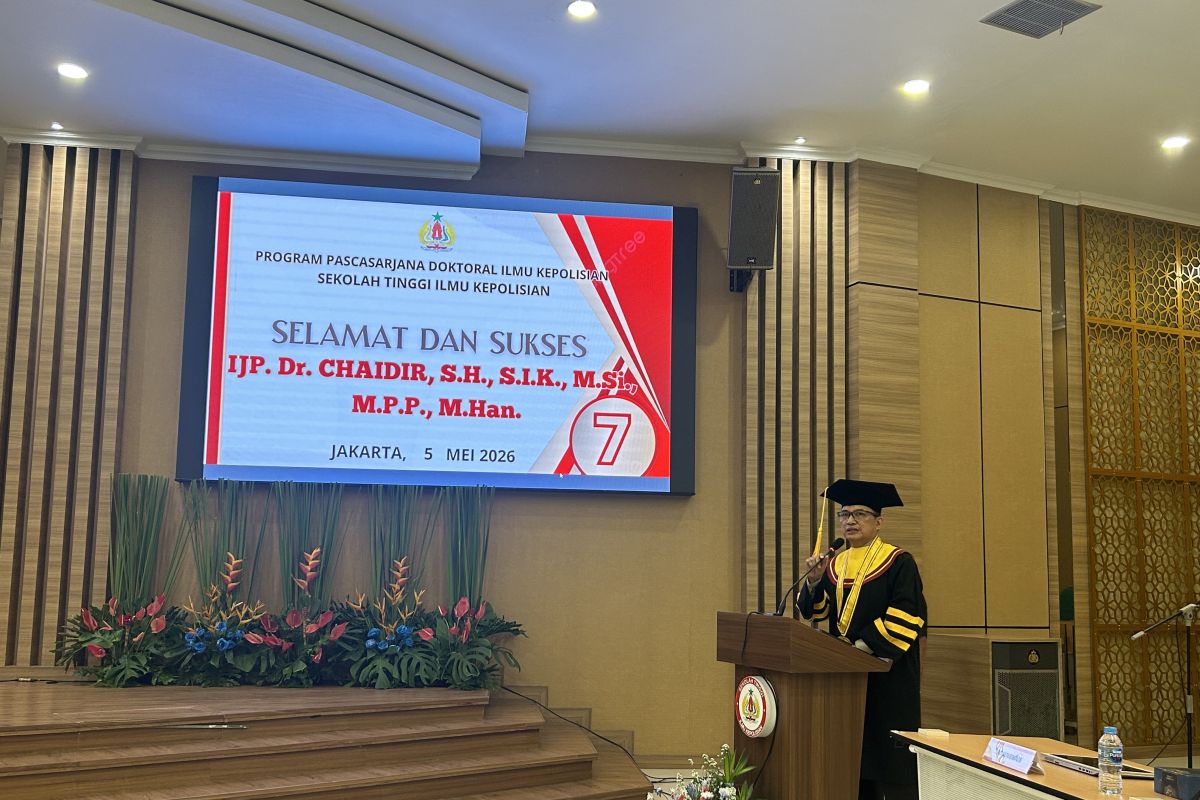
Jakarta (ANTARA) - Inspector General of Police (IGP) Chaidir has revealed the strategic role of international police cooperation in tackling transnational organised crime during an open session for his doctoral promotion at the Indonesian Police College (STIK) Polri, Jakarta.
In his dissertation titled “International Police Cooperation between Indonesia and Malaysia (Nodal Governance) in Combating Transnational Organised Crime”, Chaidir, who is a lecturer at the Indonesian National Defence Institute (Lemhannas RI), focused his research on the effectiveness of international police cooperation between the Indonesian National Police (Polri) and the Royal Malaysia Police (PDRM).
“My dissertation represents a new breakthrough in international police cooperation by building relationships across institutions. So, not only police institutions but also law enforcement institutions,” said Chaidir when met after the dissertation session at STIK Polri, Jakarta, on Tuesday.
The dissertation research stems from Chaidir’s concerns about the reality of transnational organised crime, such as illicit drug trafficking, human trafficking (TPPO), migrant workers, terrorism, arms smuggling, and cybercrime, which are becoming increasingly complex and threatening the shared security of Indonesia and Malaysia as kindred nations sharing long land and sea borders.
Both countries have significant common interests in cooperating effectively. However, Chaidir has personally witnessed how structural, capacity, and psychological obstacles often hinder smooth technical cooperation in the field.
This situation prompted him to conduct in-depth studies, analysing the root problems and formulating a strategic model that is hoped to provide real contributions to the development of policing science and the enhancement of bilateral cooperation effectiveness.
According to him, an Interpol coordination team currently exists in the International Relations Division (Polri), but its communication needs to be strengthened.
Such cooperation networks should not only be local (national) but also developed between countries so that police forces from both nations can narrow the operational space for criminals, given that perpetrators are now increasingly organised and supported by technological advancements.
“So with this technological development, the operational space for criminals is becoming more unlimited, with no barriers to their movements, especially with technology. So this situation makes crime even more difficult,” he stated.
In his research, the former Polri Attaché in Malaysia explained that police forces should not only focus on capturing perpetrators but also on obtaining digitally recorded crime evidence.
“This dissertation emphasises how technology must be understood carefully in law enforcement,” he said.
He cited cases of transnational organised crime in several countries, including those involving Indonesia and Malaysia, such as the murder of Kim Jong-nam, the half-brother of North Korean leader Kim Jong-un, in February 2017 at Kuala Lumpur International Airport, Malaysia.
Then there was the murder of journalist Jamal Khashoggi at the Saudi Arabian Embassy in Turkey. Both cases share the same intersection, namely being carried out by state authorities.
“This is the kind of crime that must be eradicated; it should not develop if we do not have an inter-country cooperation system,” said Chaidir.
The results of Chaidir’s study are not only theoretical but also practical. He offers the Indonesia-Malaysia Integrated Nodal Governance Framework for Transnational Organised Crime (IM-INGOF TOC).
The IM-INGOF-TOC model is designed for implementation, starting from establishing permanent task forces, developing joint technology platforms (SIKAT IM) to compiling bilingual SOPs and tiered capacity-building schemes.
“I hope the Polri International Relations Division can adopt the recommendations in this dissertation, especially the establishment of a permanent TOC Task Force with joint funding,” he said.
Similar mechanisms have been widely used by countries in other regions. According to him, Polri must dare to leap from ad hoc, reactive cooperation models to proactive and institutionalised joint security architectures.
Chaidir hopes his dissertation can serve as a reference for other academics and researchers interested in regional security studies, police diplomacy, and nodal governance.
The study also explains how international relations science can be integrated with policing science, which in practice can be developed through cooperation not only in diplomacy but also operationally by establishing crisis centres between the two countries or with other nations.
For his dissertation, the doctoral examination panel at STIK Polri, chaired by IGP Eko Rudi Sudarto, with examiners including Commissioner General of Police Prof. Iza Fadri, Commissioner General of Police Prof. Chryshnanda Dwi Laksana, Prof. Wahyurudhanto, Prof. Sari Wahyuni, Prof. Badri M. Sukoco, Dr. Supardi Hamid, Dr. Pratama Persada, and Promoter Prof. Hikmahanto Juwana, declared IGP Chaidir passed and earned his doctoral degree with a very satisfactory predicate or grade A.
Source: jawawa.id (https://jawawa.id/newsitem/chaidir-reveals-the-strategic-role-of-international-police-cooperation-1778194543)
Originally published by Antara (Indonesian) (https://www.antaranews.com/berita/5555405/chaidir-ungkap-peran-strategis-kerja-sama-internasional-kepolisian), translated from Indonesian