
Ceuta Tragedy: Successfully Crossing the Border Ends in a Graveyard
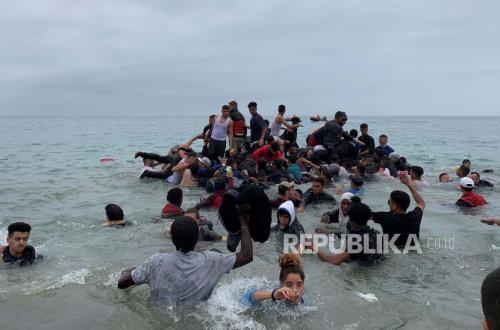
More than two weeks after tens of thousands of people stormed the Morocco-Spain border, the Ceuta tragedy is far from over. People are no longer flocking to swim towards the European territory. The fence is guarded once again. Police numbers have been increased. Floating barriers have been installed at sea.
But at a Muslim cemetery on the outskirts of the city, a different kind of work is under way. More than 60 graves have been prepared at the Sidi Embarek complex for victims of the late July migration wave. As of 14 August 2026, most of the bodies due to be buried in Ceuta had no known identity. Fewer than 20 other bodies, said to be from sub-Saharan Africa, are planned for burial in the city’s Catholic cemetery.
Only six victims had been identified by that date. Three were recognised through fingerprints, three others through DNA. Previously collected data indicated that all six were adult men of Moroccan nationality.
Those who remain unidentified will not simply be buried and forgotten. Each body is registered using a personal code in the civil records. Each grave is given an identification number and a security seal. If a family is ever able to prove a victim’s identity through DNA or other means, the remains can be exhumed and repatriated after obtaining a judge’s permission.
This is the other face of the Ceuta tragedy: a journey towards Europe that for some people ends not with a job or a new life, but with a number above a grave, as reported by La Republicca on Monday (17/8/2026).
The crisis is not over. On Sunday, 16 August, hundreds of migrants still in Ceuta staged a protest on a city beach. They demanded asylum and refused to be returned to Morocco.
Reuters estimates that around 5,000 to 8,000 migrants remain in Ceuta. Some are living in severely limited conditions at El Trampolín Beach and on the outskirts of the city.
A day later, on Monday, 17 August, the Spanish government announced four additional facilities for humanitarian handling with a total capacity of 1,500 people. Three will be managed by the central government and one by the Autonomous City Government of Ceuta.
More than two weeks have passed since the human wave surged into the city. Yet Ceuta, a Spanish territory in North Africa with a population of around 80,000, is still trying to understand how a border that had been tightly guarded for years was suddenly crossed by tens of thousands of people in a very short time. Above all, how many never actually made it to the other side.
Ceuta, together with Melilla, are two Spanish autonomous cities in North Africa. They form the European Union’s only land border with Africa. For years, this has made Ceuta one of the points sought by people wanting to reach European territory.
The latest wave began to swell on 29 July. A day later, it exploded. Footage from 30 July showed hundreds of people swimming or floating using inner tubes from the Moroccan coast, while others forced their way through land routes. Reuters also saw groups of young people walking north from Moroccan territory towards the border.
Initial figures kept changing as the chaos unfolded. The Spanish government initially said around 50,000 people had entered. The local government of Ceuta estimated up to 60,000.
After data was updated, Spanish Interior Minister Fernando Grande-Marlaska said on 4 August that 72,000 people had entered Ceuta irregularly in the wave. More than 70,000 of them had already left the city by that point, most returning to Morocco.
Reuters subsequently also used an estimate of around 72,000 people entering Ceuta in a period of about 24 hours. That number nearly equals the entire population of the city they entered. But the people who appeared on Ceuta’s beaches were only those who succeeded. At sea and around the El Tarajal breakwater, a different story was unfolding.