
Ceramic Industry Enjoys Benefits of Import Restrictions as Factory Utilisation Continues to Rise
The national ceramic industry is beginning to enjoy the positive impact of government policies that tighten the entry of imported products. Industry players assess that anti-dumping duties and the strengthened application of the Indonesian National Standard (SNI) have made domestic ceramic products more competitive and increased production capacity utilisation.
PT Platinum Ceramics Industry CEO Liem May Tjoe stated that these government regulations have been a key factor in helping the ceramic industry survive and grow amidst various challenges. “Now, because the government has provided regulations that somewhat hinder the entry of imported products, we are greatly assisted. The government is currently very supportive of us regarding imported products. This is what we want to be maintained,” May Tjoe said during the MURI Awarding Ceremony at the Indo Build Tech Expo in ICE BSD City, Tangerang, on Wednesday (8/7/2026).
According to May Tjoe, before the policy was implemented, the national ceramic industry faced pressure from the heavy flow of imported products, especially from China and India. This condition made competition in the domestic market increasingly tough for local producers. However, after the government tightened supervision of imported goods, opportunities for the domestic industry to dominate the local market began to increase. “Now that imported products are not entering, we are the ones growing,” he said.
Nevertheless, May Tjoe noted that the ceramic industry still faces several other challenges, particularly high energy and distribution costs. He said that uncompetitive gas prices and rising logistics costs remain obstacles for industry players. “Shipping and expedition are becoming a bit difficult. That somewhat hampers us,” he said. He therefore hopes the government will maintain the various policies protecting the national industry so that the current growth momentum does not weaken again.
Similar optimism was expressed by the Chairman of the Indonesian Ceramic Industry Association (ASAKI), Edy Suyanto. He said the Indonesian ceramic industry is showing a positive trend even as the global ceramic industry experiences a slowdown. According to Edy, global ceramic production fell from around 15.9 billion square metres in 2021 to approximately 11 billion square metres in 2024, a contraction of nearly 30 percent.
In contrast, the utilisation rate of national ceramic factories has continued to rise. Factory utilisation increased from 66 percent in 2025 to around 73 percent this year and is projected to rise further to 75 percent in 2026. “This achievement shows that the Indonesian ceramic industry is not only able to survive but also continues to grow despite facing challenges such as high gas prices, weakening public purchasing power, and competition with imported products,” Edy said.
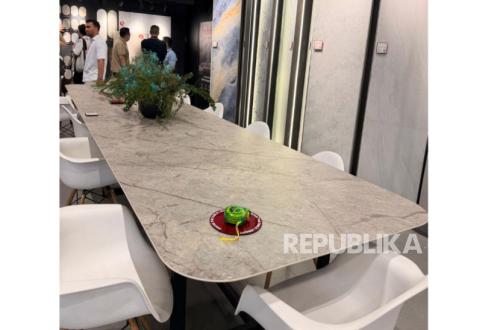
Amid the improving industry prospects, PT Platinum Ceramics Industry also introduced its Titanium Big Slab Glow in The Dark innovation, which earned a Museum Rekor Dunia Indonesia (MURI) award as the first ceramic slab in Indonesia with an afterglow effect. May Tjoe said the product development took about a year. This innovation serves as proof that the national ceramic industry can produce premium products capable of competing with foreign goods. “We want to prove that we can innovate, we are not inferior to foreign products,” he said. He is optimistic that the prospects for the national ceramic industry will continue to improve as long as the government remains consistent in supporting domestic products.