
Central Posyandu Team Strengthens Registration and Transformation of Posyandu in Sorong
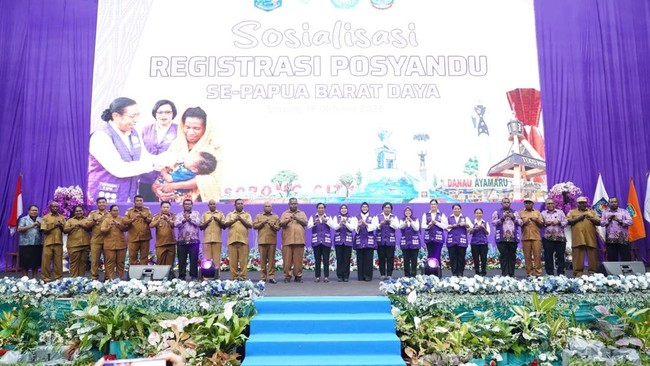
The Central Integrated Service Post (Posyandu) Development Team has strengthened Posyandu institutions through a socialisation session on registration policy and a meeting with Posyandu cadres in Remu Utara, Sorong District, Sorong City, Southwest Papua Province. The initiative aims to establish an orderly and accurate Posyandu database as a basis for guidance and stronger community services through the implementation of six minimum service standard (SPM) sectors.
Representing the chair of the Central Posyandu Team, Tri Tito Karnavian, the team’s acting secretary-general, Safriati Safrizal, said registration was an important step in organising Posyandu data nationally and mapping the institutional conditions and support needs in each area.
“Posyandu registration should not be understood merely as an administrative requirement to obtain a number. It is the gateway to building a national Posyandu database that is orderly, accurate and accountable,” she said in an official statement on Tuesday (13 October 2026).
The transformation of Posyandu expands the organisation’s role from a focus on health services to a forum for community participation in supporting the fulfilment of six SPM sectors. These cover education, health, public works, public housing, public order and security, community protection, and social services.
Safriati stressed that registration numbers were not an end in themselves, but a basis for strengthening Posyandu guidance and development in line with institutional circumstances and community needs.
“Local governments and Posyandu teams need to ensure that registered Posyandu continue to receive guidance and support, and are developed so that services across the six SPM sectors can be strengthened in line with community needs,” she said.
Registration requires coordination at every level, from village and urban-ward governments to districts, cities and regencies, provinces and the central government. Local government departments responsible for the six SPM sectors should also be involved in providing guidance, enabling Posyandu to support basic services according to each sector and community needs.
Alongside the registration policy session, the programme also examined Posyandu’s role in supporting tuberculosis (TB) control through the TB Alert Village/Urban Ward initiative.
Posyandu cadres can help educate the public, recognise signs and symptoms that warrant examination, encourage people to seek care at health facilities, and provide support within the limits of their capacity and authority. Examinations, diagnosis and treatment remain the responsibility of health professionals at health facilities.
Safriati called on local governments, Posyandu teams, village and urban-ward administrations, and cadres to strengthen cooperation in carrying out the Posyandu transformation. Orderly registration and ongoing guidance are expected to enhance Posyandu’s role in supporting basic services in response to community needs.
The event was attended by 110 participants from local government bodies, Posyandu teams, village and urban-ward administrations, and Posyandu boards and cadres, both in person and online. Attendees also included the heads of the Southwest Papua Province, Sorong City and Sorong Regency Posyandu teams, relevant local government department heads, district heads, and village and urban-ward heads.