
Central Kalimantan Sky Turns Yellow as Haze from Forest and Land Fires Reaches ‘Extremely Hazardous’ Levels
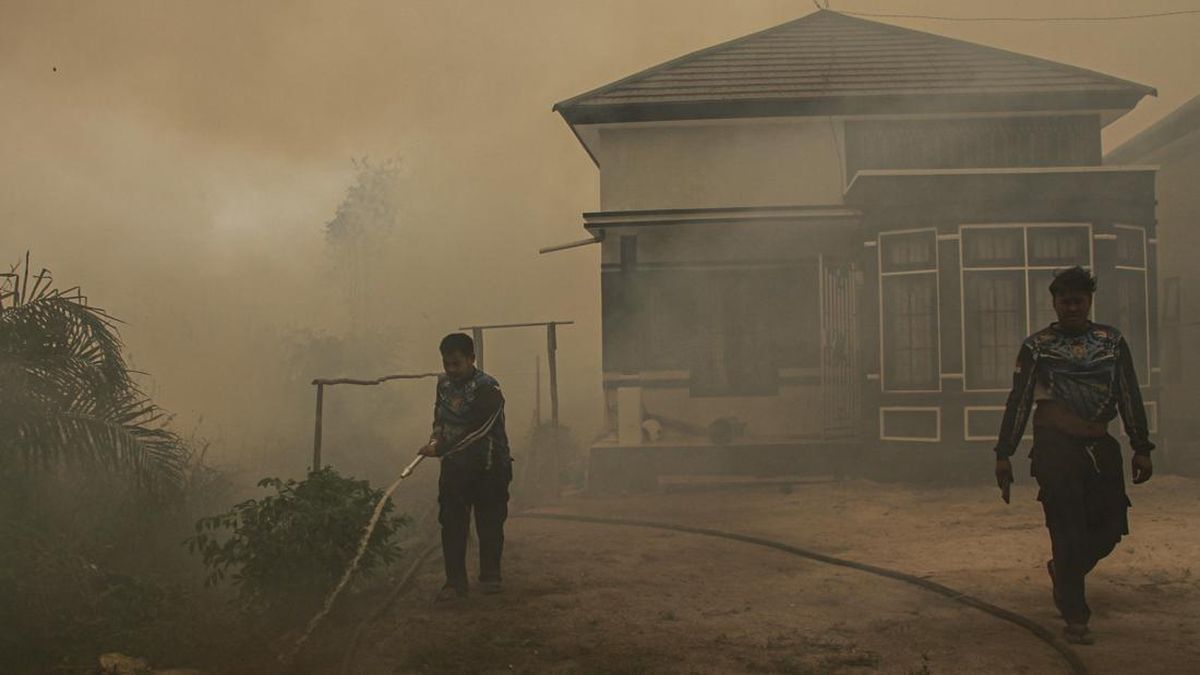
Smoke haze from forest and land fires in Kotawaringin Barat Regency, Central Kalimantan, has grown denser, making the sky appear yellow.
Residents have complained of breathing difficulties and eye irritation as a result.
Monitoring by the Kotawaringin Barat office of the Meteorology, Climatology and Geophysics Agency (BMKG) found that fine particulate matter (PM2.5) concentrations had placed air quality in the area in the extremely hazardous category.
“Correct. BMKG’s PM2.5 monitoring data shows that air quality is in the extremely hazardous category. This is consistent with the increasingly thick smoke from the forest and land fires,” Afif Rowina Khairim, an official at the Kotawaringin Barat BMKG office, said on Tuesday (13 October).
Samsul Hadi, a resident of Kampung Baru, said the haze was worse than in previous days. He said he had experienced shortness of breath and sore eyes after being exposed to the smoke.
“The past few days were already bad, but today is the worst. I’m short of breath and my eyes sting. The smoke is no longer white; it has turned yellow,” Samsul said on Tuesday.
Rohmat, a resident of Pasir Panjang, reported similar problems. He saw yellowish smoke blanketing the road he was travelling on. As well as making the journey uncomfortable, the conditions raised concerns about the impact on health.
PM2.5 consists of very small air-pollution particles that can penetrate deep into the respiratory tract. Exposure can pose health risks, particularly for people with asthma or other respiratory illnesses.
As the effects of the haze worsen, Central Kalimantan Governor Agustiar Sabran said the forest and land fires in his province did not yet need to be declared a national disaster.
He stressed that specific criteria had to be met for such a designation.
“There are criteria for declaring a national disaster; it is not based on just any figure,” Agustiar said.
Agustiar said nearly 6,000 fire incidents had been recorded in Central Kalimantan, with the area burned estimated at more than 18,000 hectares.
He said the effects of the fires were beginning to be felt by the public, disrupting work and economic activity and causing health problems, including acute respiratory infections (ARI).
He explained that a national-disaster designation was not solely within the provincial government’s authority. The decision rests with the central government, which considers the circumstances and applicable criteria.
“However, the declaration of a national disaster is not a decision that the regional government can make on its own. That authority rests with the central government, taking into account the circumstances and applicable criteria,” he added.
Agustiar also said that tackling forest and land fires was a priority for the central government in several provinces. However, fire levels in different regions needed to be assessed comprehensively before disaster status and response measures were determined.
The Central Kalimantan Provincial Government continues to work to protect residents from the effects of the haze. One measure has been to open oxygen houses to support people who need help breathing.
“Despite these conditions, the Central Kalimantan Provincial Government continues to take steps to protect the public from the effects of the haze. One of them is opening oxygen houses as support facilities for residents who need breathing assistance,” he said.
Prabowo chairs limited meeting on forest and land fires
Indonesian President Prabowo Subianto chaired a limited meeting on the response to forest and land fires in a hybrid format from Merdeka Palace in Jakarta on Monday evening (12 October).
The meeting, convened specifically to discuss the fires, was attended by Coordinating Minister for Political and Security Affairs Dudung Abdurachman, Defence Minister Sjafrie Sjamsoeddin, Coordinating Minister for Human Development and Culture Sugiono, Indonesian Military (TNI) Commander General Agus Subiyanto, National Police Chief General Suyudi Ario Seto, State Secretary Prasetyo Hadi and Cabinet Secretary Teddy Indra Wijaya.
According to a post on the Cabinet Secretariat’s official social media account, the meeting received updates on the situation and response measures. A report from the head of the National Disaster Mitigation Agency (BNPB) said that around 639 hectares of land were still being fought over in six provinces hardest hit by the fires.
The main focus is currently on two provinces: Central Kalimantan and South Sumatra.
Ground operations are supported by more than 60,177 joint personnel, with an average success rate of over 80 per cent in extinguishing fires across areas newly burned each day. Aerial water-bombing operations are also continuing in several areas to accelerate firefighting.
Conditions in Riau, West Kalimantan, Jambi and South Kalimantan have improved. Weather Modification Operations are being stepped up to make use of cloud formation and rainfall, as the rainy season is expected to begin across much of the country from mid- to late October 2026.
“The President asked that efforts to tackle forest and land fires be strengthened and all resources deployed optimally to accelerate extinguishing the fires and prevent them from spreading,” the Cabinet Secretariat’s official account said.
Source: jawawa.id (https://jawawa.id/newsitem/central-kalimantan-sky-turns-yellow-as-haze-from-forest-and-land-fires-reaches-extremely-hazardous-levels-1791863477)
Originally published by CNN Indonesia (https://www.cnnindonesia.com/nasional/20261013092506-20-1414653/langit-kalteng-menguning-akibat-asap-karhutla-kategori-sangat-bahaya), translated from Indonesian