
Central Java to Add New Industrial Estates, Permits Expected Soon
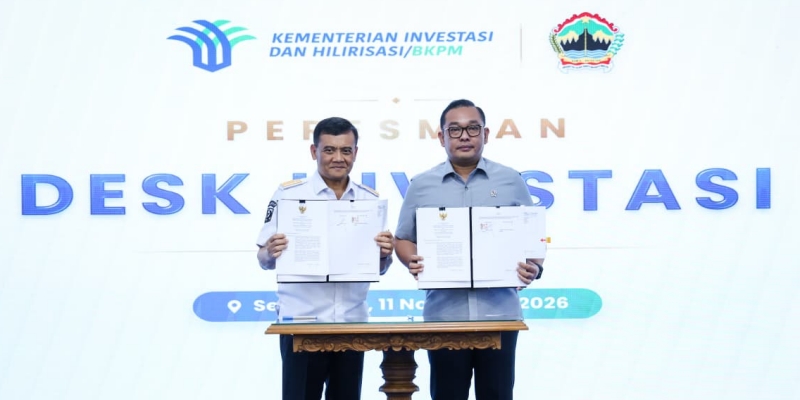
The central government has promised to complete permits for 12 proposed industrial estates in Central Java within 30 days at the latest. The acceleration is expected to open the door to new investment and broaden centres of economic growth across the province.
Deputy Minister of Investment and Downstreaming and Deputy Head of the Investment Coordinating Board (BKPM), Todotua Pasaribu, said permitting for industrial estates in the 12 regencies and municipalities was under way. They are Rembang, Demak, Semarang City, Kendal, Batang, Brebes, Cilacap, Banyumas, Kebumen, Semarang Regency, Boyolali and Grobogan.
“Thirty days at the latest. The Governor has presented the potential for industrial estates in those 12 regencies and municipalities. The process is under way, and it will be completed within 30 days at the latest,” Todotua said on the sidelines of the signing of a memorandum of understanding between the Ministry of Investment and Downstreaming/BKPM and the Central Java provincial government at Gradhika Bhakti Praja Building in Semarang on Wednesday, 11 November 2026.
The commitment responds to Central Java Governor Ahmad Luthfi’s request for the central government to accelerate investment permits, which have faced various obstacles.
Todotua said his office would soon summon businesses involved in developing the estates to clarify details and expedite the completion of permit administration.
He said industrial estate development was one strategy for attracting investment, as it provides certainty over land and makes it easier to coordinate permitting services for domestic and foreign investors.
He acknowledged that permits remained a longstanding obstacle to investment, particularly for large-scale, high-risk projects requiring coordination across ministries. To address the issue, the government has established an Investment Desk to connect the central and regional governments with businesses.
“We are also working to clear bottlenecks affecting investment plans in the regions,” he said.
Central Java is the fourth area to establish an Investment Desk, after Batam, Bali and North Sumatra. Based at the Central Java Investment and One-Stop Integrated Services Agency (DPMPTSP), the service also covers the Special Region of Yogyakarta and East Java.
The Investment Desk is focused on handling projects valued at more than Rp1 trillion.
Governor Ahmad Luthfi said faster permitting was essential to driving economic growth and expanding employment. The Central Java provincial government has asked the 12 regencies and municipalities to prepare potential sites for new industrial estates of at least 50 hectares, in accordance with spatial-planning rules. The estates are expected to host new investments and extend economic growth to more areas.
Alongside preparing land, the provincial government is developing supporting industrial infrastructure, including a dry port in Batang, port facilities in Kendal and the revitalisation of Tanjung Emas Port in Semarang.
The logistics infrastructure is expected to facilitate the movement of goods and reduce industrial operating costs.
Luthfi said the provincial government was also overseeing several major investment plans. These include a Rp4.6 trillion garment industry investment, scheduled to break ground in December 2026; a Rp2.9 trillion expansion by a Vietnamese company; and the relocation of a Chinese industry project worth Rp2.17 trillion.
According to Central Java DPMPTSP data, investment realisation from January to September 2026 reached Rp72.54 trillion, or 73.21 per cent of the annual target of Rp99.09 trillion. The investment came from 82,420 projects and created 340,334 jobs.
In the third quarter of 2026 alone, investment realisation stood at Rp24 trillion, up 16.78 per cent from the same period a year earlier. The investment involved 26,431 projects and employed 127,117 people.
Central Java’s economy grew by 5.83 per cent year on year over the same period. Luthfi welcomed the establishment of the Investment Desk as a means of strengthening business certainty and speeding up the resolution of problems faced by investors.
“The Desk will serve as the central government’s representative in addressing investment-related problems,” he said.
He said he hoped cooperation between central and regional governments would accelerate industrial estate development and foster new centres of economic growth across Central Java.