
Central Java Provincial Government Targets at Least 970,000 Hectares of Protected Rice Fields
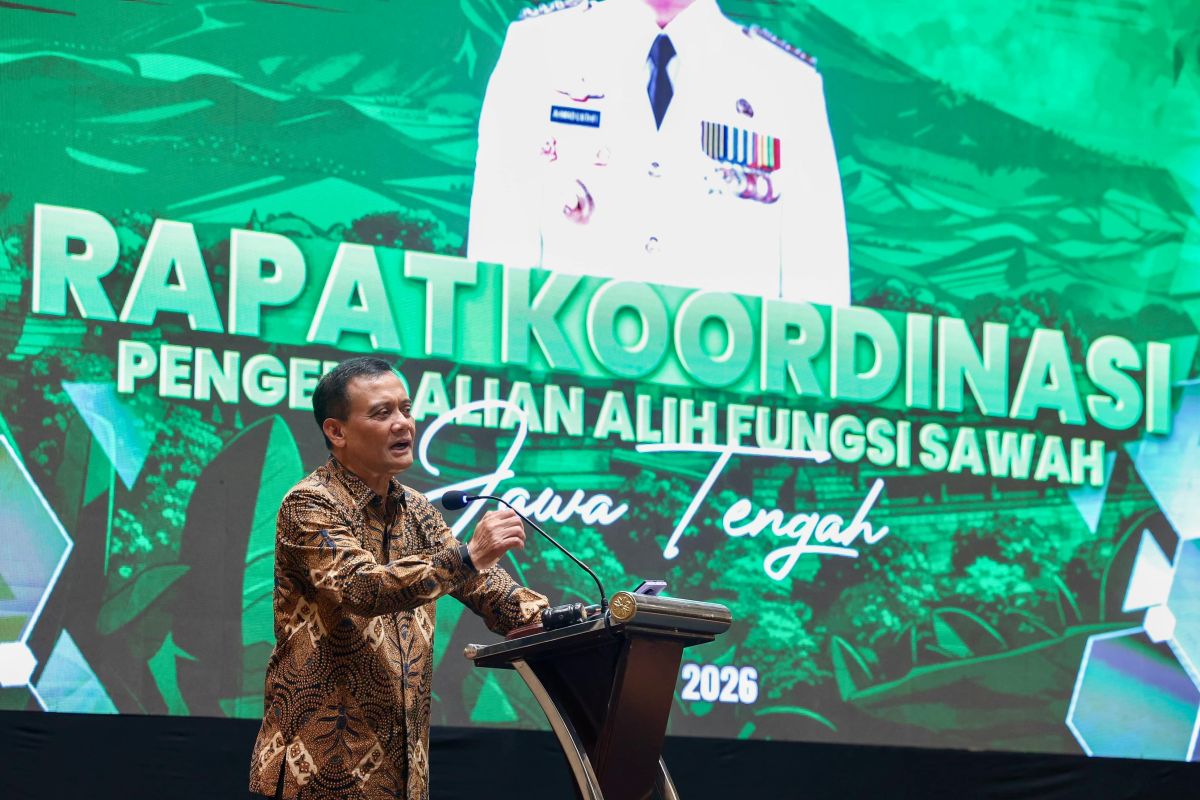
The Central Java Provincial Government is targeting a minimum of 970,000 hectares of protected rice fields (LSD), whereas the current figure stands at 825,000 hectares.
“Today, we have invited representatives from the Ministry of ATR/BPN to determine the standard land area, where Central Java has already submitted 85.11 per cent of the proposed LSD,” stated Central Java Governor Ahmad Luthpland Luthfi in Semarang on Thursday. He made these remarks during a Coordination Meeting on Controlling the Conversion of Rice Fields in Central Java.
“God willing, in the near future, the minimum requirement of 87 per cent can be met,” said the former Central Java Police Chief. To this end, he has convened all regents and mayors to accelerate the determination of the LSD.
According to the Governor, determining the standard rice field area is crucial for revitalising farmland to ensure it remains agricultural land and to facilitate the mapping of investment locations. “Everything must proceed in unison between the Ministry, the Province, and the regencies/cities,” he added.
Currently in Central Java, 24 regencies/cities have met the minimum threshold of 87 per cent of the standard rice field area (LBS). The top five regencies with the highest LBS are Magelang Regency with 24,818 ha (97.18 per cent), Purworejo with 27,872.82 ha (96.54 per cent), Wonogiri with 36,025.37 ha (96.23 per cent), Batang with 15,009.34 ha (93.75 per cent), and Demak with 52,671.39 ha (93.22 per cent).
Conversely, 11 regencies/cities have yet to meet or remain below the 87 per cent mark, including Kudus, Temanggung, Pekalongan City, Rembang, and Sragen, as well as Pekalongan Regency, Salatiga, Magelang City, Karanganyar, Semarang City, and Surakarta City. “The areas that have not yet met the target are mostly urban areas, such as Solo and Semarang. Today, we are organising this to ensure that green spaces are not converted,” he said.
Meanwhile, the Deputy Minister of ATR/BPN, Ossy Darmawan, appreciated the gathering of regional heads to accelerate the determination of standard rice field areas. “Central Java can position itself as a national role model. Hopefully, it can serve as a national example in resolving the issue of rice field conversion,” he said.
The Sustainable Food Agriculture Area (KP2B) in Central Java, which is already included in the Regional Spatial Plan (RTRW), covers 825,000 ha, while the LSD target is approximately 970,000 ha, representing 85.11 per cent completion. “Central Java is part of a progressive group. There is only a little more to be achieved to reach the national target,” he concluded.