
Central Java Provincial Government Partners with Semarang-Kendal for Waste-to-Electricity Collaboration
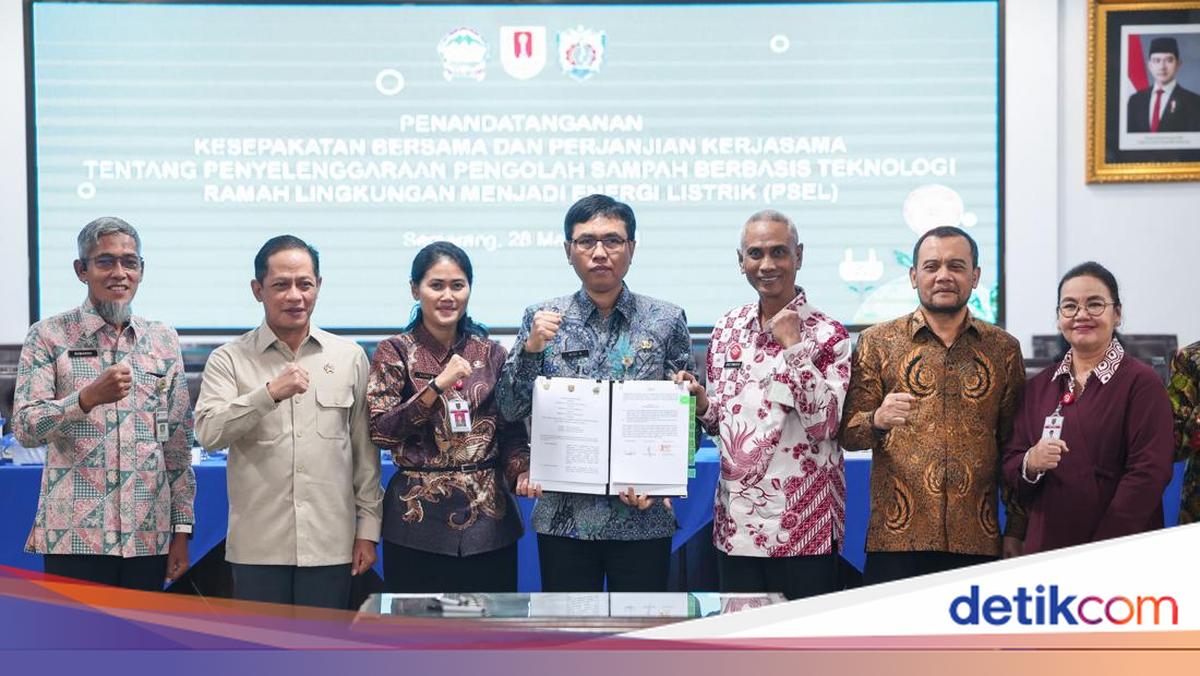
Environment Minister/Head of the Environment Control Agency (BPLH) Hanif Faisol Nurofiq has commended Central Java Governor Ahmad Luthfi for his seriousness in addressing waste issues in the province. According to him, these efforts align with the central government’s steps to reduce open dumping practices in the regions.
“Under the leadership of the Governor, we hope that by 2026 there will be a surge in the waste management rate,” he stated in a written remark on Saturday (28/3/2026).
Furthermore, Hanif explained that such measures are crucial to tackling waste problems in urban areas with high generation rates. He views the development of waste processing into electrical energy as a fundamental step to ending national waste management issues.
For regions like Greater Semarang, Hanif noted that a high-technology-based approach is an effective choice. This is because large waste volumes can no longer be adequately handled through conventional methods.
He added that building waste-to-energy facilities in Central Java would take at least three years. Therefore, during this transitional period, local governments must continue various efforts to reduce and process waste so as not to overburden final disposal sites.
On this occasion, Hanif also mentioned the Central Java Provincial Government’s steps to develop refuse-derived fuel (RDF) in several areas. He stated that this effort represents governance that does not solely wait for large projects to run but also prepares gradual solutions that can be operated immediately.
“The Governor has also developed the construction of refuse-derived fuel, which is waste turned into fuel, in three districts and it will be expanded to six more districts,” Hanif explained.
He also appreciated Governor Ahmad Luthfi’s leadership and the support from regional heads in the districts and cities. Hanif is optimistic about a significant surge in waste management in Central Java by 2026.
Meanwhile, Luthfi emphasised that accelerating waste handling in Central Java is a follow-up to the President’s policy targeting the resolution of waste issues by 2029.
“Central Java Province has formed a Waste Task Force to detail the President’s orders in line with the National Medium-Term Development Plan (RPJMN), that by 2029 there must be zero waste,” said Luthfi.
He explained that the waste handling strategy in Central Java is formulated based on the scale of waste generation in each region. Areas with waste volumes exceeding 1,000 tonnes per day are encouraged to use a regional approach, while areas with smaller generation are directed towards RDF-based processing.
“Three districts have already formed RDF, then collaborated with cement factories, namely Banyumas, Cilacap, and Magelang. Then six more districts are also heading towards RDF,” he clarified.
Luthfi added that waste generation in Central Java reaches nearly 6.4 million tonnes per year. However, of that amount, only about 30% is managed, while the rest is not yet handled optimally.
He stressed that the agreement between the Central Java Provincial Government, Semarang City Government, and Kendal Regency Government for building waste processing into electrical energy is one of the important steps in the waste handling roadmap in Central Java.
For information, the signing was also attended by Environment Minister/Head of the Environment Control Agency (BPLH) Hanif Faisol Nurofiq, Central Java Governor Ahmad Luthfi, Semarang Mayor Agustina Wilujeng Pramestuti, and Kendal Regent Dyah Kartika Permanasari.