
Central Java Provincial Government Partners with 123 Universities to Accelerate Poverty Reduction
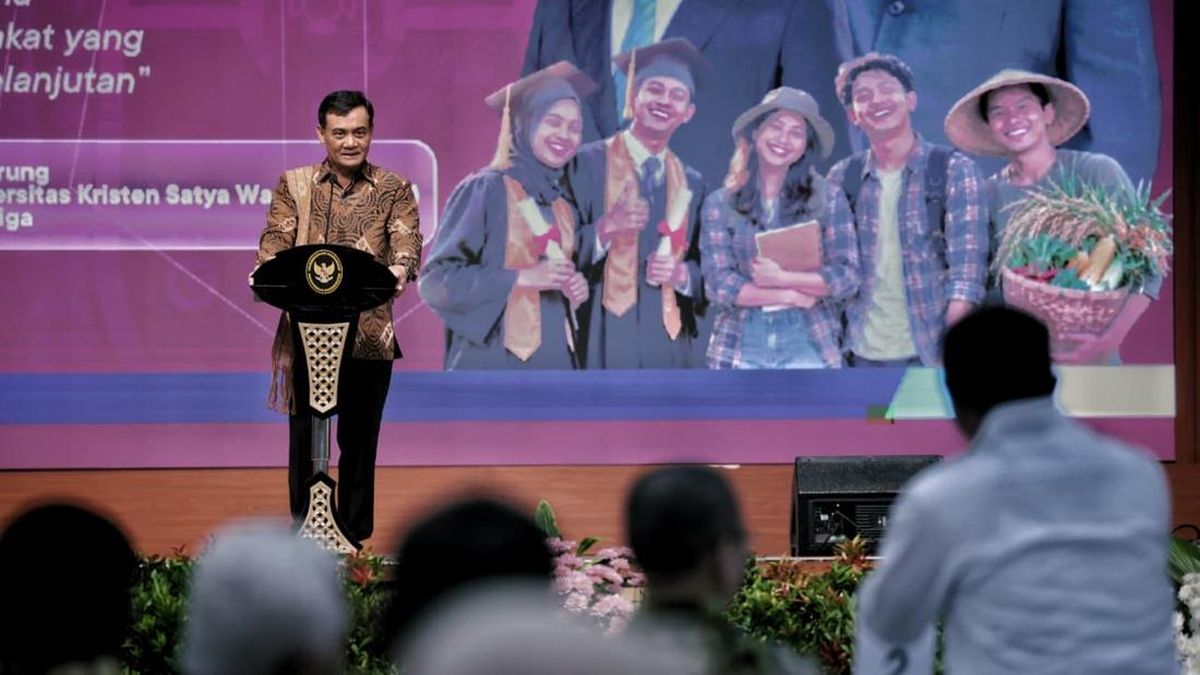
The Central Java Provincial Government has partnered with 123 universities to accelerate poverty reduction through research, data collection and community support at village level.
Central Java Governor Ahmad Luthfi said involving universities was one of the regional government’s strategies to ensure poverty-reduction programmes were better targeted and addressed people’s needs.
Luthfi made the remarks at the National Coordination Meeting of the Forum of Universities for Community Empowerment, held at the Balairung of Satya Wacana Christian University (UKSW) in Salatiga on Thursday (15 October).
According to Statistics Indonesia (BPS), Central Java’s poverty rate stood at 9.21% in March 2026, down from 9.48% in March 2025.
The decline was accompanied by a fall of 81,250 in the number of people living in poverty, from 3.37 million in March 2025 to 3.29 million in March 2026.
To speed up poverty reduction, the provincial government has joined forces with 123 universities: 49 that took part in 2025 and a further 74 in 2026.
The collaboration covers a range of programmes, including thematic community service placements (KKN), business mentoring, data collection on uninhabitable homes, stunting prevention and the development of water-desalination technology.
Luthfi said universities’ involvement was necessary to ensure poverty-reduction efforts were not limited to social assistance or home improvements. Poverty, he said, was also linked to access to healthcare and education, as well as strengthening household economies.
Meanwhile, Coordinating Minister for Community Empowerment Abdul Muhaimin Iskandar said the government was encouraging a shift in poverty-reduction policy away from an emphasis on social assistance and towards empowering communities to achieve economic independence.
“The more successful empowerment is, the fewer social-assistance recipients there will be. That means state funds can be used elsewhere,” Muhaimin said after the event.
He said the empowerment strategy focused on strengthening education, widening access to capital and land, and developing an economic ecosystem that supports communities’ independence.
Nationwide, the government has designated more than 16,500 villages across 88 regencies as priority areas for poverty reduction.
During the coordination meeting, several universities also pledged to support scholarship programmes for village community-empowerment cadres in 2027. The institutions involved include UKSW, Udinus, Unissula and Nusa Cendana University.
According to the meeting’s report, university rectors plan to provide around 2,000 scholarships for community-empowerment cadres or village residents’ children to pursue higher education.
Deputy Minister of Higher Education, Science and Technology Fauzan said the partnership was expected to make the best use of universities’ resources to help address community problems in a measurable, data-based way.
“Universities should not simply remain in ivory towers; they should be involved in resolving regional problems through community empowerment,” he said.