
Central Java Police Name Shrimp Farm Entrepreneur Suspect in Agricultural Land Conversion Case
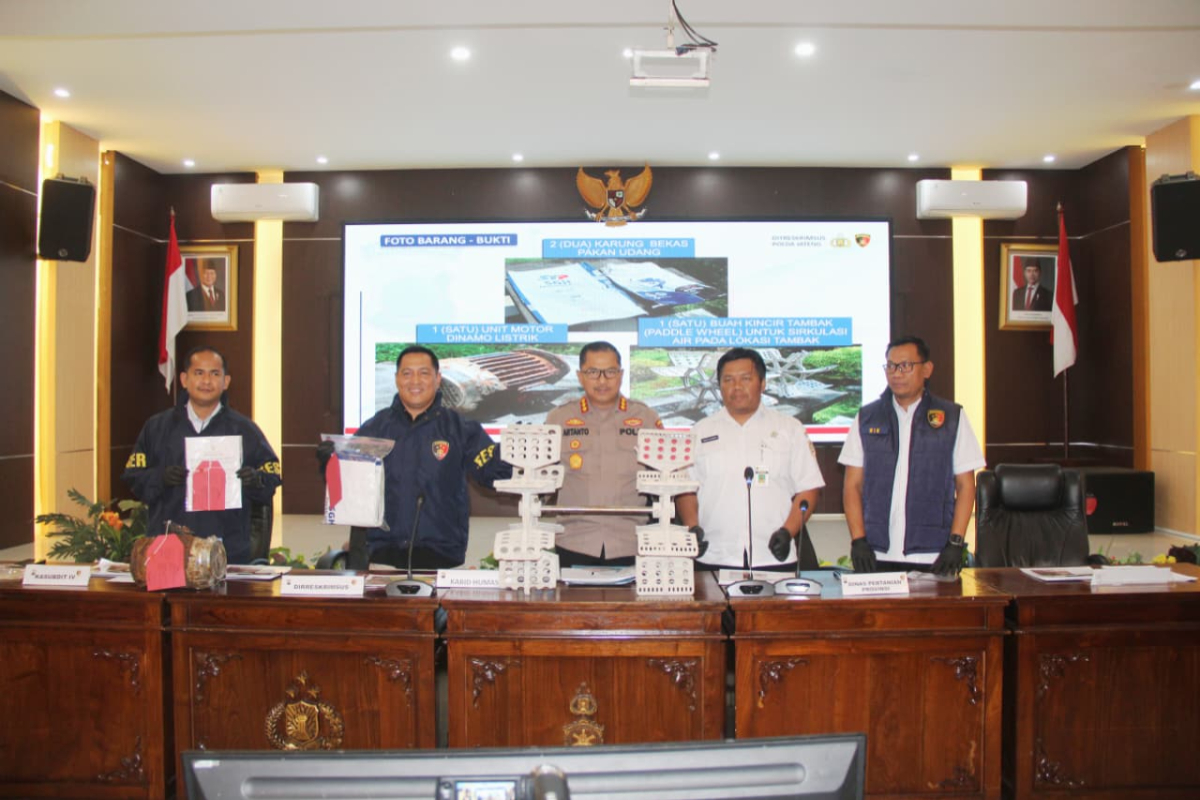
The Special Criminal Investigation Directorate (Ditreskrimsus) of the Central Java Regional Police has named a shrimp farm entrepreneur, identified by the initials AMP, as a suspect in a case involving the alleged conversion of sustainable food agricultural land (LP2B) and spatial planning violations in Batang Regency.
The designation of the suspect was announced during a press conference held at the Central Java Regional Police Headquarters in Semarang on Wednesday (10/6/2026). Present at the event were the Director of Special Criminal Investigation, Kombes Pol Djoko Julianto, the Head of Public Relations, Kombes Pol Artanto, and the Infrastructure Section Head of the Central Java Provincial Agriculture Office, Prasetyo Nugroho.
Kombes Pol Djoko Julianto explained that the case originated from community reports regarding shrimp farming activities in an agricultural area in Dukuh Roblar Timur, Sengon Village, Subah District, Batang Regency. During field inspections, officers discovered vannamei shrimp farming activities within productive agricultural land. The farm covers approximately 7 hectares and includes supporting facilities such as warehouses, offices, and water aerator installations.
Investigations revealed that the land used for the farm was previously productive paddy fields classified as Sustainable Food Agricultural Areas (KP2B). Based on the examination of the suspect, the land was purchased and subsequently converted into a shrimp farming area. While the suspect holds a business permit, the location of the farm allegedly drifted from the designated coordinates, encroaching upon protected paddy fields.
The affected area includes 6.88 hectares of LP2B and 0.34 hectares of Sustainable Food Agricultural Reserve Land (LCP2B). Investigators presented satellite imagery documentation showing significant land-use changes; in 2020, the location was a vast expanse of productive paddy fields, whereas by 2025, it had been transformed into shrimp farm ponds.
The shrimp farming operation has reportedly been running for approximately five years, generating an annual turnover of billions of rupiah, with the harvest distributed to meet local market demand. The Central Java Police noted that the land conversion has caused substantial environmental impact. Based on calculations conducted with relevant agencies, the cost required to restore the soil condition to be functional for agriculture is estimated to reach Rp32 billion.
Prasetyo Nugroho, Head of the Infrastructure Section of the Central Java Provincial Agriculture Office, stated that illegal agricultural land conversion reduces the area of productive paddy fields and threatens regional food security. He noted that the reduction in farmland affects food productivity and could disrupt efforts to achieve food self-sufficiency, while also causing ecosystem damage and loss of biodiversity.
For investigation purposes, police have seized several pieces of evidence, including two sacks of used shrimp feed, one pond aerator unit, one electric motor unit, and business permit documents under the suspect’s name. The suspect faces charges under Article 72 paragraph (1) in conjunction with Article 44 paragraph (1) of Law Number 41 of 2009 concerning the Protection of Sustainable Food Agricultural Land, as well as spatial planning violations. The suspect faces a maximum prison sentence of five years and a fine of up to Rp1 billion.