
Central Java Man Faces Five Years in Prison for Converting Rice Fields into Shrimp Ponds
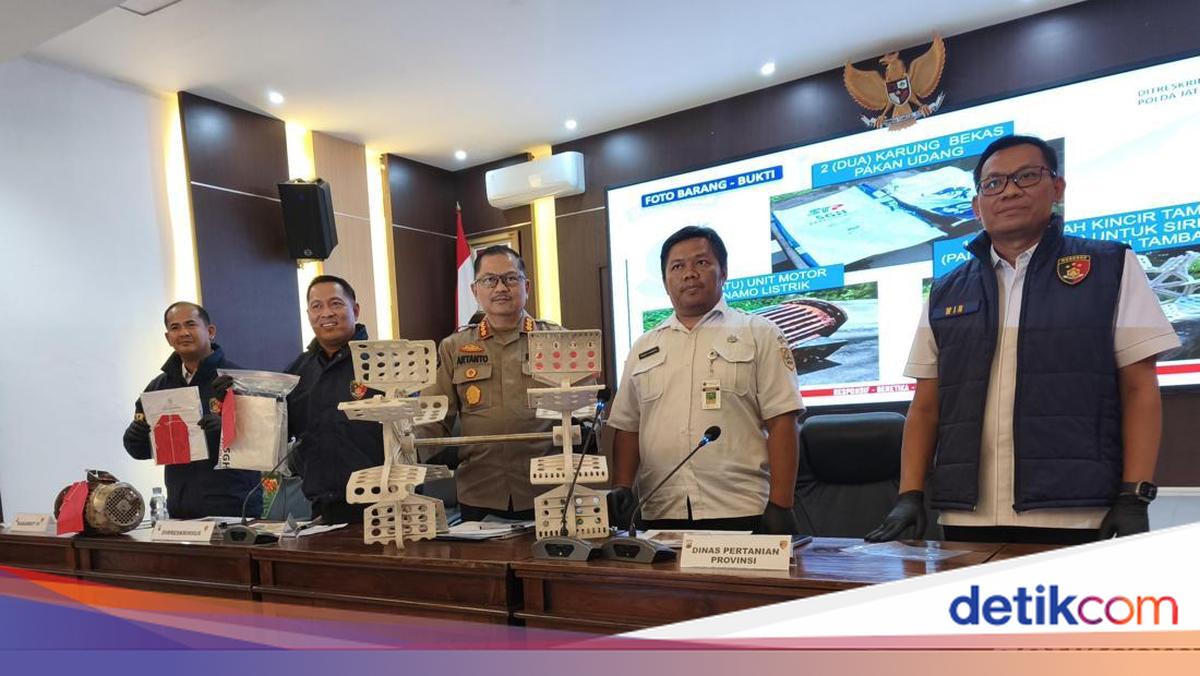
A man identified by the initials AMP (28), a resident of Sembojo Village, Tulis District, Batang Regency, Central Java, has been named a suspect after converting rice fields into vannamei shrimp ponds. As a result of his actions, the suspect faces a maximum prison sentence of five years and a fine of up to Rp 1 billion. “The threat is a maximum of five years in prison with a maximum fine of Rp 1 billion,” said the Director of Special Criminal Investigation at the Central Java Regional Police, Commissioner Djoko Julianto, at the Ditreskrimsus headquarters in Banyumanik, Semarang City, on Wednesday (10/6/2026).
Commissioner Djoko explained that the land used by the suspect is located within a Protected Rice Field Area, making it impermissible for shrimp farming operations. Police named him a suspect because the location cannot be used for shrimp ponds and the activity caused losses to the state. “The location indeed cannot be used for shrimp farming. Secondly, he had a partial permit but it was outside the designated coordinates. So, the permit coordinates covered only a small portion, while the majority of his operations were conducted without a permit,” Djoko clarified. “Furthermore, this activity did not contribute taxes to the state, particularly to the regency and city governments where the ponds are located,” he added.
The case came to light after police received a report from the community. An investigation was subsequently conducted together with several relevant agencies, including the Agriculture Service and the Central Java Provincial Government. “The business location used by the perpetrator is a place where shrimp cultivation should not be carried out. That is how we obtained the information, so together with the Agriculture Service and the Provincial Public Works Office, we inspected the location and checked the coordinates of the perpetrator’s business site,” Djoko detailed. “It was there that we discovered and were able to prove that the perpetrator was operating outside the permitted coordinates. After that, we checked the licensing documents, and indeed, not all of them were complete,” he continued.
The 7.21-hectare plot of land used by the suspect as shrimp ponds should have remained rice fields, according to Djoko. This was corroborated by the Annual Tax Notification Letter which states that the tax object falls under the rice field object code. “However, the suspect continued to use the land as a pond site in line with his business objective of becoming a vannamei shrimp farmer or brackish water crustacean grower, rather than engaging in the agricultural or crop cultivation sector,” Djoko stated.
Under Batang Regency Regional Regulation Number 13 of 2019, the overlay of the 7.21-hectare business area registered under the suspect’s name is located within a Food Crop Area or LP2B. More specifically, the vannamei shrimp pond site lies within the spatial pattern of a Sustainable Food Crop Area, consisting of 6.88 hectares of LP2B and 0.34 hectares of Sustainable Food Agricultural Reserve Land. The suspect’s act of converting rice fields into shrimp ponds has resulted in a reduction of the existing physical area of LP2B in the region. In aggregate, his actions affect the total LP2B area in Batang Regency as stipulated in the Regional Regulation concerning the Batang Regency Spatial Plan for 2019-2039.
“The conversion of agricultural land can threaten food self-sufficiency due to the reduced area of land available for agricultural production. If agricultural land decreases too rapidly, this could affect the availability of local food supplies and increase dependence on imports,” Djoko explained. He added that land conversion can also impact sustainable development. If not managed properly, such actions can damage the environment. “The aspiration to achieve sustainable development is also affected by land conversion. Poorly managed conversion can lead to environmental damage, loss of biodiversity, and a reduction in the natural carrying capacity essential for human life,” Djoko said.
Material losses resulting from the suspect’s actions reached billions of rupiah. Djoko stated that at least Rp 32 billion is required to restore the land’s function. “Approximately Rp 32 billion is needed to restore the function of the land,” Djoko confirmed. From this case, police secured evidence including two used shrimp feed sacks, one pond paddle wheel for water circulation at the pond site, one electric motor dynamo unit, and one bundle of printed Risk-Based Business Licensing documents under the suspect’s name.
The perpetrator was formally named a suspect in May 2026. For his actions, the suspect is charged under Article 72 Paragraph (1) in conjunction with Article 44 Paragraph (1) of Law Number 41 of 2009 on the Protection of Sustainable Food Agricultural Land, as amended in Chapter VIII Part Three Article 72 Paragraph (1) in conjunction with Article 44 Paragraph (1) of Law Number 6 of 2023 on the Stipulation of Government Regulation in Lieu of Law Number 2 of 2022 on Job Creation into Law, in conjunction with Law Number 1 of 2026 on Adjustments, carrying a maximum prison sentence of five years and a maximum fine of Rp 1 billion. He is also charged under Article 70 Paragraph (1) in conjunction with Article 61 Letter B of Law Number 26 of 2007 on Spatial Planning, as amended in Chapter III Part 3 Paragraph 2 Article 70 Paragraph (1) in conjunction with Article 61 Letter B of Law Number 6 of 2023, in conjunction with Law Number 1 of 2026 on Criminal Adjustments, with a maximum prison sentence of three years and a maximum fine of Rp 1 billion.