
Central Java Leads Economic Census Progress, Surpassing National Average
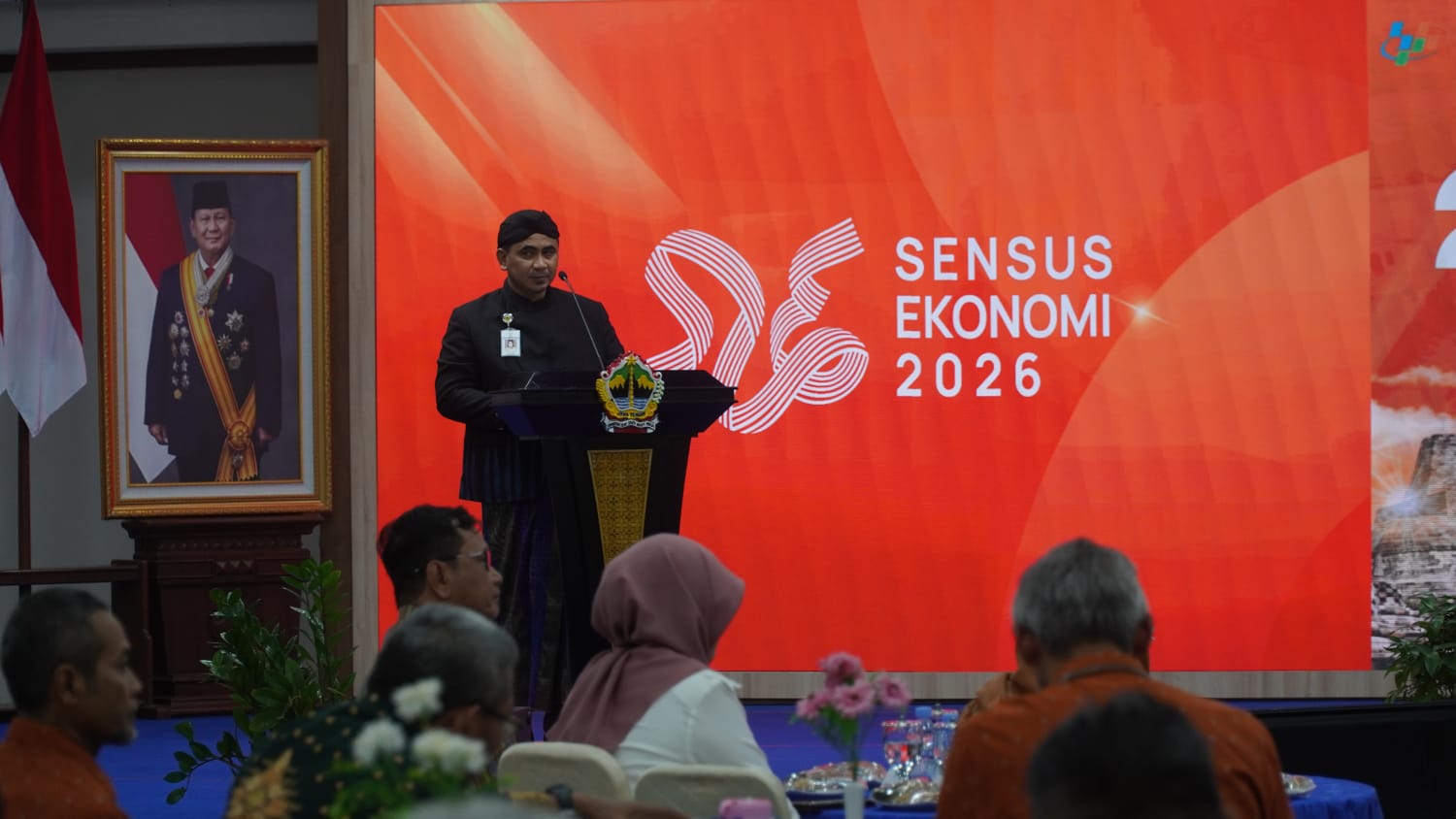
The Mayor of Tegal, Dedy Yon Supriyono, attended the Regional Coordination Meeting for the 2026 Economic Census (SE) implementation in Central Java Province. The event, organised by the Central Java Provincial Central Bureau of Statistics (BPS), was held at the Gradhika Bhakti Praja Building in Semarang on Thursday.
The meeting was attended by regional heads from across Central Java and officials from BPS RI and BPS Central Java Province, as part of efforts to strengthen synergy for the successful execution of the Economic Census.
Central Java Deputy Governor, Taj Yasin Maimoen, commended BPS Central Java for initiating the coordination meeting to accelerate the completion of the 2026 Economic Census data collection. He noted that as of 5 August 2026, data collection in Central Java had reached 80.10%, a performance deemed excellent and above the national average.
“This achievement is remarkable. Thank you to all census officers who have worked in the field and to local governments for their continuous support. We hope the data collection target can be completed according to the schedule set by BPS,” said Taj Yasin in an official statement.
He stressed that the Economic Census is not merely a data collection activity but a vital instrument for understanding the real condition of the economy and determining the direction of future economic development policies. “The success of the Economic Census is a shared responsibility, including all regional heads,” he added.
Meanwhile, Deputy Chief of BPS RI, Sonny Harry B. Harmadi, stated that the Economic Census is conducted every ten years and serves as a strategic data source for both central and regional governments in formulating development policies.
Sonny explained that post-pandemic economic changes have made business activities more dynamic. Today, economic activities are no longer confined to trade or industrial zones but are also growing from people’s homes through various digital-based and home-based business models.
“Since 2020, the economic structure has undergone very rapid changes. Today, businesses can grow from home, so the government needs accurate data to ensure policies are truly aligned with conditions on the ground,” he said.
He likened the Economic Census to a general check-up for the Indonesian economy. The census results will serve as a “compass” in determining the direction of economic development, formulating business empowerment programmes, and drafting regional investment policies.
Sonny also presented data showing that based on the 2025 Gross Regional Domestic Product (PDRB), Central Java ranks as the fourth-largest provincial economy in Indonesia, after DKI Jakarta, East Java, and West Java.
Furthermore, based on the preliminary results of the 2026 Economic Census Prelist, Central Java has approximately 4.53 million business units, making it the province with the second-highest number of businesses nationally, after West Java. For the Large Business category, Central Java ranks third nationally, while its number of Micro and Small Enterprises (UMK) also places it second nationally.
“These achievements show that Central Java has a strong economic foundation. Therefore, the data from the Economic Census must be optimally utilised by regional governments as a basis for formulating more targeted economic development policies,” Sonny emphasised.
Through its participation in the coordination meeting, the Tegal City Government affirmed its commitment to fully support the implementation of the 2026 Economic Census to produce high-quality, accurate data that can serve as a foundation for sustainable economic development planning in the region.