
Central Java Government Supports National Food Security: Achievements at 81st Anniversary
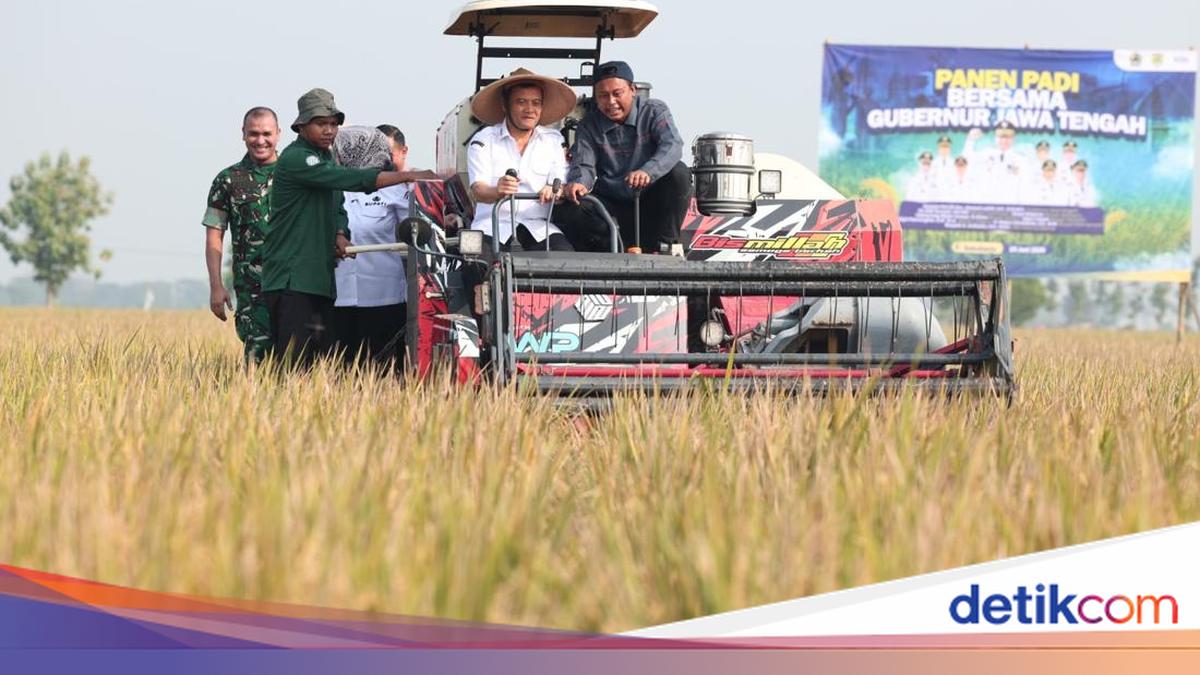
For Joko Mursito, chairman of the Gentan Village Gapoktan (farmers’ group association), the recent harvest was not only about the ripening rice grains. The moment also provided an opportunity for farmers to convey their needs directly to the government, ranging from water availability for the third planting season, electricity networks for agricultural wells, additional harvesting machines, to improvements to farm access roads.
“Alhamdulillah, the farmers of Gentan Village are pleased because our aspirations were directly received by the Governor. We feel cared for and comfortable,” Joko Mursito was quoted as saying in a Central Java Provincial Government press release on Sunday (16/8/2026).
Ahead of the 81st anniversary of Central Java Province, the agricultural sector has become a focus for the administration under the leadership of Governor Ahmad Luthfi and Deputy Governor Taj Yasin Maimoen. The ambition is not solely to meet the province’s own needs, but also to serve as a pillar of national food security.
In 2025, Central Java’s rice production reached 9.39 million tonnes of milled dry grain (GKG), an increase of approximately 493,684 tonnes compared to the previous year. This production came from a harvested area of around 1.67 million hectares. The achievement means Central Java contributes about 15 percent to national food production.
In other words, the rice harvested by Central Java farmers does not only meet regional needs. Part of it moves across regional boundaries, becoming rice that appears on dining tables in various parts of Indonesia.
This contribution is being maintained in 2026. The Central Java Provincial Government has set a rice production target of 10,559,679 tonnes of GKG. Up to the January-July 2026 period, production is projected to reach 6.74 million tonnes of GKG, or about 63.43 percent of the annual target.
Central Java Governor Ahmad Luthfi assessed that this achievement cannot be separated from the hard work of farmers and the collaboration of local governments in maintaining land, irrigation, production facilities, and the use of agricultural technology.
“Farmers are not merely planters, but guardians of the nation’s future,” said Ahmad Luthfi.
Luthfi emphasised that increasing food production requires the involvement of all regencies and cities, especially in protecting agricultural land, strengthening mechanisation, and assisting farmer groups.
“We take care of our Gapoktan, from seeding, fertilisation, to post-harvest,” he said.
Efforts to pursue the target are carried out from upstream to downstream. In 2026, the Central Java Provincial Government has prepared seed assistance and rice production facilities for 47,200 hectares of land. Similar support is provided for the development of maize on 3,200 hectares, soybeans on 3,000 hectares, chillies on 310 hectares, and shallots through true shallot seed on 25 hectares.
The Central Java Provincial Government continues to tighten control over the conversion of paddy fields in its territory.
Luthfi said that to date, 26 regencies/cities in the province have met the target for protecting Sustainable Food Agricultural Land (LP2B) of 87 percent. According to him, meeting this target is considered important to maintain Central Java as one of the national food barns.
The benefits of agricultural facility support are felt, among others, by farmers in Mojorembun Village, Kaliori District, Rembang Regency. The Budi Luhur Farmers Group, consisting of 80 farmers, manages around 35 hectares of land.
Previously, land in the area could only be planted with rice once a year. After receiving pump irrigation support and agricultural machinery, farmers can now plant up to three times a year, with production of around 7-7.5 tonnes per hectare.
Karyono, a member of the Budi Luhur Farmers Group, said the irrigation assistance gave farmers the confidence to cultivate their land again despite facing the threat of prolonged drought.
“Since receiving the pump irrigation assistance, farmers here have been able to enjoy three harvests,” Karyono said.
In addition to seed and irrigation assistance, agricultural modernisation continues to expand. One example is through an integrated mechanisation pattern known as the ‘sepur system’. Harvesting machines, soil tillers, decomposer sprayers, and planting machines work sequentially, so that land can be immediately replanted after harvest.
For a two-hectare plot, work that manually requires up to 10 days can be completed in one day. This acceleration opens opportunities to increase the planting index while saving farmers’ time and energy.
Production strengthening is also supported through the rehabilitation of 334 packages of tertiary irrigation networks and the construction of 75 packages of piped irrigation. Distribution of agricultural equipment includes 100 rice planting machines, 86 crawler tractors, 30 four-wheel tractors, 100 water pumps, 10 combine harvesters, as well as dozens of cultivators and hand tractors.
Protection against farming risks has also been prepared. The Central Java Provincial Government has allocated a Rice Farming Business Insurance programme for 10,449 hectares of land and interest rate subsidies for 800 farmer financing packages. This protection is needed so that farmers do not bear all losses alone when their land is affected by disasters or crop failure.
Seasonal changes, drought threats, land conversion, and distribution of harvests still need to be addressed. Therefore, mapping of drought-prone areas, pipanisation, well construction, utilisation of raw water sources, and distribution of pumps continue to be carried out. Central Java has also received around 17,000 pumps to be distributed according to regional needs.
Head of the Central Java Provincial Agriculture and Livestock Office, Defransisco Dasilva Tavares, reminded that abundant production needs to be balanced with equitable distribution.
“The next concern is distribution, so that this surplus can be spread evenly and maintain price stability,” he said.