
Central Government Holds Coordination Meeting for NTT Earthquake Emergency Response
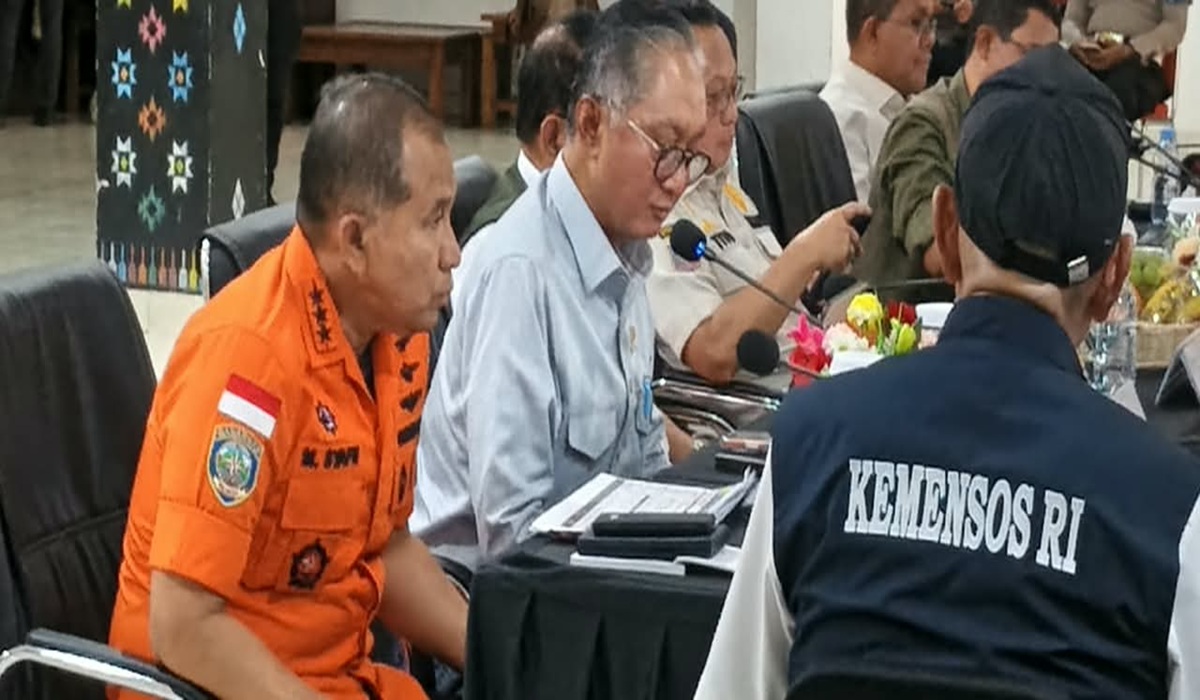
The central government held a coordination meeting on the emergency response to the earthquake disaster at the West Manggarai Regent’s Office in Labuan Bajo, East Nusa Tenggara, on Sunday (16/8). The meeting was held on the orders of President Prabowo Subianto to immediately carry out emergency response measures for the earthquake that affected several areas on Flores Island. The central government deployed ministries and agencies, the Indonesian National Armed Forces, the National Police, state-owned enterprises, and related elements to accelerate handling on the ground.
Coordinating Minister for Human Development and Cultural Affairs Pratikno said the scale of the disaster in NTT was very large, requiring the combined strength of central and regional government apparatus working in an integrated manner. Pratikno stressed that President Prabowo had ordered ministries and agencies to be fully involved while providing assistance to affected regions.
“This disaster in NTT is very large. So the central apparatus, including the TNI, Polri, ministries and agencies, and state-owned enterprises, are fully involved. The President, in addition to ordering ministries and agencies including assistance, has also provided aid,” Pratikno said during the coordination meeting in Labuan Bajo.
Pratikno emphasised two main points in disaster management: synchronisation and accountability. According to him, the large strength of central and regional government would only be effective if all elements worked through integrated coordination. “This large force, this large apparatus, can only be effective if the work is synchronised. Therefore, command posts must be immediately established and activated,” he said.
He said the National Disaster Mitigation Agency had begun building a command post system, from an aid post at Halim to national posts in Labuan Bajo and Maumere. Provincial and district governments were also asked to immediately establish and activate their respective posts so that all aid and handling could be coordinated. “If there is no synergy, this large force could become a problem. So synchronisation through command posts is very important,” Pratikno stressed.
The second point Pratikno emphasised was the importance of establishing emergency response status in affected areas. This status is needed to facilitate government intervention, including allowing the National Disaster Mitigation Agency to use ready-to-use funds for emergency handling. “Emergency response status is important. Because if there is no emergency status, intervention is also difficult. The Head of BNPB can use ready-to-use funds if there is an emergency status,” he said.
Pratikno also asked regional governments to ensure that data collection on victims, damage, community needs, and affected facilities was carried out quickly, accurately, and verifiably. This data is not only important for emergency response handling but also serves as the basis for rehabilitation and reconstruction processes. “Correct and accurate data collection is important to accelerate not only emergency response but also rehabilitation and reconstruction,” he said.
According to Pratikno, experience in disaster management in Sumatra showed differences in data collection speed between regions. Therefore, regional heads were considered to have an important role in mobilising all regional government apparatus in the data collection process. “So once again, number one is synchronisation, number two is accountability,” Pratikno said.
Meanwhile, Head of the National Disaster Mitigation Agency Lieutenant General TNI Dr. Suharyanto asked regional governments in affected areas to immediately establish regional disaster status. This status determination was considered important so that BNPB could more quickly provide intervention and disaster management support. Suharyanto was still recorded as Head of BNPB in 2026.
BNPB would also establish and activate a handling post in Labuan Bajo as part of the aid coordination system for affected areas. The post would become one of the central government’s coordination points in managing aid distribution and operational support.
In supporting aid distribution, the TNI and Polri had also prepared air fleets to help shift logistics to affected areas that were difficult to reach by land or sea routes.
Previously, Deputy Minister of Health Dante Saksono Harbuwono conveyed temporary data on victims from the earthquake, reaching 51 people dead, 36 seriously injured, and 77 lightly injured. This data could still change as the data collection and verification process continued in the field.
The central government ensured that support would continue to be provided to regional governments during the emergency response period. Pratikno asked all regional needs requiring central government support to be immediately discussed through the command posts so they could be followed up quickly and in a coordinated manner.
State-owned energy company PT Pertamina ensured support for fuel oil energy for the emergency response to the 7.7 magnitude earthquake in Flores, East Nusa Tenggara. Of the 21 hospitals on Flores Island, 16 hospitals suffered severe damage, while four hospitals could still operate partially.
Aid for the emergency handling of the 7.7 magnitude earthquake that shook Flores Island, East Nusa Tenggara, arrived in Labuan Bajo in the early hours of Sunday (16/8). Deputy for Prevention at the National Disaster Mitigation Agency Abdul Muhari conveyed the latest developments in handling the 7.7 magnitude earthquake that shook NTT. The Ministry of Health prioritised restoring health service functions in areas affected by the earthquake in East Nusa Tenggara.