
CELIOS Urges Government to Expand Tax Base to Global OTT Companies
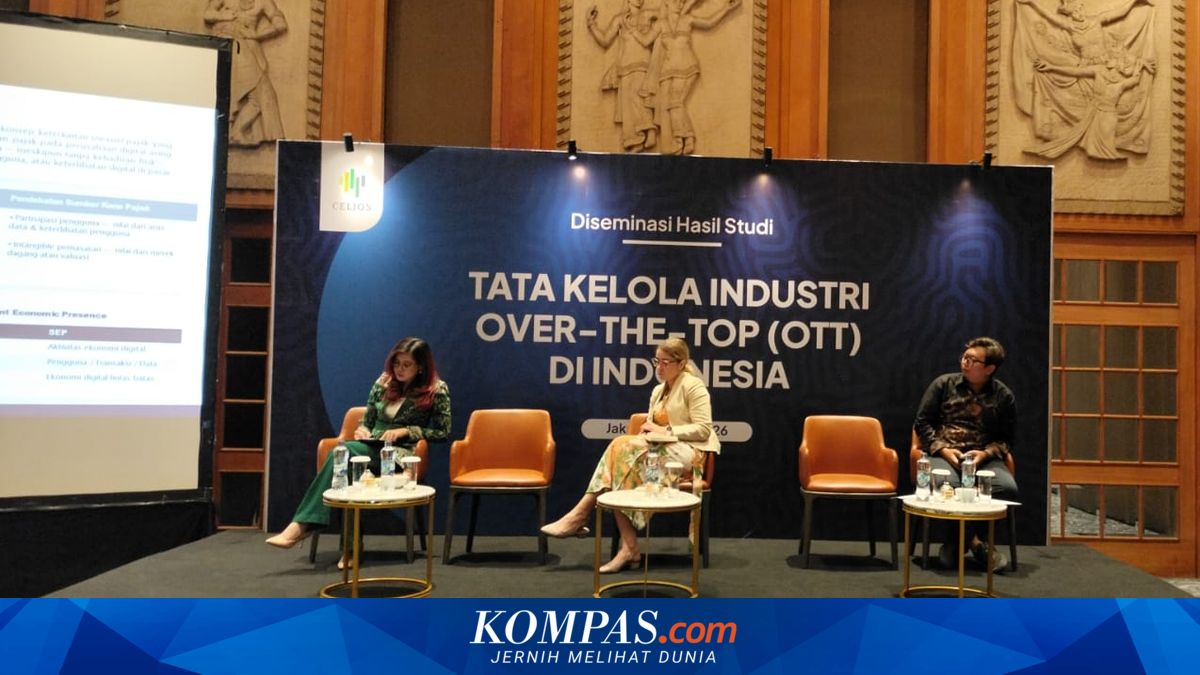
JAKARTA — The Centre of Economic and Law Studies (CELIOS) has revealed that Indonesia continues to face a substantial fiscal gap within the digital economy sector. Although the Gross Merchandise Value (GMV) of the digital economy has reached IDR 1,350 trillion, the digital tax revenue collected by the state stands at only IDR 32.32 trillion.
In a study titled ‘Governance of the Over-The-Top (OTT) Industry in Indonesia’, CELIOS noted that Indonesia’s digital tax coefficient is only 0.27. This figure is significantly lower than conventional sectors, such as manufacturing and financial services, which possess tax coefficients two to three times higher.
CELIOS Economic Director, Nailul Huda, stated that the low tax contribution from the digital economy indicates structural issues in the sector’s tax governance. Global OTT platforms operate in Indonesia without a significant physical presence, generating hundreds of trillions in revenue from the local market, yet they are not fully subject to national tax jurisdiction. “The value chain is created in Indonesia, but the taxation does not occur here,” he added.
The study examines Indonesia’s digital tax structure, the business models of global OTT platforms, regulatory comparisons across various countries, and the economic impact of several policy options, namely a 1 per cent Withholding Tax (WHT), a 3 per cent WHT, and a 0.75 per cent Universal Service Obligation (USO) levy. The findings indicate that all these scenarios have the potential to significantly increase state revenue while providing positive effects on economic output, Gross Domestic Product (GDP), and job creation.
CELIOS also highlighted that more than 77 per cent of current digital tax revenue comes from Value Added Tax on trades through electronic systems (PPN PMSE). This implies that the tax burden is largely borne by Indonesian consumers rather than the global digital companies operating within the country. According to Huda, this condition reflects an imbalance in the fiscal contribution of the digital economy. “This means that the fiscal burden of the digital economy is being carried by the Indonesian people, not the global platform companies. More than 77 per cent of digital tax is paid by our consumers through VAT, while Google, Meta, and Netflix contribute almost no corporate income tax to the state treasury. This is a very regressive and unfair tax,” he said.
He added that the imbalance is also evident in digital infrastructure investment. “Our telecommunications operators must invest 17.2 per cent of their revenue to build digital infrastructure, while the OTT platforms that utilise the network most heavily do not bear a comparable obligation,” Huda added.
Meanwhile, CELIOS Public and Fiscal Policy Researcher, Jaya Dharmawan, estimates that the implementation of appropriate tax instruments could significantly increase state revenue in the coming years. “By 2026, the potential revenue ranges from IDR 7.52 trillion to IDR 30 trillion, depending on the instrument chosen. This projection continues to rise alongside the growth of the digital economy,” said Jaya.