
Caution: Mining Policy Effects, BI Rate Rises, and Bad News from the US
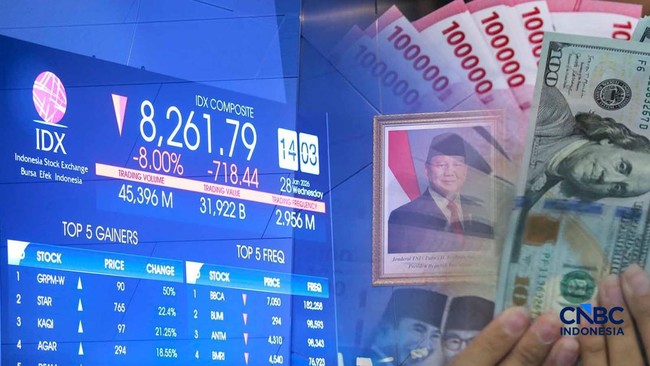
Market movements on Thursday, 21 May 2026, are expected to remain volatile. Further details on today’s market projections can be read on page 3 of this article.
IHSG moved like a roller coaster during trading on Wednesday. After fluctuating intraday, the IHSG finally closed down 0.82% at 6,318.50.
During the session, 483 shares declined, 208 rose, and 126 were flat. Trading volume reached 41.13 billion shares, with transactions worth Rp22.36 trillion and 2.47 million trades. Nevertheless, foreigners bought Rp249.17 billion worth of shares.
In the morning, ahead of President Prabowo Subianto’s speech at the House of Representatives, IHSG briefly reversed course and surged about 1% to 6,430.97 after opening under pressure.
However, the market later responded negatively to Prabowo’s speech on a one-door export policy for Indonesia’s strategic natural resources, including coal and palm oil. The IHSG even fell almost 2.5% after Prabowo announced the establishment of a state-owned export authority, before trimming its losses by the close.
Most sectors were in the red. The biggest declines were in the infrastructure and basic materials sectors, while technology and financials managed to rise.
Mining company shares broadly slumped, particularly coal stocks which could be affected by the new rules; gold mining shares also mostly fell, except for PT Aneka Tambang Tbk (ANTM).
Even though the coal sector was under pressure, state-owned coal miner PT Bukit Asam Tbk (PTBA) rose more than 6% in yesterday’s trading.
Some of the stocks weighing on the IHSG included PT Barito Renewables Energy Tbk (BREN), PT Chandra Asri Pacific Tbk (TPIA), PT Barito Pacific Tbk (BRPT), PT DCI Indonesia Tbk (DCII), PT Amman Mineral Internasional Tbk (AMMN), and PT Bumi Resources Tbk (BUMI).
In the currency market, the rupiah ended Wednesday stronger against the US dollar after BI raised the benchmark rate.
During the session, the rupiah moved quite volatile. At the start, the rupiah opened 0.20% weaker at Rp17,730 per US, brieflytouchingRp17, 745perUS. However, it later reversed to strengthen as the BI Rate was announced.
The rupiah strengthened after Bank Indonesia raised the benchmark rate by 50 basis points to 5.25%. In line with this, the Deposit Facility rate was set at 4.25%, while the Lending Facility at 6.25%.
“This policy is a further step to strengthen rupiah stability amid tensions in the Middle East,” Governor of BI Perry Warjiyo said in the briefing on the results of the Board of Governors meeting, Wednesday (20/5/2026).
The more aggressive rate hike than market expectations signals that BI is taking a firm stance to protect exchange rate stability. Previously, the rupiah had been extending new weak closing levels around Rp17,700 per US$.
In the bond market, the 10-year Government Bond yield closed up 0.22 percentage points at 6.794% on yesterday’s trading.
Yield increases suggest prices of government bonds came under modest pressure again, though movement was relatively restrained compared to the pressure in the equity market, as investors monitor the impact of BI’s rate hike on the bond market and foreign capital flows.
In the US stock market, Wall Street surged on Wednesday or early Thursday in Indonesian time, as oil prices fell and US Treasury yields declined. Traders were also awaiting Nvidia’s first-quarter earnings report.
The Dow Jones Industrial Average rose 645.47 points, or 1.31%, to 50,009.35. The S&P 500 gained 1.08 to 7,432.97, while the Nasdaq Composite rose 1.54% to finish at 26,270.36.
West Texas Intermediate futures fell 5.66% and closed at US$98.26 per barrel. Brent crude fell 5.63% and settled at US$105.02 per barrel.
The drop occurred after Donald Trump told reporters that the administration was in the final stages of negotiations with Iran.
The yield on the 10-year Treasury fell by more than 9 basis points on Wednesday, while the 30-year Treasury yield fell by more than 6 basis points. One basis point equals 0.01%.
The bond market had unsettled investors in recent days, after the 30-year yield reached its highest since 2007 and the 10-year yield neared multi-year highs.
Concerns mounted that inflation would rise again due to higher oil prices and that The Federal Reserve, which would soon be led by Kevin Warsh, lagged in its efforts to curb inflation. The rate hikes were feared to disrupt an economy already strained by high energy costs.
The minutes of the latest Federal Reserve meeting show that most officials expect further rate hikes in the future if the Middle East conflict continues to worsen inflation.
The minutes noted that the majority of participants highlighted that further policy tightening is likely needed if inflation remains above 2%.
Investors also shifted focus to Nvidia. The report was seen as important for gauging AI trends and providing updates on chip demand. The company’s shares rose by more than 1%.
Nvidia posted results that beat expectations. The stock pared its early losses after the release and traded up more than 0.5%, after having risen 1.3% in the regular session on Wednesday.
Revenue for the April quarter exceeded US$81 billion as expected, but the revenue projection of US$91 billion for the July quarter was slightly below some analysts’ expectations.
This is somewhat different from the usual pattern, when the company often provides projections that far exceed market estimates. The company also did not provide