
Causes of the Jakarta Composite Index Plummeting by Over 4% Today
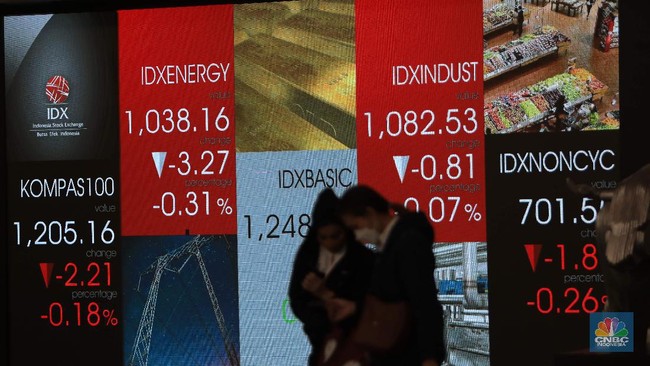
The Jakarta Composite Index (IHSG) suffered a sharp decline in today’s trading, Wednesday (3/6/2026). The index reversed its direction after closing up 1.11% yesterday. As of 11:00 WIB, the IHSG had plummeted by more than 4%, falling below the 6,000 level. A total of 679 stocks declined, 7lag 75 rose, and 205 remained unchanged.
Transaction value reached Rp 13.14 trillion, involving 20.47 billion shares across 1.56 million transactions. Market capitalisation also slumped to Rp 10,454 trillion. According to Refinitiv, the materials, healthcare, and utilities sectors saw the deepest declines, correcting by 9.16%, 7.15%, and 6.9%, respectively.
Several conglomerate stocks that boosted the index yesterday became the primary drags on today’s trading. Amman Mineral (AMMN), which hit the lower auto-reject (ARB) limit at -14.91%, contributed -17.62 points to the index’s decline. Furthermore, two stocks from Prajogo Pangestu’s empire, Barito Renewables Energy (BREN) and Barito Pacific (BRPT), contributed a combined -20.75 points. Major banking stocks, including Bank Central Asia (BBCA) and Bank Rakyat Indonesia (BBRI), also weighed on the index, contributing -16.39 points and -15.68 points respectively.
In yesterday’s session, domestic investors managed to support the IHSG despite a net foreign outflow of Rp 1.39 trillion, allowing the index to close up 1.1%. However, foreign capital continues to flow out of the Indonesian capital market following the effective MSCI rebalancing as of 1 June 2026. Hans Kwee, Co-Founder of PasarDana and capital market practitioner, noted that there is potential for further downward pressure, particularly on stocks removed from the MSCI Global Standard Index and MSCI Small Cap Index. He suggested that the post-rebalancing period could represent a bottom for the IHSG, with opportunities for a recovery based on future company fundamentals.
Kwee added that capital market reforms by the OJK and SROs have successfully enhanced the transparency, credibility, and integration of the Indonesian capital market, thereby strengthening the confidence of both local and foreign investors.
Meanwhile, the Rupiah continued to weaken in Wednesday’s trading. According to Refinitiv data, as of 11:00 WIB, the Rupiah depreciated by 0.4% to the level of Rp17,925/US, markinganewall − timelowagainstthegreenback.HavingbreachedthepsychologicallevelofRp17, 900/US, the Rupiah is now approaching the next psychological threshold of Rp18,000/US$.
In contrast, most regional markets were trading in the green. The Nikkei led the gains with a 2.91% increase, followed by the Shenzhen (2.31%) and Taiwan (2.11%) indices.