
Causes of the Expanding Landmass of Mount Anak Krakatau
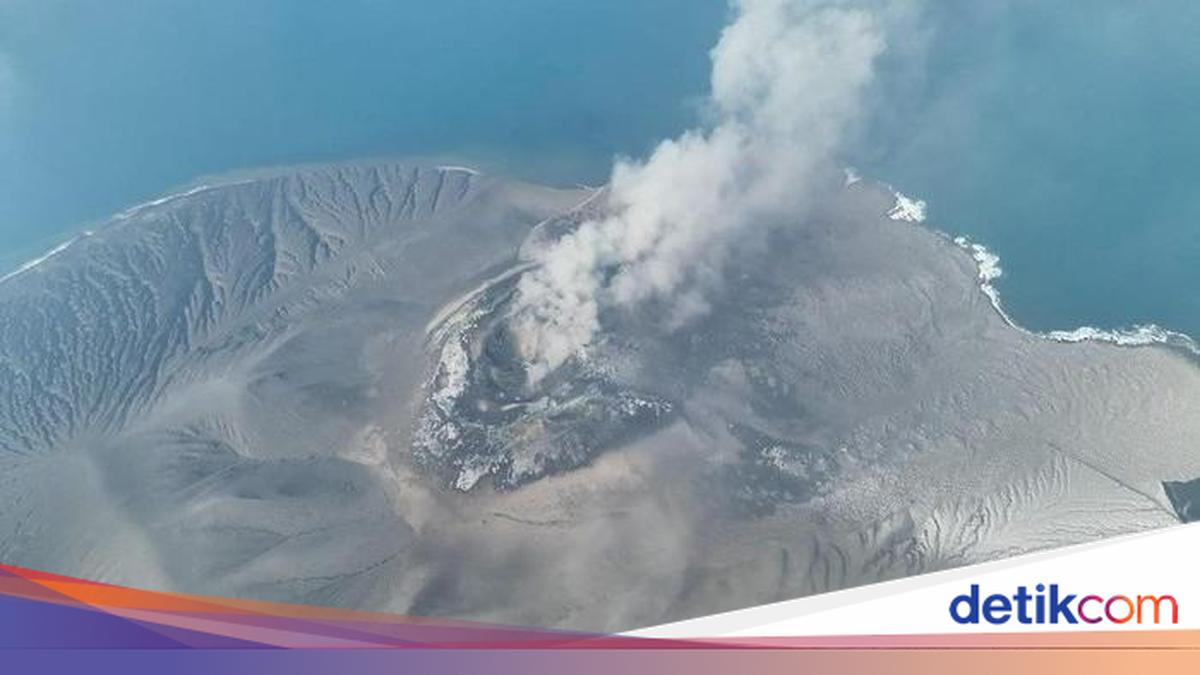
Mount Anak Krakatau is growing. The landmass of Mount Anak Krakatau has now even exceeded its size before the eruption and collapse in December 2018.
Based on Sentinel imagery as of 8 August 2026, the Centre for Volcanology and Geological Disaster Mitigation (PVMBG) of the Geological Agency initially recorded the land area of the volcano located in the Sunda Strait at approximately 312.3 hectares. Following continuous eruptions between 4 and 6 September 2026, the accumulation of ongoing eruptive material has allowed the landmass of Mount Anak Krakatau to recover and expand.
According to satellite monitoring via Sentinel imagery as of Tuesday (15/9), the total land area of Mount Anak Krakatau is approximately 341.5 hectares. There has been an additional 32.8 hectares of material deposits following the eruptions in early September 2026. The landmass of Mount Anak Krakatau has now even surpassed its size before the late 2018 eruption.
Before the 2018 Eruption
Mount Anak Krakatau experienced an eruption and landslide disaster on 22 December 2018. This event triggered tsunami waves in the Banten and Lampung regions. Prior to the eruption, specifically on 19 December 2018, the area of the volcano within the South Lampung region reached 300 hectares. The land area of Mount Anak Krakatau subsequently decreased following the eruption and landslide.
“The collapse of the south-western sector drastically reduced the mountain’s landmass to just 246.18 hectares as of 26 December 2018,” said the Head of PVMBLE, Geological Agency of the Ministry of Energy and Mineral Resources, Rita Susilawati, as reported by Antara on Saturday (26/9/2026).
Reconstruction Phase According to Research
The massive growth in physical landmass aligns with the results of collaborative research by the National Research and Innovation Agency (BRIN) alongside the University of Birmingham, ITB, Penn State University, British Geological Survey, University of Oxford, and PVMBG. The research confirms that Mount Anak Krakatau is currently in a reconstruction and rebuilding phase.
Dini Nurfiani, a researcher from the BRIN Geological Disaster Research Centre, explained that the journey of Anak Krakatau demonstrates that volcanoes are dynamic geological systems that evolve through long cycles of growth, eruption, collapse, and the formation of new cones. “The eruption history of Anak Krakatau shows that this volcano develops through cycles of growth, eruption, collapse, and rebuilding. After the 2018 collapse, the morphology and eruption style changed drastically, followed by a regrowth phase through eruptions and the formation of new lava,” said Dini.
Dini further explained that the collapse of the south-western sector on 22 December 2018 discharged approximately 0.116 cubic kilometres of material into the sea, reducing the peak height from 330 metres to 120 metres and triggering a tsunami in the Sunda Strait. The sudden loss of the mountain’s mass temporarily changed the eruption mechanism from Strombolian to explosive Surtseyan due to seawater entering the crater fissures. However, from 2019 to 2026, eruption activity has transitioned back to Strombolian types, lava fountains, and new lava flows accumulating above the post-collapse crater, consistently increasing the volcano’s land volume.
Asymmetrical Growth
Nevertheless, the BRIN research team emphasised that the growth of Anak Krakatau is not symmetrical. The south-western sector is growing on a steep undersea caldera slope, while the north-eastern part rests on shallower seabed. The physical structure of the volcano, composed of heavy, solid lava accumulations atop light, porous tuff deposits, combined with its position on slopes of varying steepness, is the primary factor influencing the long-term stability dynamics of Anak Krakatau’s slopes. “The eruption records of Anak Krakatau show that volcanic behaviour is not always constant but can change following the development of the volcano’s body, the magma system, and environmental conditions,” said Dini.
Source: jawawa.id (https://jawawa.id/newsitem/causes-of-the-expanding-landmass-of-mount-anak-krakatau-1790434478)
Originally published by detikcom (https://news.detik.com/berita/d-8680681/penyebab-daratan-gunung-anak-krakatau-makin-meluas), translated from Indonesian