
Causes Behind IHSG's Over 3.5% Surge Back to 6,200 Level
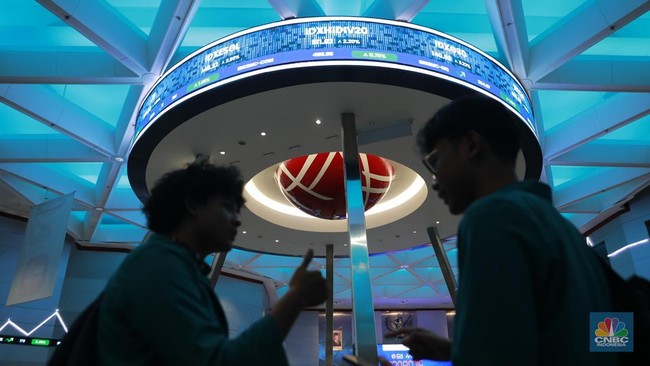
Jakarta - The Composite Stock Price Index (IHSG) surged at the opening of trading on Monday (15/6/2026), extending the significant rally recorded last week. Based on IDX Mobile data at 09.10 Western Indonesia Time, the IHSG soared more than 3.5% to 6,221.44. A total of 548 stocks advanced, 82 declined, and 91 remained unchanged. Transaction value reached Rp3.61 trillion, with a trading volume of 5.81 billion shares changing hands 363,000 times. The most actively traded issuers today included BBCA, BBRI, BMRI, TPIA, and BUMI.
The IHSG’s surge was driven by a rebound in large-cap blue-chip stocks, particularly in the banking sector, whose share performance has been under pressure since the start of the year. Meanwhile, shares of conglomerate issuers that had collectively slumped since the MSCI announcement are now gradually beginning to recover and slowly climbing from their lowest levels since early 2025.
Positive sentiment for the domestic stock index came from the announcement of a US-Iran peace agreement, which agreed to reopen the Strait of Hormuz, ultimately helping to pull down global crude oil prices. Additionally, the rupiah’s strong performance against the US dollar, successfully rebounding from its all-time low, provided further impetus to the index.
Citing Refinitiv data, all trading sectors strengthened, with the highest gains recorded by basic materials, utilities, and financials. BBCA was the main pillar of the IHSG’s performance, contributing 25 index points. BBRI and BMRI followed with contributions of 16 and 15 index points, respectively. BRMS, AMMN, and MORA each contributed around 11 index points to the rally.
Financial market movements today and over the coming week are expected to remain overshadowed by heightened global uncertainty stemming from the Middle East conflict. After world oil prices surged sharply and market volatility increased in recent weeks, investors are now awaiting a series of important economic data that could provide clues about the direction of global economic growth, interest rate prospects, and exchange rate stability.
The market’s main focus will be on the interest rate meetings of Bank Indonesia and the Federal Reserve, US consumption data, and a series of Chinese economic indicators that have long served as a barometer of global commodity demand. For Indonesia, this combination of data will influence the movement of the rupiah, the IHSG, the bond market, and the prospects for commodity sectors such as coal, nickel, and crude palm oil.
Asian bourses welcomed the news of a peace deal between the United States and Iran. World oil prices immediately plummeted after US President Donald Trump announced that the two countries had finalised an agreement to reopen the Strait of Hormuz. In the Asian region, investors responded to this geopolitical development with enthusiasm. South Korea’s Kospi index soared 5.1%, leading gains in the region. Japan’s Nikkei 225 index rose 3.6%, while the Topix index strengthened 2.3%. In Australia, the S&P/ASX 200 index also recorded a 1.3% increase.
Citing CNBC International, US crude oil futures contracts for July delivery fell 4.77% to US$80.83 per barrel at 20.27 Eastern Time. Meanwhile, Brent futures contracts, the international benchmark, for August delivery traded around 4% lower at US$83.77 per barrel. In a social media post, Trump said the Strait of Hormuz would be opened on Friday, the day the official peace treaty signing ceremony is scheduled to take place in Switzerland. “With the opening of the Strait of Hormuz after the signing of the Treaty on Friday, for the purpose of mine clearing, oil will flow again at both ends for this region, and the world!” he said. As is known, around 20% of the world’s oil supply passes through the Strait of Hormuz, before tanker traffic plummeted in early March due to Iranian attacks. The disruption in the Strait of Hormuz triggered the largest oil supply disruption in history. Pakistan’s Prime Minister Shehbaz Sharif stated that the United States and Iran had announced an immediate and permanent cessation of military operations on all fronts, including in Lebanon. The Pakistani Prime Minister acted as a mediator between the United States and Iran.