
Catfish Aquariums Turn Banteran Village Children’s Attention Away from Gadgets
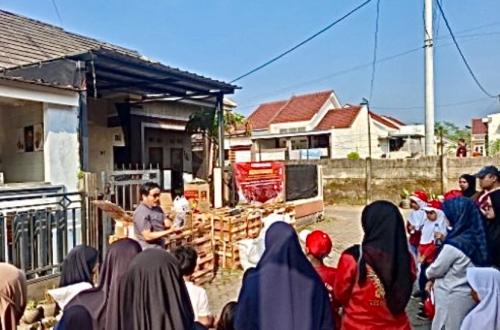
JAKARTA – Catfish aquariums have become a learning tool for children in RT 07, RW 05, Banteran Village, Sumbang District, Banyumas Regency, Central Java. Through fish-farming activities at home, children are encouraged to reduce their dependence on gadgets while developing the habit of doing activities together with their parents.
The programme was devised by a team of lecturers and students from Telkom University’s Purwokerto Campus Directorate. Entitled “Supporting Children’s Digital Behaviour Literacy through Catfish Farming Activities and the Use of Community-Based Technology”, it ran from May to September 2026 and involved 20 children and 20 parents, with the RT 07 Family Welfare Movement (PKK) as its partner.
The programme was funded by the Ministry of Higher Education, Science and Technology (Kemdiktisaintek) through the 2026 Research and Community Service Information Base (BIMA). Team leader Eka Sahputra said it was developed in response to Banteran’s relatively high level of digital access. Around 75 to 80 per cent of households in the village have smartphones, but there had been no community programme specifically supporting children’s digital behaviour.
“We do not want simply to prohibit children from using their phones. They need an enjoyable alternative activity, and parents need to be equipped to support them,” Eka said in a written statement on Wednesday (28 October 2026).
Each child received a mini aquarium, catfish fry and feed to keep at home. For 12 weeks, from 5 July to 26 September 2026, the children acted as “pond keepers”. They fed the fish in the morning and evening, observed the clarity of the water and the fish’s behaviour, and recorded their observations in a daily logbook signed by a parent.
The activity turned the home into both a place of learning and a space for interaction between children and parents. Four group meetings were held at neighbourhood level, on 10 May, 5 July, 16 August and 27 September 2026, the latter serving as the closing meeting.
The children were also introduced to appropriate technology. An Internet of Things (IoT)-based water-quality monitoring device and a solar-powered water pump were handed over to the RT 07 PKK on Sunday (16 August 2026), then installed with residents at a community-funded pond in late August 2026.
“Children learn that technology can be used to take care of something, not just to play games,” Eka said.
An evaluation using pre- and post-tests showed changes in participants’ knowledge and behaviour. The average score for the parent group rose by 7.7 per cent, while children’s scores increased by around 7 per cent. Scores improved from before the programme for 65 per cent of parents and 58 per cent of children.
According to Eka, the biggest change was in children’s gadget-use behaviour, which improved by more than 15 per cent. The children said they were less likely to lose track of time while using their phones. Parents, meanwhile, more often invited their children to do other activities and were less likely to give them a phone to keep them quiet.
“Parents’ knowledge was already high from the outset. What had been lacking was putting it into practice at home, and that is where the most visible change occurred,” he said.
Eka added that participants who had been most vulnerable at the start made the greatest progress. Parents with the lowest initial scores recorded an average increase of 0.68 points on a scale of one to five, higher than other groups.
Karsih, head of the RT 07 RW 05 Banteran Village PKK, said the activity brought a new focus to the group of mothers, who had previously struggled to draw children’s attention away from their phones. “Now the children have something of their own to keep them busy. When they get home from school, they ask whether the catfish have been fed, not about their phones. The mothers also have something to talk about with their children,” Karsih said.
Karsih thanked the team for providing training and support to the children and residents. “Thank you for travelling all this way, training and guiding the children, and bringing equipment. We hope the activity does not stop here but can continue,” she said.
The implementation team comprised Eka Sahputra, from the Data Science field, and Irmayatul Hikmah, from Biomedical Engineering, both of Telkom University’s Purwokerto Campus Directorate. The team also included Feri Wibowo from Informatics Engineering at Muhammadiyah University of Purwokerto and four Data Science students: Habibah Ratna Fadhila Islami Hana, Donna Nur Tamara, Rania Rasendriya Wijaya and Rizal Wahyu Pratama.
In addition to the technology equipment, the team provided the partner group with literacy modules and children’s activity supplies. It also prepared a family-support guide so that the programme model can be applied in other communities.
Source: jawawa.id (https://jawawa.id/newsitem/catfish-aquariums-turn-banteran-village-childrens-attention-away-from-gadgets-1794387174)
Originally published by Republika (https://daerah.republika.co.id/berita/tobus7416/akuarium-lele-alihkan-perhatian-anak-desa-banteran-dari-gawai), translated from Indonesian