
Cash Foreign Exchange Purchases Without Underlying Assets Limited to US$25,000, Here Are the Rules!
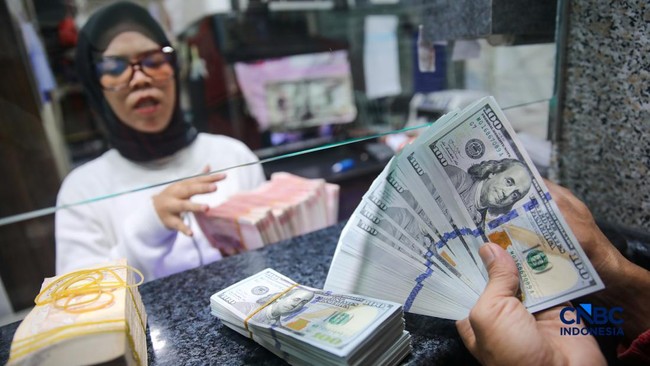
Jakarta, CNBC Indonesia - Bank Indonesia (BI) has officially tightened the limit for US dollar purchases from all parties, reducing it from US$50,000 per month per person to US$25,000 per month per person. This regulation officially came into effect on 2 June 2026.
This limit was established in the Regulation of the Member of the Board of Governors (PADG) No. 11/2026 concerning the Second Amendment to the Regulation of the Member of the Board of Governors No. 11/2024 regarding Foreign Exchange Market Transactions. The PADG was signed by Deputy Governor Thomas Djiwandono on 26 May 2026.
“A specific threshold for cash foreign exchange purchase transactions against the Rupiah, as referred to in Article 22 paragraph (1) letter a number 1, is set at US$25,000.00 (twenty-five thousand United States dollars) or its equivalent per month per foreign exchange market transaction participant,” stated Article 25 of PADG No. 11/2026, as reported on Wednesday (3/6/2026).
This regulation was implemented to achieve the stability of the Rupiah’s value amidst high-pressure global conditions. Furthermore, the limits for derivative transactions, including forwards, domestic non-deliverable forwards (DNDF), and swaps, remain unchanged. The transaction limit for forward and DNDF derivatives remains at US$100,000 per month per participant for buy transactions, while the limit for sell transactions is US$10 million or its equivalent per transaction. Meanwhile, the threshold for swap transactions remains limited to US$10 million per transaction.
Notably, in 2015, Bank Indonesia previously adjusted the maximum limit for foreign exchange purchases through spot transactions without specific underlying requirements, reducing it from US$100,000 per month per customer to US$25,000 or its equivalent per month per customer.
At that time, Bank Indonesia stated that the restriction was necessary to maintain the stability of the Rupiah exchange rate, given the high demand for foreign exchange not directly related to real economic activities (transactions without underlying assets), which could cause supply and demand imbalances in the foreign exchange market and lead to speculation.
Thus, this is not the first time Indonesia’s central bank has implemented restrictions on US dollar purchases. Ruth A. Cussoy, Director of the Financial Market Development Department at Bank Indonesia, previously indicated that the monetary authority is sending a firm signal that the underlying requirement is not necessarily a permanent policy. Regarding when the underlying requirement might be lifted, Ruth emphasised that it depends heavily on the level of market maturity and the financial literacy of economic participants.
According to her, once the public’s literacy regarding derivative instruments is high and they no longer respond to market volatility with irrational cash speculation, these restrictions could gradually be removed. “If we can be certain that there is no longer speculation, and we believe all transactions are based on correct calculations and reflect fair pricing, that is when we may no longer need the underlying requirement. Because we do not want our exchange rate to reflect something that is not real,” she asserted.