
Caring for the upstream to save the downstream
Surabaya (ANTARA) - A few hours of rain should no longer be capable of paralysing a major city. Yet climate change has made weather patterns increasingly difficult to predict.
At what should be the start of the dry season, Surabaya in East Java was instead drenched by several days of high-intensity rain at the end of June 2026.
Water inundated a number of roads, residents’ activities were disrupted, traffic was held up, and the familiar questions resurfaced. Why do floods still occur in a city that has for years been known for seriously building flood control systems?
There is no simple answer. Flooding in Surabaya is no longer merely a matter of insufficient drainage, but a question of increasingly complex urban water governance. The city keeps growing, built-up areas keep expanding, infiltration surfaces are shrinking, while rainfall has become more extreme due to climate change.
On the other hand, the Surabaya City Government has shown that work on controlling inundation continues. Since mapping was carried out in 2020, a total of 1,015 inundation points have been identified.
By 2025, around 440 points had been addressed, while around 120 more are targeted for completion throughout 2026 through the construction of drains, channel connectivity, normalisation, pump stations, and retention basins.
These achievements show that dealing with inundation is not work that ends within a single budget period. It is a long-term investment requiring phased planning as well as the ability to adapt to changing urban conditions.
Interestingly, the greatest challenge actually lies beyond the small drains in residential neighbourhoods. The core problem lies in the relationship between tertiary drains, primary channels, rivers, and the estuary. As long as that chain does not function as a single system, flooding will persist, even if neighbourhood drainage has been repaired.
The upstream knot
Society often views flooding only from the point where water collects. In reality, the problem frequently lies far downstream.
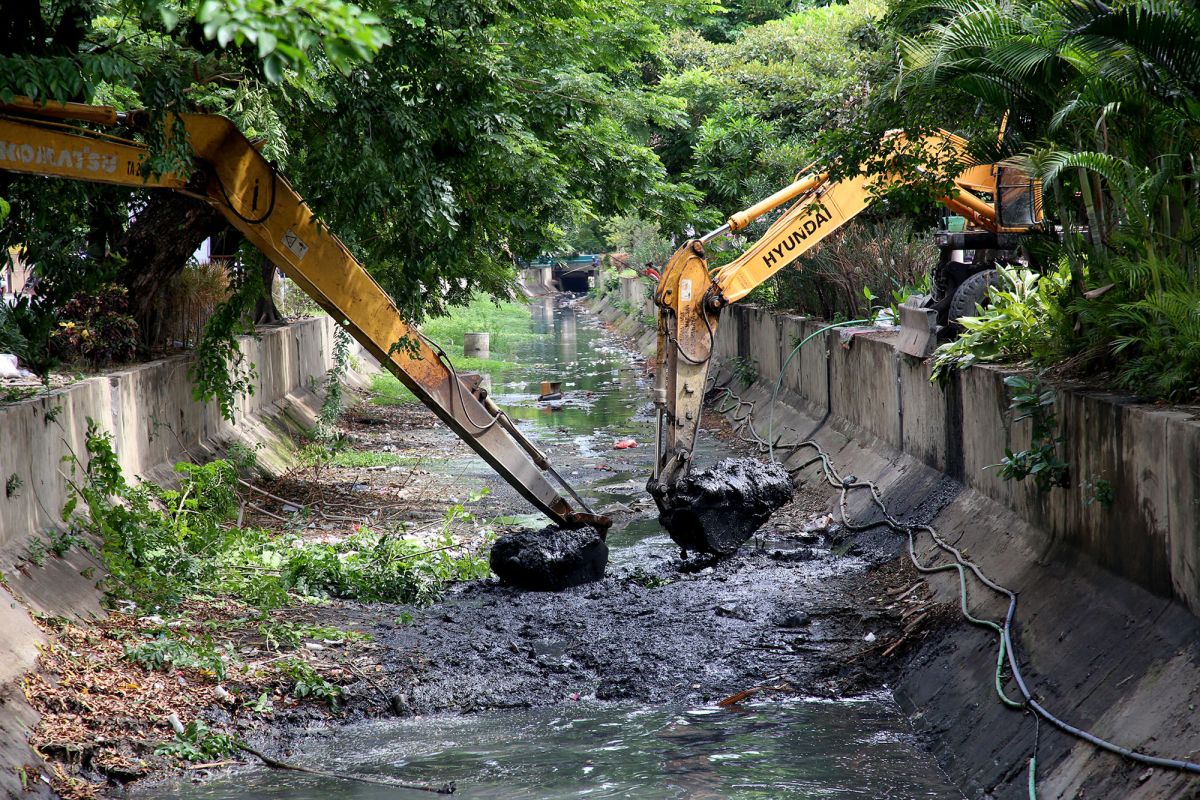
Sedimentation in the Surabaya River, Kalimas, and Kali Jagir reduces the capacity of water flow. This shallowing slows the water’s journey to the sea.
Conditions become more severe when high tide coincides with heavy rain, producing the backwater phenomenon. In such situations, pump stations work harder because the water already pumped out cannot fully flow into the sea.
This is why urban drainage development is insufficient unless river normalisation proceeds in parallel. Water always follows the law of gravity. If downstream channels are blocked, building new drains in residential areas merely moves the problem from one location to another.