
Caring for Sulawesi’s ‘Brown Gold’: How a Mobile Phone Is Changing Lives
Wayan Sudiarsa starts his day with a cup of coffee while the sun is still low, at around 5am Central Indonesia Time. Refreshed by the caffeine, the 52-year-old heads to his cocoa plantation in Langudon village, Bokat district, Buol regency, Central Sulawesi.
The road to the plantation is only a stone’s throw from Sudiarsa’s home near the Langudon village hall. It is passable only for skilled motorcyclists; one mistake on the steep, rocky track could send a rider tumbling.
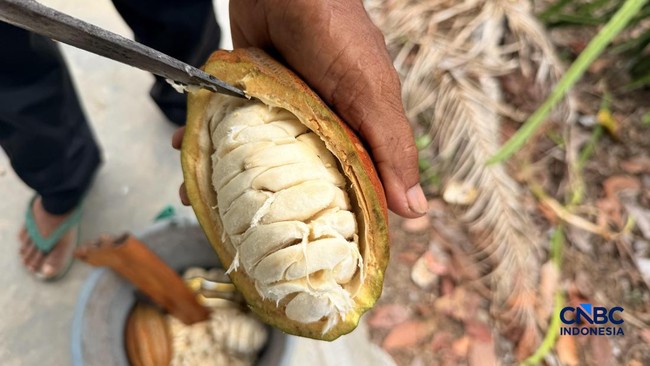
On the 0.75-hectare plot, 300 cocoa trees provide for Sudiarsa and his family. He checks each tree for leaves that need pruning, applies Alika pesticide to protect against cocoa pod borers—known locally as cocoa “cancer”—and selects ripe pods for harvesting.
The land was part of a government transmigration programme in 1996, which brought people from Bali to Central Sulawesi to develop agriculture. Sudiarsa was among those who left Bali to seek a livelihood elsewhere.
Dozens of other migrants from Java and Bali have also settled in Langudon, with generations of families continuing the Central Sulawesi tradition of growing cocoa, a leading commodity often called “brown gold”.
By 9am, the day’s work in the plantation is done. For city residents, finishing work before the sun is directly overhead might seem like a daydream.
Sudiarsa can then relax over a packed meal of rice and sea fish prepared by his wife, Iloh. He beams as he talks about her being more technologically adept than he is.
“We only have one mobile phone between us, but Mrs Iloh is the one who uses it more,” Sudiarsa says proudly.
Using the phone, Iloh handles contact with buyers, checks market prices and tracks movements in the US dollar exchange rate, a factor that influences cocoa prices.
Such conveniences were once unimaginable to local residents. Internet coverage reached Langudon in 2022 through a 4G Base Transceiver Station (BTS) built by BAKTI, under the Ministry of Communication and Digital Affairs (Komdigi).
Residents quickly put the new technology to use, particularly for farming. Of the 120 households in the mountainous village in Buol regency, 100 are engaged in agriculture.
While Iloh is more skilled at negotiating prices and selling to buyers, Sudiarsa uses the internet mainly to learn more about plantation farming through YouTube.
He says cocoa trees are like babies that need attentive care. He has learned about cultivation and pest control from his phone, in addition to receiving regular guidance from local agricultural extension officers.
One of the biggest problems to unsettle cocoa farmers has been the cocoa pod borer, which became widespread around 2010. The pest eats into the fruit and damages the quality of the cocoa beans, forcing many farmers to cut down their trees.
Farmers gradually found a solution by planting the BR-25 cocoa variety. Its shorter trunk makes it easier to apply pest-control treatments.
Grafting is a key technique: farmers combine local cocoa rootstock with the sturdier, more productive BR-25 scion.
Since gaining internet access, Sudiarsa has also become more inclined to experiment with what he learns on YouTube. For example, he makes his own organic fertiliser from kitchen spices to grow a few mango trees in his garden.
“The results are decent for experimenting. But for cocoa fertiliser, it’s better to buy it,” he says.
Sudiarsa’s cocoa plantation has a main harvest once a week, with the largest yield reaching 40kg. The beans must then be dried before Iloh takes them to Buol, the regency capital, about 25km from Langudon.
Iloh usually rides her motorbike to Buol twice a month. “On average, she brings home Rp2 million to Rp4 million each trip,” Sudiarsa says.
As well as checking and comparing the best selling prices, Iloh has begun using the internet to expand into a sideline business. One example is selling sponge cakes in neighbouring villages.
She uses Telegram to promote the cakes when she is in the mood to bake, and sometimes receives large orders for local celebrations. “Mrs Iloh earns an extra Rp100,000 a week on average from selling cakes,” Sudiarsa says.
The couple have three daughters, now living independently in Palu, Buol and Bali. Some are married, while others are single.
Video calls on Telegram help ease their longing for their children and grandchildren. When a grandchild asks, “Where’s Grandpa?”, Iloh usually hands the phone to Sudiarsa.
“It makes me so happy when my grandchild asks for me and I can see their face on the phone screen,” he says.
Fed up with office work, he switched careers to become a young farmer
Of Langudon’s 100 farmers, 35 grow cocoa. Another is 33-year-old Wayan Adiatmika, who is much younger than Sudiarsa but already manages six hectares of farmland, including cocoa.
Adiatmika worked in office jobs from 2011 to 2019, trying his hand at roles ranging from security guard to salesperson. But after starting a family in 2019, he decided to become a full-time farmer. His reason was simple: he wanted to spend more time with his family.
“I can’t be away from my family any more,” Adiatmika says.
Another benefit of farming, he says, is control over his time. There is no boss setting his working hours or targets. “With a plantation, you can go to the farm whenever you like,” he says.
Of the six hectares he manages, one is planted with cocoa. The rest is used for durian, avocado and other fruit, with some land cultivated jointly with his parents.
Unlike Sudiarsa, Adiatmika was born and raised in Sulawesi. His grandfather first migrated to South Sulawesi, then his parents moved to Central Sulawesi in 1997. Farming has been the family’s livelihood throughout.
Adiatmika says farming can bring in more than an office job, but the weather is a decisive factor. In recent months, Buol farmers have faced the threat of drought associated with El Niño.
The effects are more acute in a mountainous area such as Langudon than in coastal regions. Low rainfall dries up water sources, making it difficult for crops to grow well.
To retain moisture in the soil, farmers pile banana leaves around the cocoa tree trunks. The method does not always work: some trees fail to produce a good crop, while others bear smaller pods. This directly reduces harvest volumes and farmers’ income.
Adiatmika only began cultivating cocoa in 2022. His cocoa seedlings, as he puts it, are only just learning to bear fruit. He says information on the internet has been a major help as he expands his plantation into cocoa.
“Although I learn a lot from my parents and fellow farmers, I also get a lot of new information and knowledge from YouTube and TikTok. There are many tutorials on planting techniques, care and strategies to boost production,” Adiatmika says.
He also sometimes buys farming equipment and fertiliser through e-commerce platforms. In the past, he could only buy such items in person when travelling to town.
Adiatmika shares what he learns online with his parents. He patiently teaches them how to find reliable information on the internet so they can continue innovating in their farming.
His cocoa plantation can produce up to 25kg every two weeks. Prices follow movements in the US dollar and market supply. So far this year, cocoa prices have fluctuated sharply, at one point soaring to Rp170,000 per kg before plunging to Rp30,000.
In mid-October 2026, the latest price was Rp96,000 per kg. Adiatmika has typically received between Rp80,000 and Rp90,000 per kg. Buyers send most of Langudon’s cocoa harvest on to Surabaya.
Since internet coverage expanded in Langudon, one problem has disappeared: farmers no longer have to deal with middlemen who mislead them or set prices arbitrarily.
“There are no more middlemen now. They used to come to the villages to buy cocoa. Now we take our harvest directly to buyers in Buol. We can share prices with them over WhatsApp beforehand and compare offers,” he says.
Source: jawawa.id (https://jawawa.id/newsitem/caring-for-sulawesis-brown-gold-how-a-mobile-phone-is-changing-lives-1793505061)
Originally published by CNBC Indonesia (https://www.cnbcindonesia.com/research/20261026152335-128-779540/merawat-emas-cokelat-di-tanah-sulawesi-ubah-hidup-lewat-layar-hp), translated from Indonesian