
Carbon treasure from leading commodity crops
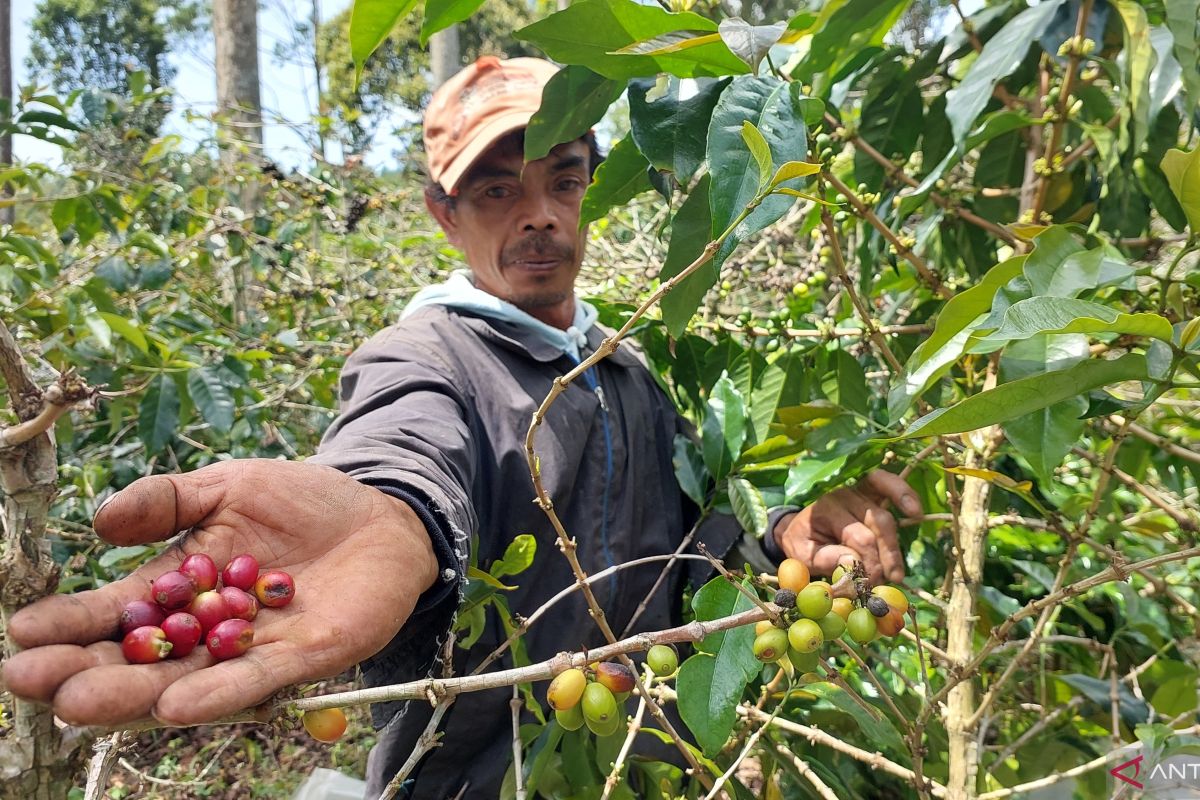
Indonesia possesses strong social and ecological capital in the form of traditional agroforestry systems.
Jakarta (ANTARA) - The discourse on Indonesia’s leading national commodity crops in the context of climate change often becomes trapped in simplifications of the source of problems or as part of the solution.
In reality, Indonesia’s plantation landscapes are far more complex. The ecosystems created are not merely production spaces for commodities, but also ecological spaces that store significant amounts of carbon, particularly in smallholder garden systems based on agroforestry.
Ironically, this potential has not yet been fully recognised as a strategic asset. Amid increasing global pressure on the carbon footprint of agricultural products, commodities such as coffee, cocoa, coconut, aren, and spice plants have the potential to become the backbone of Indonesia’s low-carbon economy.
The issue is no longer about the availability of potential, but rather our ability to manage it systematically and beneficially.
Scientifically, a landscape’s capacity to store carbon is determined by two main components: above-ground biomass (trees, canopies, roots) and soil organic carbon. In this context, agroforestry systems that dominate most of Indonesia’s smallholder gardens have advantages.
For coffee, for example, agroforestry systems can store around 18-21 tonnes of carbon per hectare in above-ground biomass. In comparison, unshaded coffee systems store only about 10 tonnes of carbon per hectare. Additionally, coffee agroforestry has a carbon absorption rate of around 0.9 tonnes of carbon per hectare per year.
This variation is not solely determined by the type of plant, but by the garden structure. In areas like Gayo, Aceh, coffee gardens with large shade trees can have carbon stocks approaching those of secondary forests. Conversely, gardens that are overly simplified without shade trees lose much of their ecological function.
A similar phenomenon is observed in cocoa. Cocoa agroforestry systems can store around 90 tonnes of carbon per hectare, with more than half stored in the soil. Even in more complex systems, carbon stocks can exceed 100 tonnes per hectare. This shows that soil plays a central role in the garden’s carbon balance.
Coconut and aren exhibit different characteristics, but are no less important. Coconut, with its long lifespan and large biomass, functions as a long-term carbon store, especially in mixed garden systems. Meanwhile, aren, which generally grows in secondary forest ecosystems, makes a significant contribution to maintaining carbon stocks as well as hydrological stability.
Spice plants such as nutmeg and cloves add another dimension. In Maluku and Sulawesi, traditional spice gardens often form multi-layered vegetation structures resembling forests. These systems not only store large amounts of carbon but also maintain biodiversity.
Thus, Indonesia’s plantation landscapes, particularly those based on agroforestry, are actually a mosaic of carbon-storing ecosystems. The problem is that this function has not yet been adequately integrated into economic calculations.
Ecological potential into economic instruments