
Carbon Storage Business Development Enters Implementation Phase
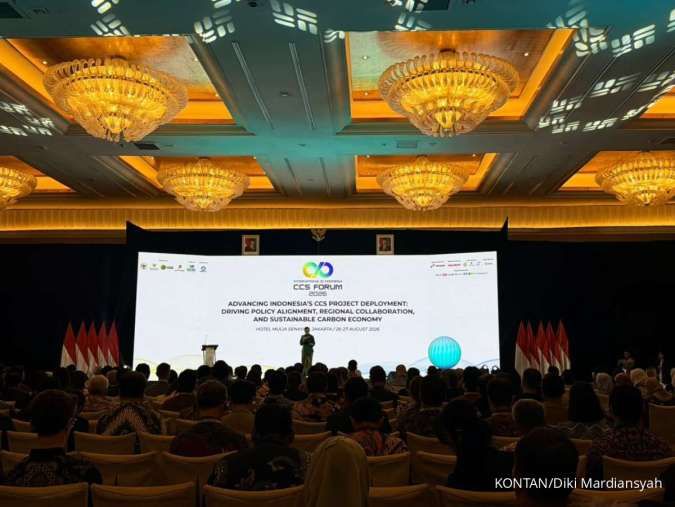
The development of carbon capture and storage (CCS) business in Indonesia is beginning to enter the project implementation phase.
The government and industry players are now being encouraged to no longer stop at strengthening regulations, but to begin accelerating investment and the construction of commercial-scale projects.
This emerged at The 4th International & Indonesia Carbon Capture and Storage (IICCS) Forum 2026 held on 26–27 August 2026 in Jakarta.
Executive Director of the Indonesia Carbon Capture and Storage Center (ICCSC) Belladonna Troxylon Maulianda said Indonesia has recorded progress in CCS development, among others through regulatory refinement, international cooperation and growing investment interest.
However, the next challenge is ensuring that investment, financing, infrastructure and project execution can proceed simultaneously.
“Indonesia is now at a very important momentum in its CCS development journey,” said Belladonna in Jakarta on Wednesday (26/8/2026).
One of the latest developments comes from Indonesia-Japan cooperation through the Joint Credit Mechanism (JCM) scheme.
The governments of Indonesia and Japan, through the JCM Joint Committee, have approved the Ofaweri decarbonisation initiative utilising Tangguh CCUS to advance to the next stage as a JCM project.
Tangguh CCUS has become the first CCUS project registered under the JCM framework. This status opens up opportunities for the development of carbon credits from the project.
In addition, bp and Mitsubishi Research Institute have been selected by Japan’s New Energy and Industrial Technology Development Organization (NEDO) to develop a new JCM methodology for low-carbon CCUS technology in Indonesia.
On the other hand, ICCSC is also strengthening cooperation with the Indonesia Carbon Trade Association (IDCTA) through the signing of a memorandum of understanding regarding CCS advocacy and carbon trading. The cooperation includes knowledge exchange, joint activities and cross-participation in various events.
The cooperation covers information exchange, business-to-business (B2B) matchmaking and joint studies related to low-carbon development and infrastructure.
Chairman of the IICCS Forum 2026 Committee Junaedi added that CCS development requires stronger collaboration in order to be translated into real projects. “Indonesia has entered a new phase in Carbon Capture and Storage development,” he said.
According to him, the involvement of government, industry, investors, technology providers, academics and international partners is important to accelerate the implementation of CCS projects in Indonesia.
Meanwhile, Deputy Speaker of the People’s Consultative Assembly (MPR RI) Eddy Soeparno assessed that CCS has the potential to strengthen energy security while increasing Indonesia’s competitiveness amid the global economic transformation.
He said Indonesia has the opportunity to become one of the CCS development hubs in the Asia Pacific region. To realise this opportunity, synergy between the government and the business community needs to be strengthened.
In addition to the conference agenda, Pertamina Hulu Energi together with the Indonesia CCS Center also launched a publication titled “Cross-Border CCS for Domestic Market Activation”.
The publication discusses cross-border CCS development as well as opportunities to activate the domestic carbon market.